
Official statement
Other statements from this video 14 ▾
- □ Should you switch domains when cutting your catalog, or is keeping your existing one the smarter move?
- □ Can backlinks to a 404 page really be recovered, or are they permanently lost?
- □ Can you really have millions of 301 redirects without hurting your SEO?
- □ Should you really ignore 404 errors in Google Search Console?
- □ Do you really need to add paginated pages to your XML sitemap?
- □ Can Google really crawl links in dropdown menus on hover?
- □ How many redirects can you really have on a site without triggering an SEO penalty?
- □ Should you use a person or organization as your article author for SEO purposes?
- □ Do you really need to align URL, title, and H1 to rank in SEO?
- □ Can blocking a redirect page with robots.txt really stop PageRank from passing through?
- □ Do multiple hyphens in your domain name actually hurt your SEO rankings?
- □ Do you really need to publish content every day to rank well on Google?
- □ Should you really stop using text in images for SEO?
- □ Do Core Web Vitals really override relevance in Google rankings?
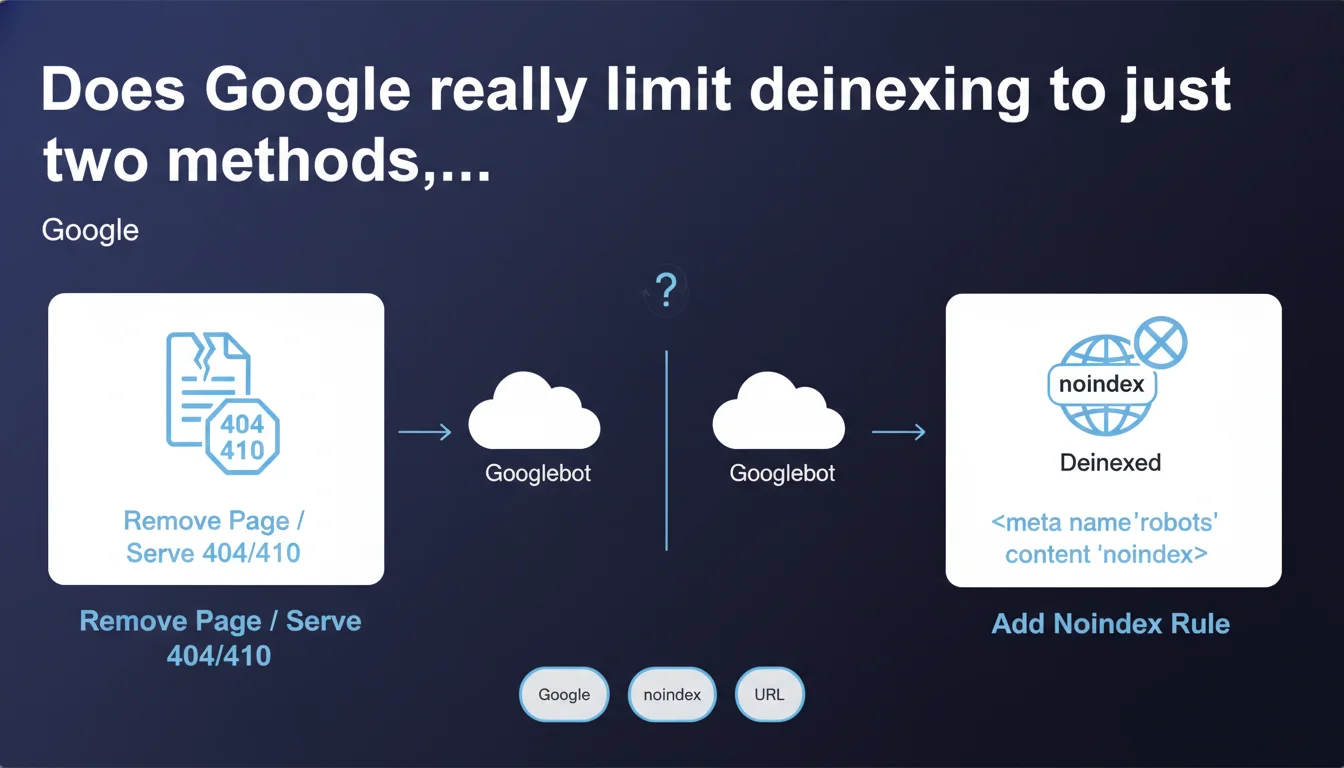
Google claims there are only two effective ways to deindex URLs: returning an HTTP 404/410 status code or using the noindex directive while allowing Googlebot to crawl the page. This deliberate simplification overlooks other technical methods and raises questions about their real effectiveness compared to the two officially recommended options.
What you need to understand
Why does Google insist on only two methods?
Google seeks to simplify communication with webmasters by narrowing the spectrum of possibilities to two clear and manageable options. This pedagogical approach avoids confusion and implementation errors that occur when too many alternatives are offered.
However, this simplification deliberately obscures other technical levers — robots.txt, cross-domain canonical tags, deindexing via Search Console, 301 redirects followed by deletion. Google considers them either ineffective, or as workarounds it prefers to discourage.
What is the fundamental difference between 404/410 and noindex?
The HTTP 404 or 410 status code signals permanent removal at the server level. Googlebot immediately understands the resource no longer exists and removes the URL from the index, usually within days depending on crawl frequency.
The noindex directive requires Googlebot to access the page (status 200) to read the meta tag or HTTP header. It's an explicit instruction requesting not to index the content, while still allowing the crawler to follow links on the page. This nuance changes everything for internal linking and PageRank distribution.
What happens if you block crawling of a noindex page?
Let's be honest: it's a classic mistake. Blocking via robots.txt a page containing a noindex directive prevents Googlebot from discovering that instruction. Result? The URL remains potentially indexed with a truncated snippet.
Google has been insisting on this point for years — and that's why this statement explicitly specifies "allow Googlebot to crawl these pages". Without access, no noindex directive can be read, so no clean deindexing occurs.
- 404/410: Immediate removal, no need to access content
- Noindex: Requires crawling to be applied, preserves crawling of internal links
- Robots.txt: Blocks crawling but doesn't prevent indexing if backlinks exist
- Frequent error: Combining robots.txt + noindex cancels the noindex effect
- Timing: Deindexing via noindex can take several weeks depending on crawl budget
SEO Expert opinion
Is this statement consistent with practices observed in the field?
Broadly yes. Observations align: 404/410 and noindex are indeed the two most reliable levers for deindexing content in a predictable manner. Other methods often produce erratic or incomplete results.
But this simplification sidesteps real use cases. Cross-domain canonicalization, for example, can serve to deindex in favor of another URL — even though Google only considers it a suggestion. 301 redirects followed by deletion on the destination side also create a form of gradual deindexing, albeit less controlled.
What nuances should be added to this claim?
Google says "really only a handful of ways" — which implies others exist, but aren't recommended or as effective. It's an editorial choice, not an absolute technical truth.
Deindexing timing varies dramatically by method. A 410 Gone is treated more aggressively than a standard 404. A noindex on a daily-crawled page will be applied within days; on an orphaned or deep page, it can drag on for weeks. [To verify]: Google publishes no official metrics on average deindexing delays by method.
In what cases is this rule insufficient?
Complex situations escape this binary framework. Imagine a site with millions of dynamically generated URLs — facets, filters, parameters — you want to deindex without physically removing them. Massive noindex can work, but it wastes crawl budget unnecessarily.
In this context, other strategies — aggressive canonicalization, URL parameters in Search Console, architectural redesign — become essential. Google doesn't mention them here, which can mislead practitioners facing large-scale indexation problems.
Practical impact and recommendations
What should you do concretely to deindex properly?
Strategic choice: If content is permanently deleted and will never return, opt for a 404 or 410. If the content still exists but shouldn't appear in search results — member areas, internal conversion pages, duplicate content — use noindex.
Verify that Googlebot has proper access to the pages in question. Check your robots.txt file and ensure no Disallow directive blocks the path. For noindex, crawling must be allowed — it's non-negotiable.
Monitor deindexing via Search Console: search site:yoursite.com/url-to-deindex in Google or track indexed pages in the coverage report. If the URL persists after several weeks, investigate: external backlinks maintaining indexation, crawl issue, mixed signal (contradictory canonical + noindex).
What mistakes should you absolutely avoid?
Never combine robots.txt + noindex on the same URL. It's the most frequent error and completely cancels the desired effect. Google cannot read a directive it doesn't have permission to crawl.
Avoid flipping an entire site to noindex "as a precaution" during migration or redesign. It happens — and it generates SEO disasters. Instead use a staging environment with HTTP authentication or a subdomain blocked via robots.txt.
Don't count on a 301 redirect alone to deindex. The redirect transfers PageRank and signals a move, but the source URL can remain indexed if the destination itself returns an error code or if the redirect chain is broken.
How do you verify your site follows these best practices?
- Audit your robots.txt file: no Disallow directive should block noindex URLs
- Verify HTTP headers of pages to deindex: 404/410 or 200 + noindex code, never incoherent mix
- Check the coverage report in Search Console: identify URLs "Excluded by noindex tag" vs "Not found (404)"
- Scan external backlinks pointing to deindex URLs — they can slow or prevent removal
- Test with a crawler (Screaming Frog, OnCrawl) to spot inconsistencies between directives
- Document your deindexing strategy: which method for which content type, to avoid team errors
❓ Frequently Asked Questions
Peut-on utiliser robots.txt pour désindexer des URLs ?
Quelle différence entre un code 404 et un code 410 ?
Combien de temps faut-il pour qu'une URL en noindex soit désindexée ?
Faut-il supprimer les backlinks vers une page désindexée ?
Peut-on combiner noindex et canonical sur la même page ?
🎥 From the same video 14
Other SEO insights extracted from this same Google Search Central video · published on 29/12/2022
🎥 Watch the full video on YouTube →
💬 Comments (0)
Be the first to comment.