
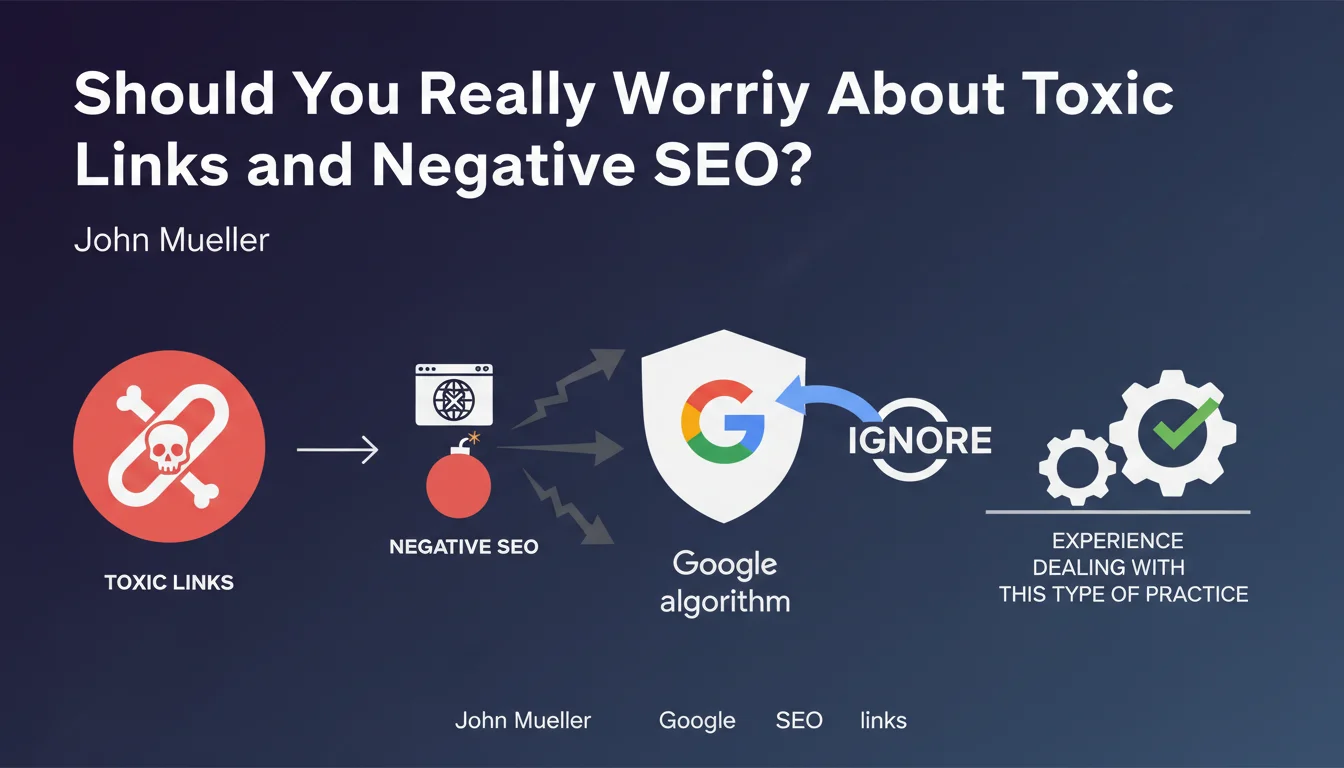
Official statement
What you need to understand
What Does Google Consider a Toxic Link?
Google defines as toxic links those that point to dangerous or very low-quality content: sites with malware, aggressive advertising networks, or unsolicited pornographic content. These links are generally automatically detected by Google's algorithms.
The important nuance here is that many third-party SEO tools label as "toxic" links that aren't actually toxic in Google's eyes. This divergence in assessment often creates unnecessary confusion and concern among SEO practitioners.
How Does Google Actually Handle These Toxic Links?
John Mueller's official position is clear: Google automatically ignores these problematic links. The search engine has sufficiently sophisticated systems to identify and neutralize these links without human intervention.
These links often appear identically in Search Console across numerous websites, which confirms that Google already knows about them and processes them in bulk. Their presence doesn't trigger manual or algorithmic penalties.
Why Do SEO Tools Flag So Many False Positives?
Third-party SEO tools use their own metrics and algorithms to evaluate link quality. These criteria don't correspond exactly to Google's and can be much more restrictive or simplistic.
A link from a low domain authority site or an infrequently visited directory will often be flagged as toxic by these tools, whereas Google simply considers it a low-value link that it naturally ignores.
- Google automatically ignores genuinely toxic links without penalizing your site
- SEO tools generate numerous false positives on toxic links
- The presence of these links in your backlink profile is not an emergency
- Link disavowal remains possible but is only necessary in extreme cases
- Toxic links often appear identically across numerous sites, confirming Google knows about them
SEO Expert opinion
Does This Statement Align with Observed Practices?
In 15 years of SEO practice, I've observed that sites receiving poor-quality links indeed don't experience automatic penalties. Cases of demotion are almost always related to manual actions for link manipulation, not the passive reception of dubious links.
This statement aligns perfectly with Google's evolution toward more intelligent and nuanced algorithms. The search engine now understands that webmasters don't control all incoming links and shouldn't penalize them for negative SEO.
What Important Nuances Should Be Considered?
The main nuance concerns the difference between toxic links and manipulative links. If you've actively created or purchased links in private blog networks (PBNs), link farms, or spam directories, you're in a different risk category.
In these cases, Google can indeed apply a manual penalty if the spam team detects a manipulation pattern. The disavow tool then becomes relevant, but only after receiving a notification in Search Console.
When Should You Actually Take Action on These Links?
Link disavowal remains relevant in three specific situations: after receiving a manual action in Search Console, if you've inherited a site with a confirmed manipulation history, or in case of massive and documented negative SEO attack.
In all other cases, time spent analyzing and disavowing links would be better invested in creating quality content and obtaining natural editorial links. It's a matter of resource prioritization.
Practical impact and recommendations
What Should You Actually Do With These Alerts?
When an SEO tool alerts you about toxic links, start by checking your Search Console to see if you've received a manual action. In the absence of notification, there's generally no urgency to act.
Manually examine a sample of the flagged links to evaluate their actual nature. If they're links to obviously dangerous or illegal sites, you can create a disavow file for these specific domains, but without rushing.
Instead, focus your efforts on acquiring quality links that will naturally dilute the relative weight of these problematic links in your overall profile. This is the most effective and least time-consuming approach.
What Mistakes Should You Absolutely Avoid?
The most common error is massively disavowing links following automatic recommendations from a third-party tool. This practice can cause you to lose links that bring real value, even minimal, to your profile.
Never disavow a link without manually examining it. Tools can mark as toxic a link from a small legitimate site simply because it has little authority or an unusual link profile.
How Can You Effectively Monitor Your Link Profile?
Set up a monthly monitoring routine rather than obsessive daily checking. Check Search Console for new notifications and examine new incoming links via your preferred backlink tool.
Create a list of domains already identified as problematic and genuinely toxic. If you notice a sudden increase in links from these same networks, document it but only act if accompanied by an unexplained performance drop.
- Check Search Console monthly to detect any manual actions
- Don't panic over automatic alerts from third-party SEO tools
- Manually examine links before any disavowal, never in automatic mode
- Only disavow clearly dangerous domains (malware, extreme spam)
- Prioritize acquiring new quality links over cleanup obsession
- Document any sudden changes in link profile for future reference
- Only create a disavow file in case of confirmed manual penalty
- Reassess your link building strategy if you regularly receive suspicious links
Managing toxic links shouldn't monopolize your time and energy. Google has robust systems to automatically neutralize these links without impacting your ranking.
Focus on the fundamentals: quality content, optimal user experience, and natural acquisition of editorial links. These elements will have an infinitely more positive impact on your visibility than hours spent analyzing false positives.
In-depth analysis of a backlink profile and implementing a balanced link building strategy require deep expertise and up-to-date knowledge of Google's quality signals. For businesses that want to secure their organic growth without risk, support from a specialized SEO agency provides an accurate diagnosis and personalized strategy adapted to your industry and objectives.
💬 Comments (0)
Be the first to comment.