
Official statement
Other statements from this video 7 ▾
- □ Faut-il vraiment exclure les URL non-canoniques de votre sitemap XML ?
- □ Le sitemap XML est-il vraiment indispensable pour améliorer le crawl de votre site ?
- □ Faut-il vraiment limiter les mises à jour de lastmod dans vos sitemaps XML ?
- □ Quelles sont les limites techniques réelles des fichiers sitemap XML ?
- □ Faut-il vraiment diviser vos sitemaps volumineux en plusieurs fichiers ?
- □ Faut-il vraiment indexer toutes les URL de votre sitemap ?
- □ Quels types de contenu faut-il vraiment inclure dans vos sitemaps ?
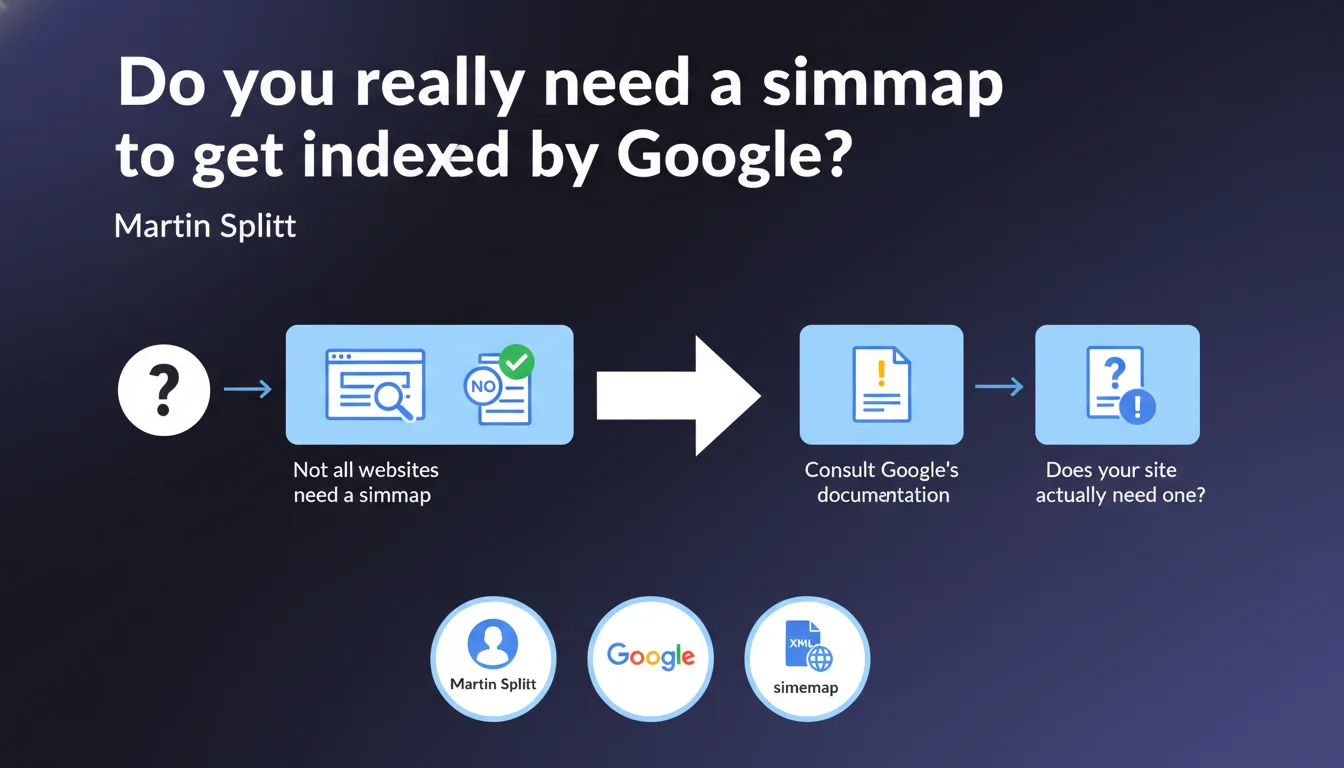
Martin Splitt states that not all websites need a sitemap. Google invites webmasters to consult its documentation to determine if their site actually requires this file. A statement that challenges a practice often considered essential in SEO.
What you need to understand
Why is Google questioning the universal usefulness of sitemaps?
This statement breaks an entrenched belief in the SEO community: the sitemap would not be essential for all websites. Google suggests a case-by-case approach rather than a universal rule.
The official documentation clarifies that small sites with clear architecture and effective internal linking can do without it. Crawlers naturally discover pages through internal links.
In what cases can a site do without a sitemap?
A site with fewer than 500 pages, with logical navigation and no orphaned pages, technically doesn't need a sitemap. Googlebot explores links recursively as soon as it reaches the homepage.
Well-structured static sites, blogs with clear pagination, or simple portfolios fall into this category. The main criterion: all important pages are accessible in less than 3 clicks from the home page.
When does a sitemap become essential?
The situation changes dramatically for complex sites. An e-commerce site with thousands of product pages, a multilingual site, or a platform with user-generated content absolutely requires a sitemap.
Critical cases include: sites with isolated pages, frequently updated content, images or videos to index, or deep architecture exceeding 4 levels of navigation.
- Small static site well-linked: sitemap optional
- Site with more than 500 pages: sitemap recommended
- Orphaned or isolated content: sitemap essential
- Frequent updates: sitemap with priority and frequency tags
- Media-rich (images/videos): specialized sitemaps required
SEO Expert opinion
Is this statement consistent with real-world observations?
Yes and no. On paper, Google is right: a perfectly structured site doesn't need a sitemap to be crawled. In reality, I've never seen a professional site voluntarily skip it.
Why? Because the sitemap offers much more than simple crawl assistance. It allows you to control priorities, signal updates, and most importantly diagnose indexation issues via Search Console. Removing this visibility layer means flying blind.
What nuances should be added to this advice?
Splitt's statement is technically correct but dangerously oversimplified. It omits a crucial point: even if Google can crawl without a sitemap, this guarantees neither speed nor completeness of indexation.
I've observed sites with 200 perfectly linked pages taking 3 weeks to be fully indexed without a sitemap, versus 48 hours with one. The sitemap accelerates discovery, period. [To verify]: Google publishes no comparative data on indexation timelines with or without sitemaps.
Another blind spot: evolving sites. A blog with 100 articles today can have 500 in 6 months. Installing the sitemap from the start avoids having to catch up on indexation delays later.
In what contexts does this rule become counterproductive?
Never apply this advice to an e-commerce site, even a small one. Product pages change status (in stock/out of stock), prices fluctuate, variants multiply. The sitemap remains the only reliable way to signal these changes to Google quickly.
Same logic applies to news sites or active blogs. Publishing without a sitemap means hoping Google will come at the right time. Not professional.
Practical impact and recommendations
What should you concretely do with this information?
Don't remove your existing sitemap just because Google says it's "not necessary". Keep it, even if your site is small. The maintenance cost is almost zero, the potential benefit not negligible.
For new projects, ask yourself the real question: do you have the skills to maintain flawless internal linking over the long term? If the answer is no, the sitemap remains your safety net.
How to verify if your site could theoretically do without a sitemap?
Run a crawl with Screaming Frog or Sitebulb. Verify that 100% of important pages are discovered in less than 3 clicks from the home page. No orphaned pages tolerated.
Check Search Console: compare the number of URLs submitted via sitemap and the number of URLs discovered. If the gap is minimal, your architecture holds up. If 30% of URLs are only found via the sitemap, you have a linking problem, not an unnecessary sitemap.
- Keep the XML sitemap even on small sites — the risk of removing it far outweighs the theoretical advantage
- Verify crawl depth: no strategic pages beyond 3 clicks
- Eliminate orphaned pages through an internal linking audit
- Use the Search Console coverage report to detect URLs not discovered without a sitemap
- Segment large sitemaps (>50,000 URLs) into thematic files
- Enable server logs to measure Googlebot responsiveness with and without a sitemap
- Prefer a dynamic sitemap that updates automatically over a static file
Google's position on sitemaps reflects an idealized vision of the web where every site would be perfectly architected. Reality is more nuanced. The sitemap remains an essential control and diagnostic tool for any professional site.
Ignoring this technical layer means giving up part of the control over your indexation. If you're unsure about the optimal architecture of your sitemap or the analysis of your indexation metrics, these technical optimizations often require an outside expert perspective. Specialized SEO agencies have the tools and field experience to thoroughly audit your crawl budget and help you avoid costly visibility errors.
❓ Frequently Asked Questions
Un site WordPress a-t-il besoin d'un sitemap si Yoast SEO le génère automatiquement ?
Google crawle-t-il différemment un site avec ou sans sitemap ?
Faut-il soumettre le sitemap via Search Console ou suffit-il de le référencer dans le robots.txt ?
Un sitemap mal configuré peut-il nuire à l'indexation ?
Quelle est la taille maximale recommandée pour un sitemap ?
🎥 From the same video 7
Other SEO insights extracted from this same Google Search Central video · published on 16/11/2023
🎥 Watch the full video on YouTube →
💬 Comments (0)
Be the first to comment.