
Official statement
Other statements from this video 7 ▾
- □ Faut-il vraiment exclure les URL non-canoniques de votre sitemap XML ?
- □ Le sitemap XML est-il vraiment indispensable pour améliorer le crawl de votre site ?
- □ Faut-il vraiment un sitemap pour être indexé par Google ?
- □ Quelles sont les limites techniques réelles des fichiers sitemap XML ?
- □ Faut-il vraiment diviser vos sitemaps volumineux en plusieurs fichiers ?
- □ Faut-il vraiment indexer toutes les URL de votre sitemap ?
- □ Quels types de contenu faut-il vraiment inclure dans vos sitemaps ?
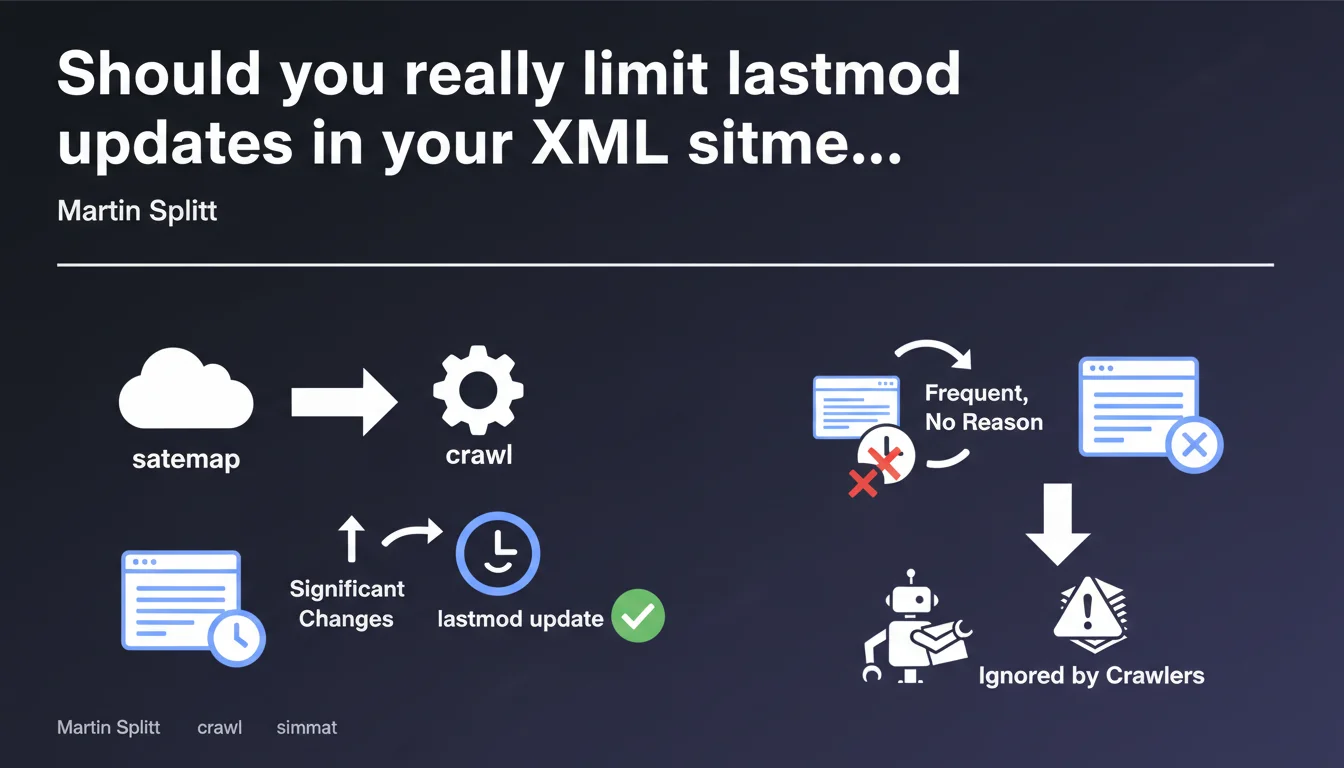
Google recommends modifying the lastmod attribute only when substantial changes occur on a page. Modifying this attribute too frequently without valid reason causes crawl scheduling algorithms to progressively ignore these signals. Result: you risk degrading your crawl budget instead of optimizing it.
What you need to understand
The lastmod (last modified) attribute in an XML sitemap theoretically serves to signal to Google that a page has been updated. The idea: help the search engine prioritize crawling freshly modified content.
The problem? Too many sites use this attribute as an automatic signal, modifying the date every time the sitemap is generated — even when nothing has actually changed on the page. Google has clearly understood this.
Why does Google threaten to ignore lastmod entries?
The crawl scheduling algorithms learn from your site's behavior. If you cry wolf every day by modifying lastmod without reason, Google eventually treats this signal as noise.
Martin Splitt speaks here of a machine learning mechanism: the system detects patterns of fake updates and adjusts its confidence in your sitemaps. Over time, it simply ignores this attribute on your domain.
What constitutes an "important change" according to Google?
Google doesn't define this threshold precisely — typical. We can reasonably interpret it as substantial modifications to main content: paragraph rewrites, section additions, data updates, argument changes.
Conversely, modifying a footer, fixing a typo, or adjusting CSS pixels should not trigger a lastmod change. It's a matter of proportionality.
- The lastmod attribute must reflect substantial changes, not cosmetic adjustments
- Google learns to ignore sites that abuse this attribute
- Poorly managed lastmod degrades your crawl budget instead of optimizing it
- No strict definition of "important change" — it's up to you to interpret intelligently
SEO Expert opinion
Is this statement consistent with practices observed in the field?
Yes. We regularly observe cases where sites systematically modify lastmod every time the sitemap is generated, sometimes hourly. Result: no correlation between reported updates and actual crawl intensity.
Google has previously mentioned that it uses its own freshness detection mechanisms, independent of lastmod. Splitt's reminder confirms that the attribute is just one signal among many — and it can even become counterproductive.
What nuances should be added to this recommendation?
Let's be honest: Google doesn't say much about what constitutes an "important change." This gray area leaves room for interpretation, and it's frustrating for those wanting to optimize precisely.
[To verify]: no public data specifies the threshold of modifications at which Google considers the signal legitimate. We therefore work blind, relying on common sense.
Another point: some CMS automatically generate lastmod on every save, even minor ones. If you're in this situation, you need to disable or filter this functionality — otherwise you're sabotaging your own crawl budget without knowing it.
In what cases can this rule be circumvented?
On news sites or e-commerce platforms with rapid inventory rotation, frequent updates are legitimate. There, modifying lastmod regularly makes sense — provided pages actually change.
The real trap is the typical corporate website that publishes 2 articles per month but regenerates its sitemap every night with lastmod updated on all pages. That's the best way to shoot yourself in the foot.
Practical impact and recommendations
What should you concretely do to manage lastmod intelligently?
First, audit your current sitemap. Check whether lastmod changes frequently without actual content modification. If so, you have a configuration problem.
Then, configure your sitemap generator to modify lastmod only if main content changes. Many CMS allow you to link this attribute to the article or product's last modification date — that's a good start.
What errors should you absolutely avoid?
Never link lastmod to the sitemap generation date. This is the classic mistake that kills your credibility with Google.
Also don't trigger a lastmod modification for minor adjustments: spelling correction, footer change, tracking pixel addition. Only substantial changes to main content count.
- Audit your XML sitemap to identify abusive lastmod updates
- Configure your CMS so lastmod reflects only substantial modifications to main content
- Disable plugins or scripts that automatically regenerate lastmod on every build
- Document what constitutes an "important change" for your editorial team
- Monitor crawl frequency in Search Console after adjustments
How can you verify that your site respects this recommendation?
Compare lastmod history in your sitemaps with your actual content modification history. If the two aren't aligned, you have a problem.
Also use Search Console reports to observe whether crawl frequency evolves after correction. If Google starts actively exploring your modified pages again, that's a good sign.
Managing the lastmod attribute precisely requires technical expertise and deep understanding of how Google interprets crawl signals. If your infrastructure is complex or if you find your sitemaps aren't configured optimally, calling in a specialized SEO agency can save you valuable time and avoid compromising your crawl budget long-term.
❓ Frequently Asked Questions
Si je ne mets pas d'attribut lastmod, est-ce que Google crawle quand même mes pages ?
Est-ce que corriger une faute de frappe justifie de modifier lastmod ?
Mon CMS met à jour lastmod automatiquement à chaque sauvegarde, que faire ?
Comment savoir si Google ignore déjà mes attributs lastmod ?
Faut-il supprimer complètement lastmod de mon sitemap ?
🎥 From the same video 7
Other SEO insights extracted from this same Google Search Central video · published on 16/11/2023
🎥 Watch the full video on YouTube →
💬 Comments (0)
Be the first to comment.