
Official statement
Other statements from this video 10 ▾
- □ Is Googlebot really rejecting HTML pages larger than 15 MB from being crawled?
- □ Is Google really replacing First Input Delay with Interaction to Next Paint in Core Web Vitals, and what does that mean for your SEO?
- □ Should you really stop obsessing over Core Web Vitals scores?
- □ Why does Google separate Googlebot and Google-Other in its crawling activities?
- □ Is Google-Extended really just a token and not an active crawler?
- □ Is Google really preparing a universal opt-out for AI training?
- □ Does Google really check 4 billion robots.txt files every single day?
- □ Are Google's AI principles really shaping how search results rank?
- □ Can you really trust AI-generated content for SEO?
- □ How does Google really want to regulate AI usage in content creation?
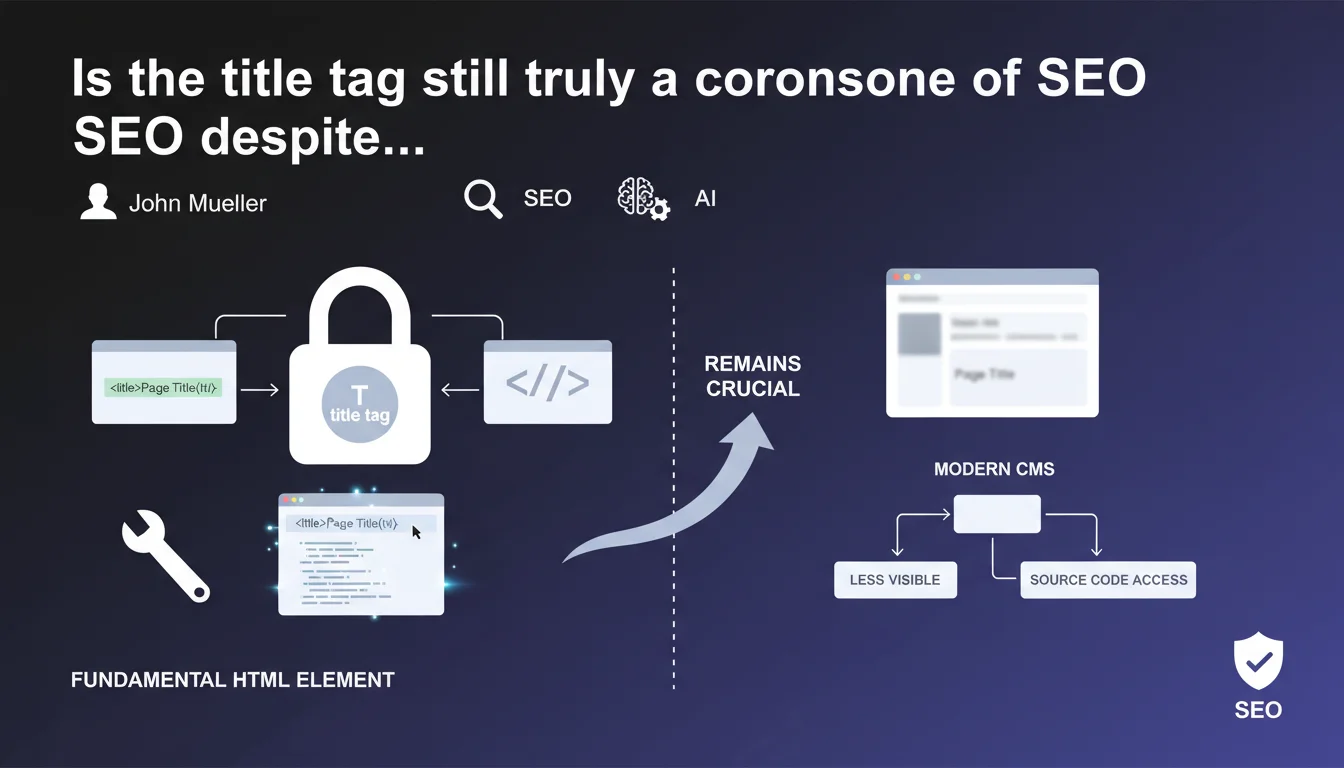
Google emphasizes that the title tag remains a fundamental HTML element for search engine optimization. SEO professionals must be able to locate and modify it directly in the page's source code, even though modern CMS platforms tend to hide this technical manipulation behind simplified interfaces.
What you need to understand
Why is Google restating this obvious fact in 2023?
Because the technical abstraction of modern CMS platforms has created a generation of SEO practitioners who control title tags through form fields — Yoast, Rank Math, Shopify — without ever opening the source code. The problem? When a plugin malfunctions, an automatic rewrite activates, or a conflict occurs, these professionals find themselves helpless.
Mueller points to a risk of disconnection between SEO practice and the technical reality of the web. The title tag remains raw HTML — a single line of code between <head> and </head> — and understanding this functionality is non-negotiable.
What makes the title tag "fundamental" in 2023?
Three concrete reasons. First, it remains the strongest on-page signal for thematic relevance to a page in Google's eyes. Second, it directly influences click-through rates in the SERPs — therefore organic traffic acquisition. Finally, it serves as a fallback for hundreds of scenarios: Open Graph, social shares, browser tabs, bookmarks.
Unlike meta descriptions that Google cheerfully rewrites, the title maintains major decision-making power for the SEO professional. Even though Google sometimes replaces it (we'll come back to that), it remains the starting point for any semantic optimization of a page.
What does it concretely mean to "know how to locate and modify in the source code"?
It means opening your browser's inspector (F12), navigating to the <head>, identifying the <title> tag, and understanding where it comes from: PHP template, React component, JavaScript injection, server-side rendering.
It also means auditing the differences between the title visible in your CMS and the one actually sent to the browser. Too many WordPress sites display "Home Page" in Yoast but send "My Site | Just another WordPress site" in the DOM — because a poorly coded theme forces a rewrite.
- The title tag remains the most powerful on-page signal for thematic relevance
- Modern CMS platforms hide its manipulation behind simplified user interfaces
- Knowing how to access the source code becomes a differentiating skill against bugs and conflicts
- Google sometimes rewrites titles, but initial control belongs to the SEO
SEO Expert opinion
Is this statement consistent with practices observed in the field?
Yes and no. On one hand, SEO audits systematically reveal massive inconsistencies between intended titles and served titles — especially on e-commerce sites with automatic generation. On the other, the majority of SEO consultants operate exclusively through plugins and never touch the code.
The paradox? The best SEO results are achieved by teams that master both editorial strategy AND technical implementation. Blindly delegating to developers or relying solely on a plugin creates critical blind spots. [To verify]: what proportion of titles are actually rewritten by Google in 2023? Google publishes no metrics on this.
What nuances should be added to Google's reminder?
First nuance: Google rewrites titles increasingly frequently, especially since August 2021. Optimizing a perfect title no longer guarantees it will appear as-is in the SERPs. Algorithms sometimes favor H1s, anchor text, or content snippets they judge more relevant for a given query.
Second nuance: on sites with thousands of pages (media, marketplaces, aggregators), manual modification in source code becomes impractical. What matters is understanding the patterns of automatic generation and knowing how to diagnose when a template produces suboptimal titles.
In what cases doesn't this rule apply fully?
On single-page applications (SPAs) in React, Vue, or Angular, the title tag is often dynamically injected by JavaScript after initial rendering. Google crawls JavaScript-rendered content, but standard SEO tools (Screaming Frog in standard mode, certain scrapers) will only see the title of the empty HTML shell.
Another edge case: multilingual sites with CDN and edge computing. The title can be rewritten on the fly based on geolocation or user language preferences, without appearing in the CMS. Again, "knowing how to locate" becomes a network debugging skill, not just HTML editing.
Practical impact and recommendations
What should you concretely do to maintain control over your title tags?
First action: systematically audit the gap between intended titles and served titles. Crawl your site with Screaming Frog or Oncrawl, extract the titles, compare them with those defined in your CMS or templates. Identify pages where a plugin, theme, or script silently rewrites your optimizations.
Second action: train your teams to use the browser inspector. No need for a developer diploma — just know how to open F12, navigate the DOM tree, locate the <head>, and verify that the <title> tag matches what's expected. This takes 30 seconds per page and prevents weeks of erratic diagnosis.
What errors should you avoid in managing title tags?
Error #1: blindly trusting CMS previews. WordPress, Shopify, PrestaShop often display a title "preview" that doesn't reflect rewrites applied during HTML rendering. Always test in real conditions, browser open.
Error #2: ignoring conflicts between SEO plugins. If Yoast and Rank Math coexist (yes, it happens), or if a theme imposes its own title logic, you get unpredictable results. One SEO plugin active at a time — and verify the theme doesn't contradict it.
Error #3: optimizing for Google while forgetting other display contexts. A title truncated to 50 characters to avoid being cut off in SERPs becomes illegible in a browser tab. Think multi-channel: SERPs, social networks (Open Graph), bookmarks, history.
How do you verify your title tags are correctly implemented?
- Crawl the entire site and export title tags from your SEO tool
- Compare this list with titles defined in your CMS or templates
- Manually test 10-20 strategic pages in the browser inspector (F12 > Elements > <head>)
- Verify each page has a unique, descriptive title optimized for its target query
- Control length stays between 50 and 60 characters to avoid truncation in SERPs
- Monitor Google's title rewrites via Search Console (Performance > Pages > filter by URL)
❓ Frequently Asked Questions
Google réécrit-il systématiquement les balises title que j'optimise ?
Puis-je me contenter de Yoast ou Rank Math pour gérer mes titles ?
Quelle longueur idéale pour une balise title en 2023 ?
Comment savoir si Google a réécrit ma title dans les SERP ?
Les balises title ont-elles encore un impact sur le classement en 2023 ?
🎥 From the same video 10
Other SEO insights extracted from this same Google Search Central video · published on 21/12/2023
🎥 Watch the full video on YouTube →
💬 Comments (0)
Be the first to comment.