
Official statement
Other statements from this video 10 ▾
- □ Pourquoi Googlebot refuse-t-il de crawler les pages HTML de plus de 15 Mo ?
- □ La balise title reste-t-elle vraiment un pilier du SEO malgré l'évolution des CMS ?
- □ Pourquoi Google remplace-t-il le First Input Delay par l'Interaction to Next Paint dans les Core Web Vitals ?
- □ Faut-il vraiment arrêter d'optimiser pour les Core Web Vitals ?
- □ Pourquoi Google sépare-t-il Googlebot et Google-Other dans ses crawls ?
- □ Google-Extended est-il vraiment un token et non un crawler ?
- □ Google prépare-t-il vraiment un opt-out universel pour le training IA ?
- □ Pourquoi Google vérifie-t-il 4 milliards de robots.txt chaque jour ?
- □ Les principes d'IA de Google s'appliquent-ils vraiment aux résultats de recherche ?
- □ Peut-on vraiment faire confiance aux contenus générés par l'IA pour le SEO ?
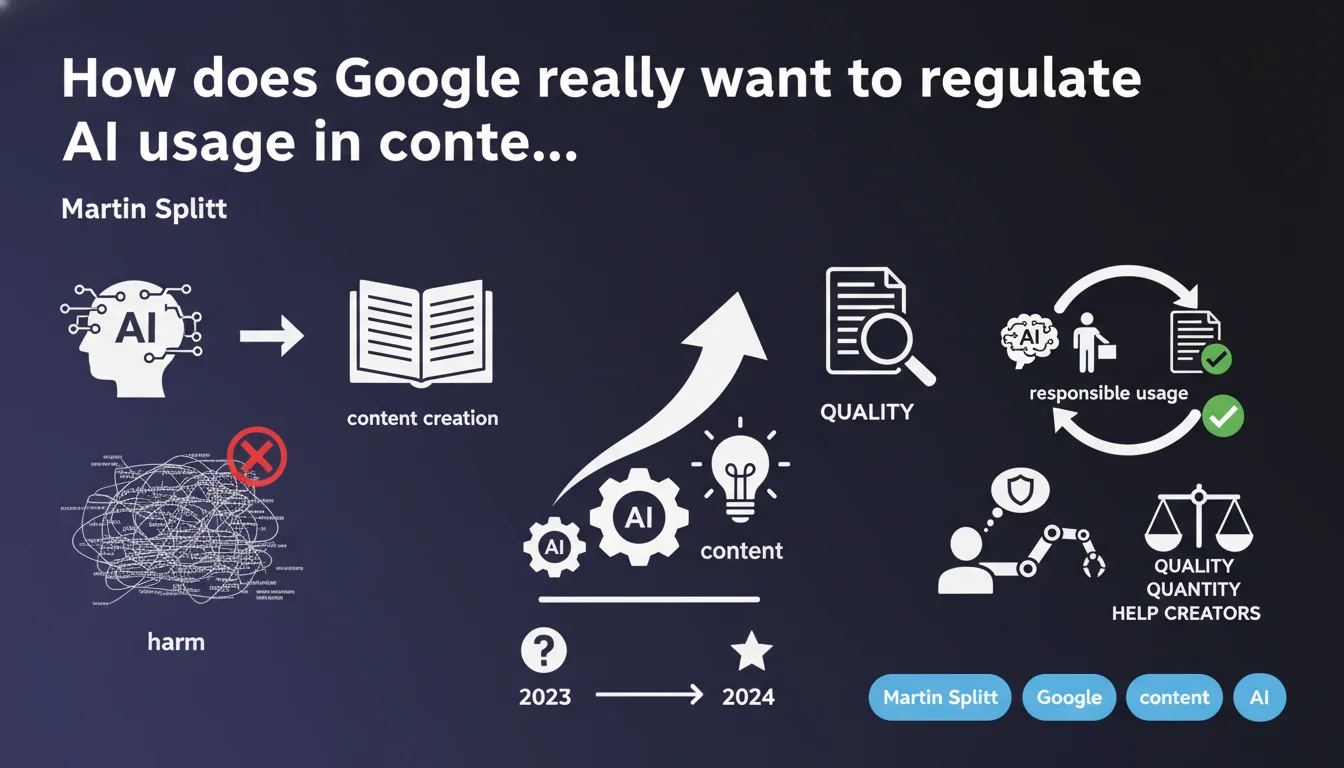
Google is holding firm on its core directive: content quality remains the top priority, even in the era of generative AI. The goal isn't to ban AI, but to encourage creators to use it responsibly so it doesn't degrade the web ecosystem. In practical terms, this means AI-generated content isn't penalized by default, but its final quality remains the deciding factor.
What you need to understand
Why does Google insist so much on quality rather than the origin of content?
Martin Splitt's statement reflects a strategic positioning in response to the flood of AI-generated content. Google can't — and probably doesn't want to — ban AI from its index.
The real risk for the search engine is a massive inflation of mediocre pages that bury relevant results. Rather than forbidding AI, Google is choosing to educate creators so they use AI as a helping tool, not as a lazy replacement for human thinking.
What does "responsible and reasonable" AI usage look like according to Google?
Google remains deliberately vague on this point — no technical definition accompanies this statement. We can infer that responsible usage implies human oversight, fact-checking, and added value that goes beyond simply rephrasing existing sources.
"Reasonable" usage suggests not automating production excessively just to saturate the index with thousands of identical or near-identical pages. But in practice, this boundary remains subjective.
Does this approach mark a policy shift?
Not really. Since the first Helpful Content Updates, Google has hammered home the same message: quality trumps production method. What's changing is the context: generative AI is now accessible to everyone, and the spam risk becomes exponential.
Google is therefore trying to get ahead of the curve by communicating massively on the topic, without revealing its exact algorithmic criteria for detecting — or ignoring — low-quality AI content.
- Content quality remains the deciding criterion, regardless of production method.
- Google adopts an educational rather than repressive stance toward AI.
- No precise technical definition of "responsible" usage is provided — everyone must interpret it themselves.
- The real stakes for Google: avoiding massive degradation of its index quality.
SEO Expert opinion
Is this statement consistent with what we're seeing in practice?
Let's be honest: the reality is more nuanced. Many sites producing massively AI-generated content continue to rank well, as long as the content answers queries and respects classic signals (EAT, backlinks, UX).
Google claims to focus on quality, but its algorithms don't systematically detect — or penalize — all low-value AI content. [To be verified]: certain sectors seem less scrutinized than others, particularly technical niches where queries are highly specific.
What nuances should we add to this official stance?
Google's rhetoric remains intentionally vague to preserve its maneuvering room. Saying "use AI responsibly" without defining measurable criteria leaves the door open to all sorts of interpretations.
From a practical standpoint, this means a site can produce AI content in bulk and perform well, as long as it doesn't get flagged by quality raters or spam algorithms. The risk exists, but it's not systematic.
Another point: Google is developing its own generative AI tools (Search Generative Experience, Bard/Gemini). It therefore has an interest in AI being perceived as a legitimate tool, not as a threat to eliminate.
In what situations does this rule not really apply?
If you produce AI content on YMYL (Your Money, Your Life) topics, quality standards will be infinitely stricter — and potential factual errors could be catastrophic for your ranking.
Conversely, on low-stakes informational queries (like "how to clean a keyboard"), well-structured AI content can easily outperform poorly written human articles.
Practical impact and recommendations
What should you actually do if you're using AI to produce content?
First rule: never publish raw AI content. Any generation must go through human review, fact-checking, and enrichment with examples, data, or original angles.
Next, make sure each page delivers genuine added value compared to pages already ranking for your target query. If your AI content just repeats what the top 10 Google results say, it has no chance of breaking through.
What mistakes must you absolutely avoid with AI?
Avoid mass, unsupervised production of satellite pages or auto-generated SEO categories. Google has the tools to detect patterns of duplicate or near-duplicate content at scale.
Another trap: AI hallucinations. A single wrong figure, a made-up source, and you lose all credibility in the eyes of quality raters — and potentially in the algorithm's eyes too.
How can you verify your AI content meets Google's quality standards?
Test your content against the EAT criteria: expertise, authority, trustworthiness. If an expert in your field reads your page, do they find it credible? Useful? Better than what already exists?
Also use Core Web Vitals and UX signals: good content on a slow or hard-to-read page is still bad content. AI doesn't exempt you from caring about user experience.
- Review and enrich each piece of AI content before publishing
- Systematically verify facts, figures, and cited sources
- Add examples, concrete cases, original angles
- Never publish in bulk without human oversight
- Regularly audit AI pages to catch factual errors
- Monitor UX signals and Core Web Vitals
- Test your content against already-ranking pages: does it offer more?
❓ Frequently Asked Questions
Google pénalise-t-il automatiquement le contenu généré par IA ?
Comment Google détecte-t-il qu'un contenu a été généré par IA ?
Peut-on utiliser l'IA pour rédiger des pages produits ou des fiches techniques ?
Faut-il mentionner qu'un contenu a été généré par IA ?
L'IA peut-elle remplacer un rédacteur humain sur un site éditorial ?
🎥 From the same video 10
Other SEO insights extracted from this same Google Search Central video · published on 21/12/2023
🎥 Watch the full video on YouTube →
💬 Comments (0)
Be the first to comment.