
Official statement
Other statements from this video 10 ▾
- □ Pourquoi Googlebot refuse-t-il de crawler les pages HTML de plus de 15 Mo ?
- □ La balise title reste-t-elle vraiment un pilier du SEO malgré l'évolution des CMS ?
- □ Pourquoi Google remplace-t-il le First Input Delay par l'Interaction to Next Paint dans les Core Web Vitals ?
- □ Faut-il vraiment arrêter d'optimiser pour les Core Web Vitals ?
- □ Pourquoi Google sépare-t-il Googlebot et Google-Other dans ses crawls ?
- □ Google-Extended est-il vraiment un token et non un crawler ?
- □ Google prépare-t-il vraiment un opt-out universel pour le training IA ?
- □ Pourquoi Google vérifie-t-il 4 milliards de robots.txt chaque jour ?
- □ Peut-on vraiment faire confiance aux contenus générés par l'IA pour le SEO ?
- □ Comment Google veut-il encadrer l'usage de l'IA dans la création de contenu ?
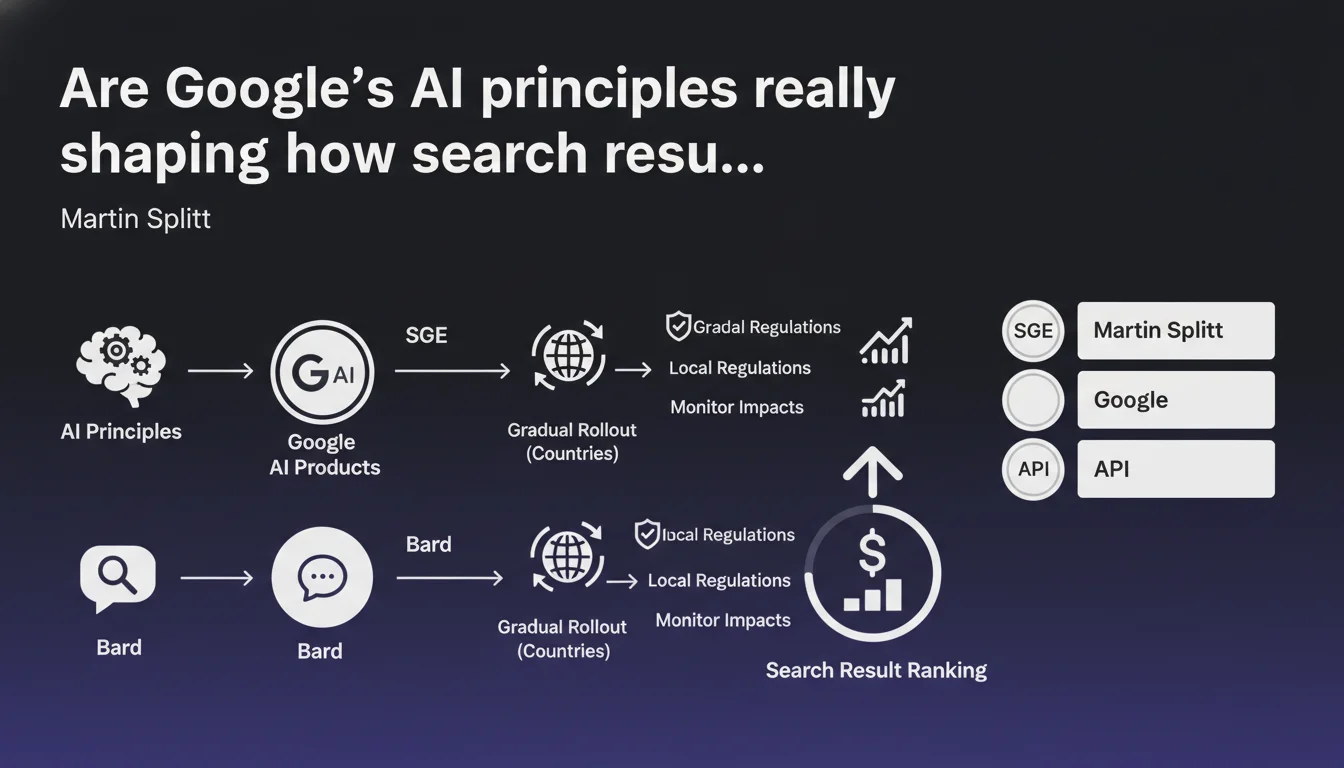
Google claims to apply its ethical AI principles to SGE and Bard. The gradual rollout aims to respect local regulations and monitor impacts. The question remains whether these principles actually influence traditional organic search rankings.
What you need to understand
What are these famous AI principles Google keeps talking about?
Google has an AI ethics charter published back in 2018, which establishes seven principles: being socially beneficial, avoiding unfair bias, being tested for safety, being accountable to users, incorporating privacy safeguards, maintaining high scientific standards, and respecting limitations of use. These principles theoretically govern all of the company's AI development.
Application to SGE (Search Generative Experience) and Bard means these tools must undergo internal audits before launch. In practice? Google verifies that generated answers don't carry discriminatory bias, respect privacy, and don't produce harmful content.
Why is the rollout happening progressively by country?
AI regulations vary significantly across jurisdictions. The European Union imposes the AI Act, California has its Consumer Privacy Act, China has its own legislation. Google tests first in less restrictive regulatory zones (United States, Japan) before tackling stricter markets.
This caution also helps detect "impacts" — meaning bugs, AI hallucinations, user complaints, or regulator feedback. A universal immediate rollout would be a risky bet legally and reputationally.
How does this concern traditional SEO?
The question that haunts everyone: do these AI principles modify traditional organic ranking criteria? Martin Splitt talks about "AI-related products," which includes SGE but doesn't clarify whether the core search algorithm is part of it.
Let's be honest — Google has used machine learning in its search engine since RankBrain (2015), then BERT, MUM, and now Gemini. If ethical principles apply to these models, it means privileged pages should theoretically avoid unfair bias and deliver social value. But no tangible data proves these principles directly influence organic SERPs.
- Google's AI principles have existed since 2018 and cover ethics, safety, and bias
- SGE and Bard are explicitly subject to these rules
- Rollout by country responds to local regulatory constraints
- The impact on organic SEO remains unclear — no confirmation that these principles modify traditional ranking criteria
SEO Expert opinion
Is this statement consistent with observed practices?
On the surface, yes. Google is indeed rolling out SGE cautiously: launched in the United States in May 2023, extended to India and Japan by late 2023, still absent from the EU in early 2025. This caution isn't philanthropic — it's a legal and commercial risk management strategy.
Where it gets tricky: Google provides no metrics on this "impact monitoring." What KPIs are they tracking? AI response error rates? User complaints? Traffic degradation to publishers? We don't know. [To be verified] — this opacity makes the statement difficult to audit.
Do AI principles really influence organic rankings?
That's the real issue. Martin Splitt mentions "AI-related products" without clarifying whether the core search algorithm is part of it. Yet all of Google's modern ranking systems rely on machine learning. RankBrain, BERT, MUM, Gemini — these are AI models.
If principles apply to these models, then theoretically, Google should penalize biased, discriminatory, or socially harmful content. In reality? Dubious medical sites, conspiracy content, and black hat SEO practices continue to rank. Either the AI principles don't apply to the core algorithm, or their implementation is ineffective. Hard to tell.
Should you adapt your SEO strategy to these principles?
As it stands, no — at least not directly. Traditional criteria (quality content, authority, user experience, E-E-A-T signals) remain a priority. Nothing proves that a site respecting "AI ethics" better ranks higher.
That said, preparing for SGE's arrival requires different adjustments: structure content so it's citable by AI, optimize for featured snippets, strengthen brand authority. But that's a different battle.
Practical impact and recommendations
What do you need to do concretely right now?
In the short term, nothing radical. Google's AI principles are an internal framework, not an officially announced new ranking criterion. Keep applying SEO fundamentals: quality content, E-E-A-T signals, technical optimization, clean link building.
However — and this is where it gets interesting — if your site operates in a sensitive sector (health, finance, legal, politics), be vigilant about bias and information accuracy. Why? Because if Google detects that your content generates problematic AI answers (via SGE or Bard), it could degrade your visibility. [To be verified] — no direct proof of this mechanism, but logic suggests a site cited by a faulty AI could be penalized.
How do you prepare for SGE's arrival in your market?
SGE will cannibalize some organic traffic — that's inevitable. Generated answers appearing directly in SERPs reduce the need to click through. Your strategy must evolve toward capturing authority and being cited by AI.
Practically: structure your content with clear definitions, numerical data, expert citations, and summaries. Use Schema.org to mark up your key information. Strengthen your brand to be recognized as a trusted source — because AI will favor authority sites to limit hallucinations.
What mistakes should you avoid?
Don't rush to rewrite all your content in "AI ethics mode." That would be a waste of time as long as no concrete signals prove these principles influence organic rankings. Focus on what has always worked: relevance, expertise, user experience.
Also avoid neglecting SGE preparation just because "it's not deployed in our market yet." Progressive rollout means your market will be affected sooner or later. Sites that have optimized their content structure will get a head start.
- Maintain your SEO fundamentals: content, E-E-A-T, technical, link building
- Structure your content so it's easily citable by AI (definitions, data, sources)
- Strengthen your brand authority in your sector
- Use Schema.org to mark up your key information
- Monitor SGE deployment announcements in your region
- Don't rewrite all your content in "AI ethics mode" — it's not (yet) a ranking criterion
❓ Frequently Asked Questions
Les principes d'IA de Google influencent-ils les résultats de recherche classiques ?
Pourquoi SGE n'est-il pas encore disponible dans mon pays ?
Dois-je modifier mon contenu pour respecter les principes d'IA de Google ?
Quels secteurs sont les plus exposés à l'impact de ces principes ?
Comment savoir si mon site est cité par SGE ou Bard ?
🎥 From the same video 10
Other SEO insights extracted from this same Google Search Central video · published on 21/12/2023
🎥 Watch the full video on YouTube →
💬 Comments (0)
Be the first to comment.