
Official statement
Other statements from this video 5 ▾
- □ Why does the text result remain the most strategic element of Google SERPs?
- □ Can you really control what appears in your SERP snippet, or does Google have the final say?
- □ Do webmasters really have complete control over Google search result attribution elements?
- □ Why does Google display your URLs as breadcrumb trails in search results?
- □ How can you precisely control the appearance of your results in Google's SERP?
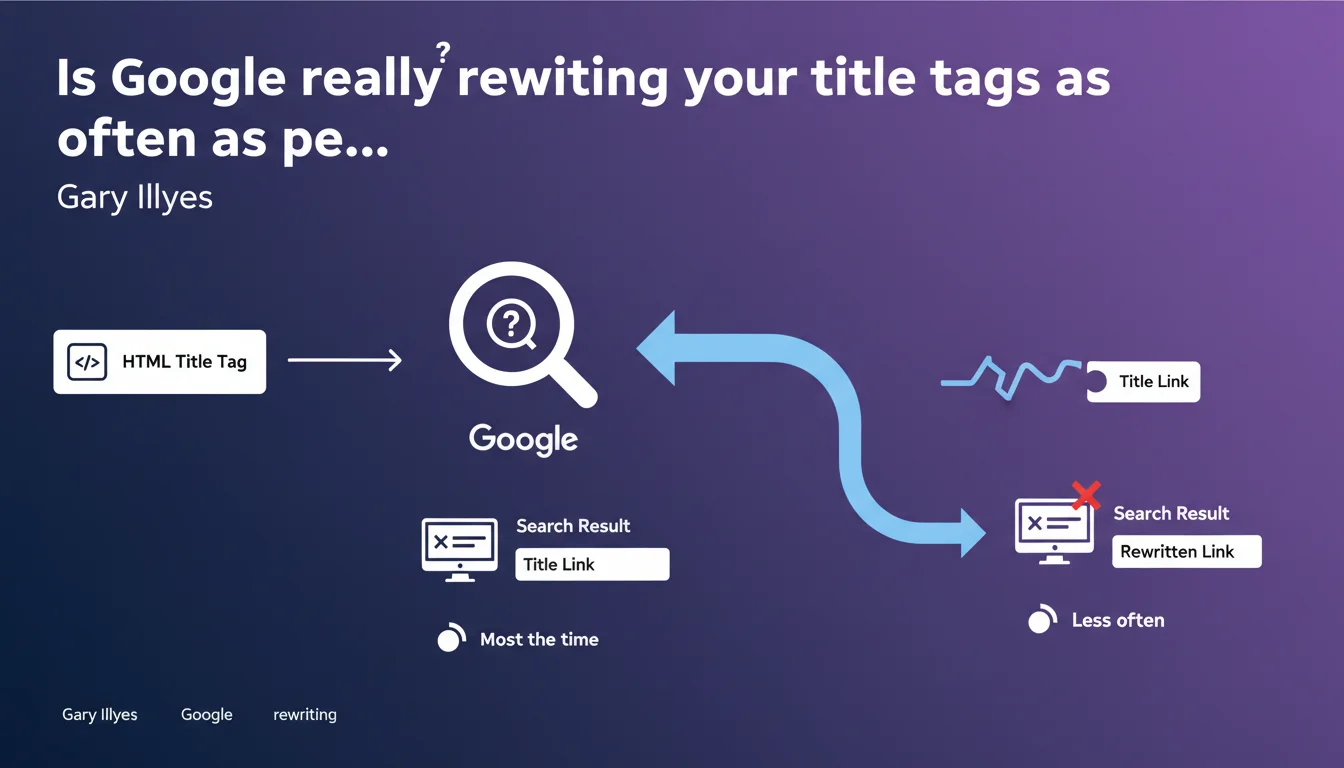
Gary Illyes confirms that the title link displayed in the SERPs comes primarily from the HTML title tag — it's one of the few elements you directly control. The key word here: "primarily". Google reserves the right to rewrite your titles, but it's far from systematic if your title tag is well-designed.
What you need to understand
Gary Illyes's statement reminds us of a fundamental principle often overlooked: the title tag remains the primary source of the title link displayed in search results. Yet for years, many SEO professionals have had the impression that Google is constantly rewriting their titles.
The term "primarily" deserves close attention — it means that in most cases, what you write in your title tag will appear as-is. But not always.
Why does Google rewrite certain titles anyway?
Google may decide to modify your title link for several reasons: inconsistency with the page content, title too long or too short, keyword stuffing, or simply because the algorithm believes another element on the page (an H1, internal anchor text) describes the subject better.
Google's objective remains to display the most relevant title for the user's search query. If your title tag isn't aligned with search intent, Google will intervene.
What elements does Google use to rewrite a title?
When Google decides to rewrite a title link, it draws from several sources: the H1, visible text on the page, internal link anchors pointing to this page, or even the Open Graph title content.
But be warned — these replacements aren't predictable or precisely documented. It's an algorithmic decision that varies depending on the query and context.
Does this mean the title tag has lost importance?
No. It remains the primary lever you control to influence what appears in the SERPs. It's also a relevance signal for ranking — even if Google rewrites it on display, it's still considered to understand your page's subject.
Neglecting the title tag because "Google rewrites it anyway" would be a strategic mistake.
- The title tag remains the primary source of the link displayed in search results
- Google reserves the right to rewrite it if it doesn't match the query or content
- Alternative sources include the H1, internal anchors, visible text, and Open Graph tags
- Even when rewritten on display, the title tag remains a relevance signal for ranking
- Controlling this element is part of directly actionable SEO levers
SEO Expert opinion
Is this statement consistent with what we observe in the field?
Yes, broadly. SEO professionals who properly optimize their title tags observe that they display primarily as-is in the SERPs. But the word "primarily" leaves a significant gray area.
Since 2021, Google has intensified its title rewrites — sometimes inexplicably. Short titles, clear ones, aligned with content, yet still rewritten. It's hard to predict when it will happen. [To be verified]: Google has never published precise statistics on the rewrite rate nor exact criteria triggering a modification.
What nuances should be added to this claim?
First nuance: "primarily" doesn't mean "always". If your title tag contains keyword stuffing, abusive special characters, or doesn't reflect your page content, Google will intervene.
Second nuance — and this one is rarely mentioned: the title link can vary depending on the query. For the same page, Google can display a different title depending on what the user typed. A title optimized for a broad query might be rewritten for a long-tail query.
Third point: Gary Illyes is talking about the "title link", not the title tag in the broader SEO sense. The title remains a ranking signal, even if Google rewrites it on display. Let's not confuse what's displayed with what's indexed.
In what cases does this rule not apply?
Some e-commerce sites see their product titles systematically rewritten, especially when they include price mentions, promotions, or SKU codes. Google then prefers to compose a title from the H1 or visible product name on the page.
Another frequent case: pages with multiple H1s or overly generic titles. If your title tag says "Home" or "Welcome", don't expect Google to respect it.
Practical impact and recommendations
What should you do concretely to maximize the display of your title tags?
First rule: align your title tag with your page content. If your title promises one thing and the content covers another, Google will intervene. Consistency between title, H1, and body text is essential.
Second rule: respect best practices for length. Aim for 50 to 60 characters to avoid truncation. A title that's too long will be cut off; one that's too short risks being completed by Google with other page elements.
Third rule: avoid keyword stuffing. A natural, readable title that integrates one main keyword at the beginning of the sentence works better than a succession of terms without structure.
What mistakes should you absolutely avoid?
Don't duplicate your title tags across multiple pages — Google hates this and often rewrites duplicated titles to differentiate them. Each page must have a unique and descriptive title.
Avoid overly generic titles: "Home", "Page 1", "Product". Google will systematically replace them with something it deems more relevant — and you'll have no control over the result.
Be careful with excessive special characters: pipes, multiple dashes, emojis. Google may remove them or completely rewrite the title if it believes it harms readability.
How do you verify that your title tags are being respected?
Use Google Search Console to identify pages where the title link has been rewritten. Compare impressions and CTR between pages where your title displays as-is and those where Google modifies it.
Do manual searches on your main keywords and observe whether your titles appear as intended. If Google rewrites them massively, that's a warning sign: something is off in your structure or content.
- Verify that each title tag is unique across your entire website
- Align the title, H1, and page content to avoid inconsistencies
- Respect a length of 50 to 60 characters to avoid truncation
- Integrate the main keyword at the beginning of the title, naturally
- Avoid keyword stuffing and excessive special characters
- Regularly analyze the GSC to identify title rewrites
- Fix pages where the title link is systematically modified by Google
❓ Frequently Asked Questions
Google réécrit-il systématiquement toutes les balises title ?
Pourquoi Google modifie-t-il certains titres alors qu'ils respectent les bonnes pratiques ?
Quelles sources Google utilise-t-il pour réécrire un titre ?
Une balise title réécrite par Google perd-elle son impact SEO ?
Comment savoir si Google réécrit mes titres ?
🎥 From the same video 5
Other SEO insights extracted from this same Google Search Central video · published on 23/04/2024
🎥 Watch the full video on YouTube →
💬 Comments (0)
Be the first to comment.