
Official statement
Other statements from this video 5 ▾
- □ Pourquoi le résultat textuel reste-t-il l'élément le plus stratégique des SERP Google ?
- □ Google réécrit-il vraiment vos balises title aussi souvent qu'on le croit ?
- □ Le snippet des SERP est-il vraiment contrôlable par le propriétaire du site ?
- □ Peut-on vraiment contrôler tous les éléments d'attribution des résultats Google ?
- □ Pourquoi Google affiche-t-il vos URLs sous forme de fil d'Ariane dans les SERP ?
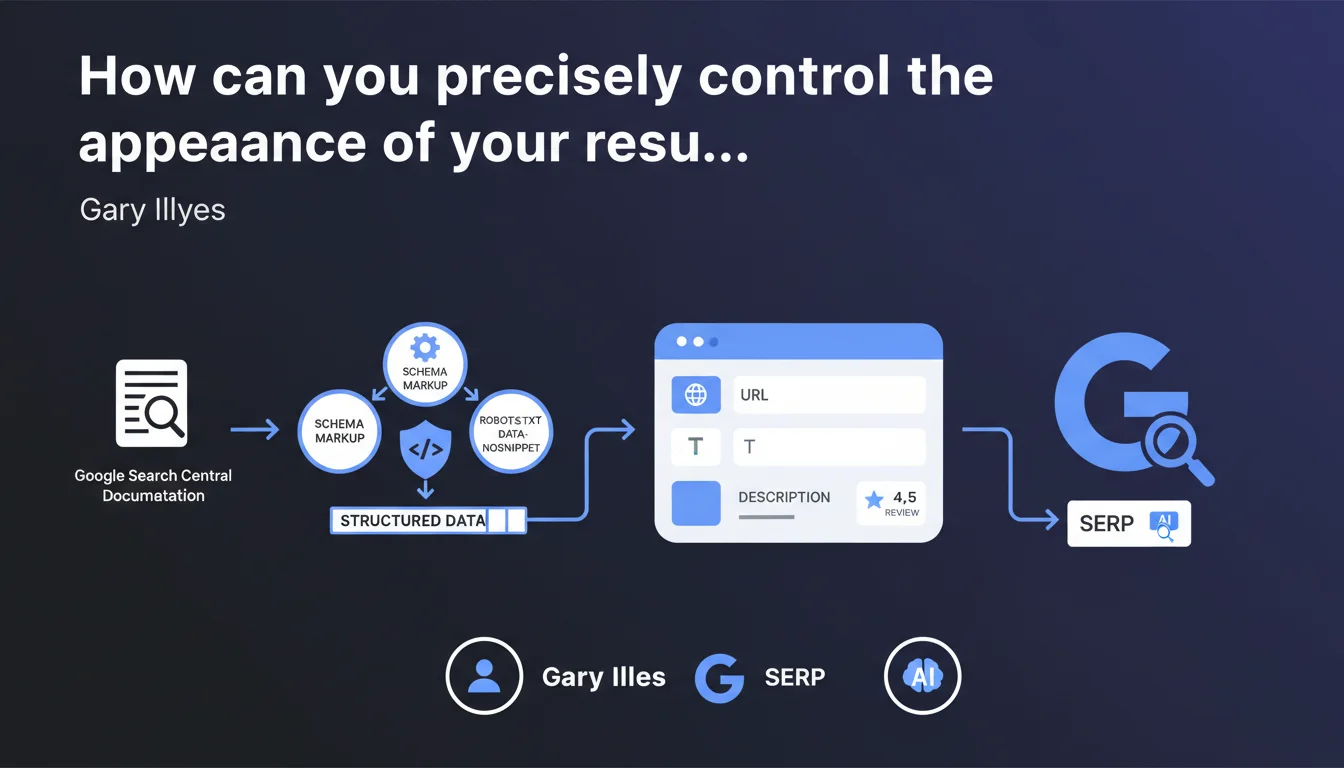
Google provides comprehensive documentation on Search Central detailing how to master the display of each element in a search result. This resource enables you to concretely optimize the rendering of snippets, rich results, and other components visible to users. A useful reminder that control levers exist — provided you know about them and apply them correctly.
What you need to understand
Which elements of a search result can you actually control?
Google displays numerous components in its results: the title tag, the meta description, rich snippets, featured snippets, sitelinks, breadcrumbs, review stars, images, and many more. All these elements can be influenced — some directly, others partially — through HTML tags, structured data, or configuration files.
Search Central documentation compiles all these techniques. For each type of result, it specifies which levers are available, what specifications to follow, and how to concretely implement best practices. It's the official reference — but it remains dense and sometimes unclear on practical nuances.
Why is Google emphasizing this documentation now?
This statement from Gary Illyes announces nothing new: the documentation has existed for years. The emphasis rather reflects a desire to make webmasters accountable. If your snippet doesn't look as expected, Google pushes back: the doc is there, consult it.
It's also a response to recurring criticism about the lack of control publishers have over algorithmic decisions. By reminding people of these resources, Google shifts the question: the problem is no longer "Google does whatever it wants" but "did you follow the guidelines properly?"
Where to find this documentation and how to leverage it?
The documentation is accessible at developers.google.com/search. It's structured in several sections: search result appearance, structured data, meta tags, crawl control, and more. Each page details the rules, provides code examples, and indicates validators to use.
The challenge isn't access but operational implementation. Recommendations are sometimes contradictory between sections, certain specifications change without clear communication, and real results don't always reflect what the docs promise. You need to cross-reference this official documentation with field observations and A/B testing.
- Title tags: Google can rewrite them if it deems them poorly relevant, too long, or keyword-stuffed
- Meta descriptions: used as a base but Google often generates alternative snippets depending on the query
- Structured data: JSON-LD or Microdata format, mandatory validation via Rich Results Test
- Robot tags: noindex, nofollow, max-snippet, max-image-preview to finely control display
- Breadcrumbs: implementation via BreadcrumbList Schema.org to show navigation path
- Sitelinks: Google generates them automatically but can be guided through clear architecture and coherent internal linking
SEO Expert opinion
Is this documentation really complete and up-to-date?
Let's be honest: Search Central documentation is voluminous but incomplete. It covers the basics well — title, description, standard structured data — but remains vague on certain critical mechanisms. For example, how exactly does Google decide to rewrite a title? The precise criteria are never detailed. [To verify]: the consistency between what the docs say and what we actually observe.
Another example: featured snippets. The docs explain you can't "force" their appearance, only optimize your chances. But the patterns that work — structured lists, short paragraphs answering a specific question, HTML tables — come from field observations, not clear official guidance. Google maintains an intentional gray zone.
Is the promised control real or theoretical?
Google loves to talk about "control" when it's often partial influence. You can provide a perfect meta description: Google will use it... or not. You implement Product Schema.org with reviews: the stars will display... or not. Rich results depend on undocumented criteria — site quality, history, perceived relevance.
Concretely? We observe that sites with strong good E-E-A-T, clean architecture, and stable history more often benefit from enriched display. New sites or those with questionable backlink profiles see their structured data ignored, even when perfectly valid. The docs don't say it, but that's field reality.
What are common mistakes despite the documentation?
First mistake: implementing irrelevant structured data to artificially boost display. Google detects and penalizes this. An e-commerce site that marks all items as "AggregateRating" with fake ratings will eventually lose its rich results — and potentially more.
Second mistake: neglecting semantic consistency between markup and visible content. If your Schema.org says "price €99" but the DOM displays "€129", Google ignores the markup or demotes the page. The docs mention this vaguely, but many miss it.
Third mistake: thinking that once implemented, it's done. Specifications evolve — Recipe, HowTo, FAQPage have all had recent changes. A structured data audit must be recurring, not one-time.
Practical impact and recommendations
What should you audit first on your site?
Start by checking basic elements compliance: titles, meta descriptions, headings, images with alt attributes. Use Search Console to identify pages with rewritten titles — it's a signal that Google considers your tags inadequate.
Next, move to structured data. Validate each implemented type with Google's Rich Results Test. Compare what you declared with what actually displays in the SERP. Gaps often reveal implementation errors or insufficient content.
Which optimizations deliver the best ROI?
FAQ and HowTo schemas remain among the most profitable when relevant: they increase the space occupied in the SERP and boost CTR. But be careful, Google tightened the rules — no more long FAQs to fill space, you need real useful questions and answers.
The structured breadcrumb (BreadcrumbList) improves result readability and can reinforce perceived internal linking. It's quick to implement and risk-free. Product reviews with stars (Product + AggregateRating) clearly boost CTR in e-commerce, but require verifiable real reviews.
Finally, work on snippet control via max-snippet, max-image-preview, and max-video-preview. On sensitive or premium content, limiting the preview can drive clicks. On informational content, maximizing preview can strengthen visibility.
How do you verify optimizations are working?
Use Search Console to monitor CTR evolution page by page after your changes. An optimized snippet should show measurable improvement within weeks. Cross-reference with Analytics data to verify that additional traffic is qualified.
Regularly test your pages with Rich Results Test and Mobile-Friendly Test. Structured data errors also appear in the Search Console "Improvements" tab — fix them immediately, they can block enriched display.
Monitor competitors: if a competitor displays rich results you don't have, analyze their source code to understand what they implement differently. Gaps often reveal unexploited opportunities.
- Audit titles and descriptions rewritten by Google in Search Console
- Validate all structured data with Rich Results Test and fix errors
- Implement FAQ and HowTo schemas on relevant content
- Add BreadcrumbList to all pages except homepage
- Configure max-snippet tags according to content strategy
- Monitor CTR in Search Console after each modification
- Plan a quarterly structured data audit to track updates
- Analyze rich results displayed by competitors on your target queries
❓ Frequently Asked Questions
Google respecte-t-il toujours les données structurées correctement implémentées ?
Pourquoi Google réécrit-il mes titles malgré la documentation suivie ?
Les FAQ schemas sont-elles encore efficaces après les restrictions récentes ?
Comment savoir si mes structured data bloquent l'affichage enrichi ?
Faut-il implémenter tous les types de structured data disponibles ?
🎥 From the same video 5
Other SEO insights extracted from this same Google Search Central video · published on 23/04/2024
🎥 Watch the full video on YouTube →
💬 Comments (0)
Be the first to comment.