
Official statement
Other statements from this video 5 ▾
- □ Pourquoi le résultat textuel reste-t-il l'élément le plus stratégique des SERP Google ?
- □ Google réécrit-il vraiment vos balises title aussi souvent qu'on le croit ?
- □ Le snippet des SERP est-il vraiment contrôlable par le propriétaire du site ?
- □ Pourquoi Google affiche-t-il vos URLs sous forme de fil d'Ariane dans les SERP ?
- □ Comment contrôler précisément l'apparence de vos résultats dans la SERP Google ?
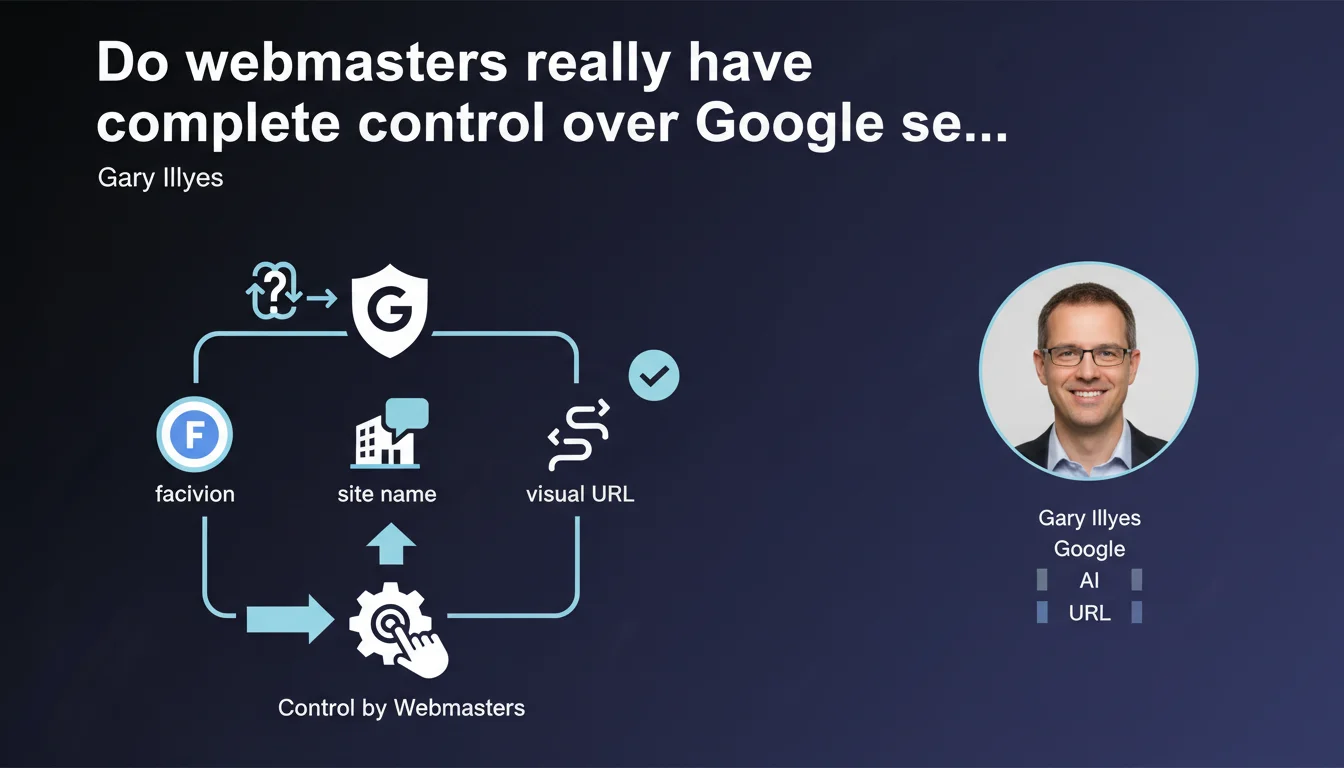
Google claims that webmasters fully control the favicon, site name, and visual URL (breadcrumb) displayed in search results. This statement positions these elements as entirely manageable through markup and structured data, without arbitrary algorithmic intervention from Google.
What you need to understand
What exactly are these attribution elements?
The attribution elements refer to the visual components that identify a website in the SERPs: the favicon (16x16 or 32x32 pixel icon), the site name (title displayed above the blue link) and the visual URL which often takes the form of a structured breadcrumb trail.
These elements play a crucial role in click-through rate (CTR) and brand recognition. A distinctive favicon and consistent site name reinforce credibility with users who quickly scan search results.
How does Google currently determine these elements?
The favicon is retrieved via the <link rel="icon"> tag in the <head>. The site name prioritizes WebSite structured data (schema.org) with the "name" property, otherwise Google may extract a name from other signals (title, meta tags).
The visual URL relies on BreadcrumbList structured data. Without appropriate markup, Google displays the raw URL or attempts to reconstruct a logical path — sometimes with imprecise results.
Why does this statement deserve attention?
Because it explicitly assigns responsibility to website owners. Gary Illyes dismisses the idea that Google arbitrarily imposes these elements or modifies them according to opaque criteria.
This means that if your favicon doesn't appear, if the site name is incorrect, or if the visual URL looks like a soup of parameters, that's a technical implementation problem on your end — not an algorithmic whim.
- Complete control implies a technical responsibility: correct markup, accessible files, Search Console validation
- Google follows its own guidelines for these elements — ignoring them exposes you to degraded displays
- Lack of control suggests a technical audit or maintenance deficiency
- These elements directly impact user perception and organic CTR
SEO Expert opinion
Is this statement completely accurate in the real world?
Let's be honest: in 95% of cases, yes. When markup is clean and compliant with Google's specs, elements display as expected. I've rarely observed situations where Google ignores a properly declared favicon or valid BreadcrumbList structured data.
But — and this is where it gets tricky — there are gray areas. For example, Google can sometimes substitute the site name with a variant it deems "more representative" if brand signals are contradictory (title tag vs schema.org vs external mentions). [To verify] in which specific contexts this occurs, because Google remains vague about the triggering thresholds.
What nuances should be added to this claim?
The term "control" assumes immediate and predictable execution. Yet, the delay between implementation and SERP display varies: a few days for a favicon, sometimes several weeks for a site name change if Google needs to recrawl and re-evaluate signals.
Another point: even with perfect markup, structured data conflicts (multiple contradictory WebSite schemas, poorly nested BreadcrumbLists) can cause Google to ignore your directives. And in such cases, it doesn't always notify you via Search Console — you discover the issue in the SERP.
In which cases doesn't this rule fully apply?
On sites where Google doubts the legitimacy or quality, attribution element display may be intentionally degraded. I've observed cases where Google removes the favicon from sites suspected of spam or deceptive content — even if the markup is technically correct.
Likewise, during manual penalties or severe algorithmic downgrades, certain visual elements may disappear. It's rare, but it happens. Google doesn't document this officially anywhere, but several audits have confirmed it.
Practical impact and recommendations
What must you do concretely to guarantee control?
Start with a technical audit of your tags and structured data. Verify that your favicon is declared in the <head>, accessible (HTTP 200 status), and compliant with recommended dimensions (16x16, 32x32, or SVG format). Google sometimes takes several days to index it.
For the site name, implement WebSite structured data with the "name" and "url" properties. Make sure this name is consistent with your branding everywhere else (homepage title tag, external mentions, social profiles). Inconsistencies create friction.
For the visual URL, integrate valid BreadcrumbList markup on all relevant pages. Respect the logical navigation hierarchy. Test with Google's structured data validator and immediately fix any errors reported.
What mistakes should you absolutely avoid?
Don't multiply contradictory WebSite schemas across different pages or subdomains. Google generally prioritizes the homepage, but mixed signals slow adoption or generate unpredictable displays.
Avoid favicons that are too heavy or hosted on unstable CDNs. If Google can't fetch them quickly, it displays a generic placeholder — which harms brand recognition.
Don't neglect Search Console. It's your only direct feedback channel from Google about attribution issues. If an element doesn't display as expected, first check the "Enhancements" and "Coverage" reports.
- Validate favicon via Search Console ("Page Experience" section)
- Implement schema.org WebSite with "name" and "url" on the homepage
- Deploy BreadcrumbList on all pages with hierarchical navigation
- Test structured data with Google's Rich Results Test
- Verify site name consistency across all channels (title, meta, external)
- Monitor actual SERP display after each modification (2-4 week delay)
- Regularly audit potential conflicts (multilingual, subdomains)
❓ Frequently Asked Questions
Combien de temps faut-il pour qu'un nouveau favicon apparaisse dans les résultats Google ?
Peut-on utiliser plusieurs favicons différents selon les sections du site ?
Que se passe-t-il si je n'implémente pas de données structurées BreadcrumbList ?
Le nom de site dans les SERP peut-il différer du title tag de la homepage ?
Les éléments d'attribution impactent-ils directement le classement SEO ?
🎥 From the same video 5
Other SEO insights extracted from this same Google Search Central video · published on 23/04/2024
🎥 Watch the full video on YouTube →
💬 Comments (0)
Be the first to comment.