
Official statement
Other statements from this video 5 ▾
- □ Google réécrit-il vraiment vos balises title aussi souvent qu'on le croit ?
- □ Le snippet des SERP est-il vraiment contrôlable par le propriétaire du site ?
- □ Peut-on vraiment contrôler tous les éléments d'attribution des résultats Google ?
- □ Pourquoi Google affiche-t-il vos URLs sous forme de fil d'Ariane dans les SERP ?
- □ Comment contrôler précisément l'apparence de vos résultats dans la SERP Google ?
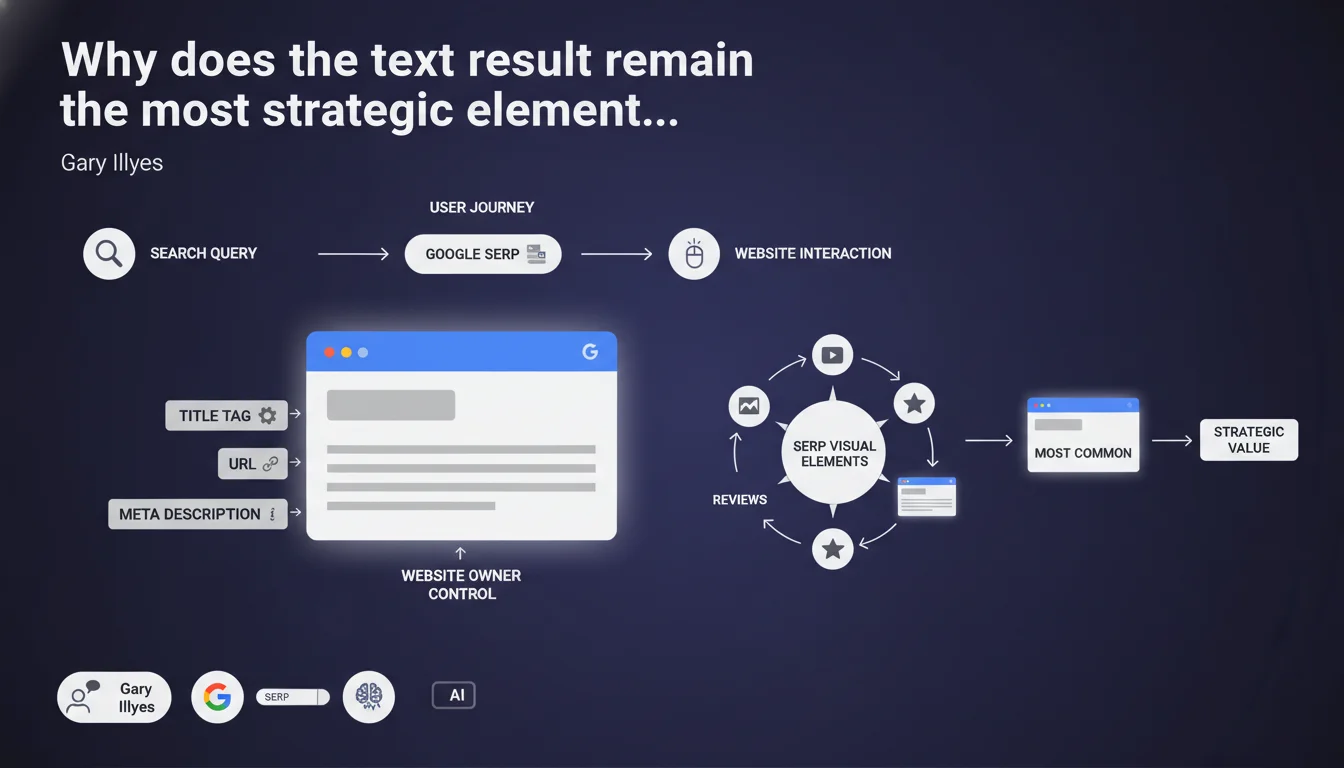
Google confirms that the classic text result is the dominant visual element in its search results pages. Most of its components — title, description, visible URL — remain under direct control of the website owner. A reminder that mastering meta tags and HTML structure remains the tactical foundation of SEO, before any technical sophistication.
What you need to understand
What exactly does Google mean by a "text result"?
Gary Illyes is referring here to the classic snippet that every SEO professional knows: the blue link, the meta description, and the displayed URL. No featured snippet, no rich result with images or stars — just the basic component that has existed since the search engine's inception.
Despite the proliferation of enriched formats and advanced SERP features, this format remains the most frequent in results. Most queries continue to display these standard text results, especially in the long tail and B2B queries.
Why emphasize that "most components are controlled by the owner"?
This statement is a strategic reminder. Unlike featured snippets or PAA (People Also Ask) that Google composes as it sees fit, the classic text result primarily uses your title tags and meta descriptions.
"Primarily", not "always" — that's where it gets tricky. Google reserves the right to rewrite your titles and descriptions if it deems them unsuitable for the query. But by optimizing these elements correctly, you maximize the chances they'll be displayed as-is.
What are the key components of this text result?
Gary Illyes mentions "few components", which indeed corresponds to a minimalist structure:
- The clickable title (title tag, potentially rewritten by Google)
- The visible URL (simplified slug, breadcrumb if correctly marked up)
- The meta description (or a generated excerpt if Google deems it irrelevant)
- The publication date (depending on content type and schema.org markup)
- Sitelinks for certain brand queries
Each of these elements directly influences your click-through rate (CTR) from the SERP, and thus your final organic traffic.
SEO Expert opinion
Is this statement consistent with real-world observations?
Yes, but with a major caveat. The text result indeed remains the most frequent element in absolute SERP volume — especially in B2B sectors, technical niches, and the long tail where Google hasn't (yet) deployed enriched formats.
However, on high-volume commercial queries and popular informational queries, SERPs are now saturated with advanced features: PAA, featured snippets, local packs, image carousels. The text result remains present, but relegated below the fold.
So yes, it is "the most common" by number of occurrences — but on high-stakes business queries, it is often obscured by other formats. [To verify]: the exact proportion varies by industry, and Google publishes no official statistics on this point.
What is the real message behind this statement?
It's an implicit wake-up call: stop neglecting the basics. Too many sites invest in complex strategies (advanced schema.org, massive AI content, aggressive link building) while forgetting that their title tags are truncated, their meta descriptions are generic, or their URLs are unreadable.
Gary Illyes implies that before chasing featured snippets or rich results, you need to master what you control directly. A well-optimized title, a description that compels clicks, a clean URL — it's basic, but it's what generates traffic on 70-80% of queries.
In which cases does this rule not apply?
On certain queries, the classic text result is virtually non-existent or completely ineffective:
Similarly, on local queries ("restaurant Lyon"), the local pack captures most clicks. And on ultra-competitive informational queries, featured snippets and YouTube videos monopolize attention.
Let's be honest: saying the text result is "the most common" doesn't mean it's the most visible or most clicked in all situations. It's an average that masks enormous disparities by sector.
Practical impact and recommendations
What should you concretely optimize on your text results?
Focus first on the title tag. It should include the main keyword at the beginning of the tag, stay under 60 characters to avoid truncation, and compel clicks without resorting to clickbait.
Next, the meta description. Google rewrites it in about 60% of cases, but a well-written description (155-160 characters, with a subtle call-to-action) significantly improves CTR when displayed. Never neglect it.
Finally, the visible URL. Use short, descriptive slugs, avoid technical parameters (?id=12345), and implement BreadcrumbList markup to display a breadcrumb trail rather than a raw URL.
What mistakes should you absolutely avoid?
Never duplicate your title tags and meta descriptions across multiple pages — it's the best way to see Google systematically rewrite them. Each page must have its own tags, adapted to its specific search intent.
Also avoid titles that are too long and get truncated. Google displays approximately 600 pixels width for a title — beyond that, the rest disappears. A truncated title gives an impression of negligence and tanks CTR.
And here's the catch: don't stuff your titles with keywords. Google now favors semantic relevance and search intent. A natural, engaging title outperforms keyword stuffing.
How do you verify that your text results are optimal?
Use Google Search Console to identify pages with abnormally low CTR despite good ranking. This often signals a poorly optimized title or description.
Test your tags with SERP preview tools (Sistrix, Mangools, or dedicated Chrome extensions) to verify they're not truncated and remain readable and attractive.
- Audit all title tags and meta descriptions to detect duplicates
- Verify your titles stay under 60 characters (or 600px width)
- Write unique meta descriptions with a differentiating angle per page
- Implement BreadcrumbList schema.org markup for enriched URLs
- Analyze CTR per page in Search Console and identify underperformers
- Test different title formulations via A/B tests (if sufficient volume)
- Avoid keyword stuffing and favor natural formulations
❓ Frequently Asked Questions
Google réécrit-il systématiquement les balises title et meta description ?
Quelle est la longueur optimale d'une balise title en 2025 ?
Le balisage schema.org améliore-t-il l'affichage des résultats textuels ?
Faut-il encore optimiser les meta descriptions si Google les réécrit souvent ?
Les résultats textuels vont-ils disparaître au profit des formats enrichis ?
🎥 From the same video 5
Other SEO insights extracted from this same Google Search Central video · published on 23/04/2024
🎥 Watch the full video on YouTube →
💬 Comments (0)
Be the first to comment.