
Official statement
Other statements from this video 10 ▾
- □ Should you still optimize meta descriptions if Google ignores them anyway?
- □ Should you still optimize meta descriptions for SEO in 2024?
- □ Is one backlink really all Google needs to discover and index your site?
- □ Is boilerplate content really hurting your pages' search rankings?
- □ Is boilerplate really a threat to your search engine rankings?
- □ Are geolocation redirects killing your Google crawl?
- □ How does Google really determine user location for local SEO?
- □ Are IP geolocation databases really reliable enough for international SEO?
- □ Can Google really display rich results without schema markup?
- □ Should you configure the Content-Language header for PDFs and non-HTML files?
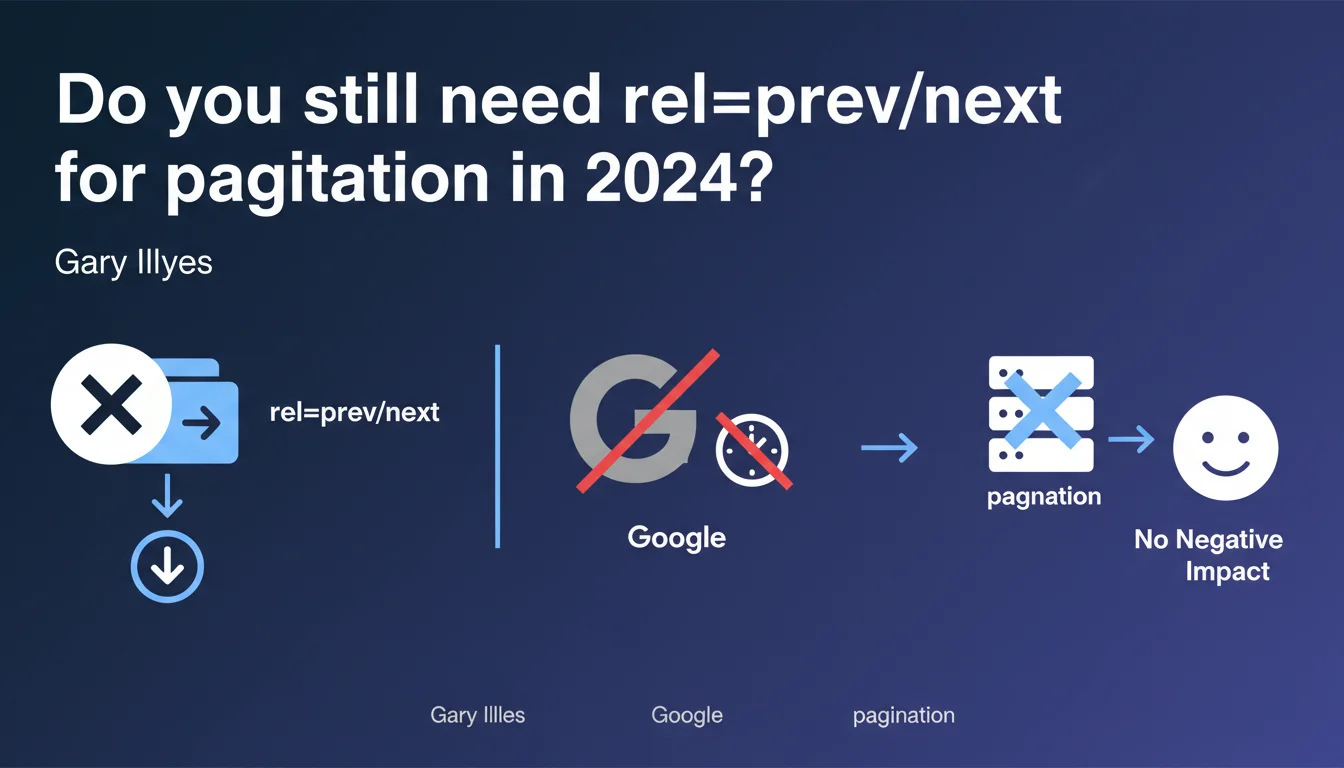
Google has completely ignored the rel=prev/next attribute for years. Gary Illyes confirms that this pagination attribute is deprecated and can be removed without any consequences. Sites with pagination must now rely on other signals to help Google understand their structure.
What you need to understand
Why did Google abandon rel=prev/next?
The rel=prev/next attribute was supposed to help Google understand that a series of pages formed a logical sequence — typically for product lists, blog articles, or paginated search results. In theory, this allowed the search engine to intelligently index these fragmented contents.
The reality? Google found that this attribute contributed nothing decisive to its algorithm. Crawling and indexing worked just as well — even better — without it. The abandonment is consistent with Google's philosophy: simplify technical signals when they are redundant with other comprehension mechanisms.
How long has Google actually been ignoring this attribute?
Gary Illyes revealed that Google was already disregarding rel=prev/next well before the official announcement. Some industry sources suggest the attribute had been ineffective for several years.
Let's be honest: many sites were still using it out of habit, without seeing any obvious difference. This official statement simply formalizes something Google had quietly buried.
What does this concretely change for paginated sites?
Nothing dramatic. Sites that used rel=prev/next won't collapse in the SERPs. Google relies on other signals to understand pagination: internal linking, structured URLs, XML sitemaps, and especially its own intelligent crawling.
The real question becomes: how do you optimize pagination without this attribute? And that's where things get a bit more complicated.
- rel=prev/next is officially dead — no need to maintain it in your code anymore
- Google uses other mechanisms to understand pagination (crawling, internal links, URL structure)
- The attribute was likely ignored for several years before the official announcement
- This deprecation carries no penalty — removing it is risk-free
SEO Expert opinion
Was this announcement really a surprise?
Not really. Attentive SEO professionals had already noticed that rel=prev/next seemed to have no measurable effect anymore. A/B tests conducted on e-commerce sites showed identical results with or without the attribute.
What's interesting is that Google waited so long to formalize this. For years, this attribute was still listed in the guidelines. Result: thousands of sites continued implementing it religiously, for nothing.
What risks for sites that keep the attribute?
No direct risk — Google ignores it, period. But there's an indirect cost: unnecessary maintenance. Every line of code that serves no purpose is technical debt. If your CMS still auto-generates rel=prev/next, there's no emergency, but you might as well remove it during your next redesign.
And that's where it gets tricky: some developers will panic and mishandle the transition. I've seen cases where removing rel=prev/next was accidentally accompanied by deletion of internal linking between paginated pages. That's catastrophic.
What alternatives exist to optimize pagination now?
The truth? There's no one magic solution. It all depends on your context: number of pages, pagination depth, content type. Some sites benefit from infinite scroll with pushState, others from a « View All » structure with canonical, still others from simple, clean internal linking.
[To verify] Google claims that its intelligent crawling is enough, but in practice, sites with hundreds of paginated pages still experience indexation issues. « Intelligent crawling » has its limits — especially on sites with low crawl budget.
Practical impact and recommendations
What should you concretely do on your site?
First reflex: audit your code. Check if rel=prev/next is still present in your pagination templates. If it is, plan its gradual removal — nothing urgent, but might as well clean things up.
Next, verify that your pagination remains crawlable. Google must be able to discover all pages through standard HTML links. No pure JavaScript pagination without fallback, no « Load more » buttons that block crawling.
What mistakes must you absolutely avoid?
Never touch rel=canonical at the same time you're removing rel=prev/next. These are two distinct attributes with different functions. The canonical remains essential for indicating which version of a paginated page is the authoritative one.
Another trap: believing that Google will magically index all your paginated pages without help. On deep sites (pagination of 20+ pages), you often need to force discovery through XML sitemaps or strategic internal linking.
How do you verify your pagination is correctly managed?
Use Search Console to monitor the indexation of paginated pages. Filter by URL pattern (e.g., ?page=) and verify that Google regularly crawls these pages.
Compare the number of paginated pages crawled versus the actual number. A significant gap signals a problem — often related to crawl budget or deficient internal linking.
- Gradually remove rel=prev/next from templates (no urgency, but clean it up eventually)
- Verify that all paginated pages remain crawlable through HTML links
- Never touch rel=canonical at the same time
- Monitor the indexation of paginated pages in Search Console
- Optimize internal linking to facilitate discovery of deep pages
- Use an XML sitemap for sites with extensive pagination
- Test the impact of removal on a sample before global deployment
❓ Frequently Asked Questions
Dois-je supprimer immédiatement rel=prev/next de mon site ?
Est-ce que rel=canonical est aussi déprécié ?
Comment Google comprend-il maintenant la pagination ?
Mon site pagine sur 50+ pages, est-ce un problème sans rel=prev/next ?
Bing et les autres moteurs ignorent-ils aussi rel=prev/next ?
🎥 From the same video 10
Other SEO insights extracted from this same Google Search Central video · published on 25/04/2024
🎥 Watch the full video on YouTube →
💬 Comments (0)
Be the first to comment.