
Official statement
Other statements from this video 11 ▾
- □ Do Core Web Vitals Really Impact Your Content's Search Rankings?
- □ Is mobile-friendliness really no longer a Google ranking factor?
- □ Is Google really switching from FID to INP in Core Web Vitals — and should you worry?
- □ Are Core Web Vitals Really Not Enough to Guarantee a Good User Experience?
- □ Is Google's Search Generative Experience (SGE) about to completely transform how organic traffic works?
- □ Does the Rich Results Test code editor really transform how you validate structured data?
- □ Does Search Console Insights really work without Google Analytics? A game-changer for site owners?
- □ Does Google's improved video indexing report finally reveal the real blocking issues?
- □ Should you really stop using the ping endpoint to submit your sitemaps?
- □ Why is Google documenting a new generic crawler and revealing its IP addresses?
- □ Is Google's new spam report really a game-changer for SEOs?
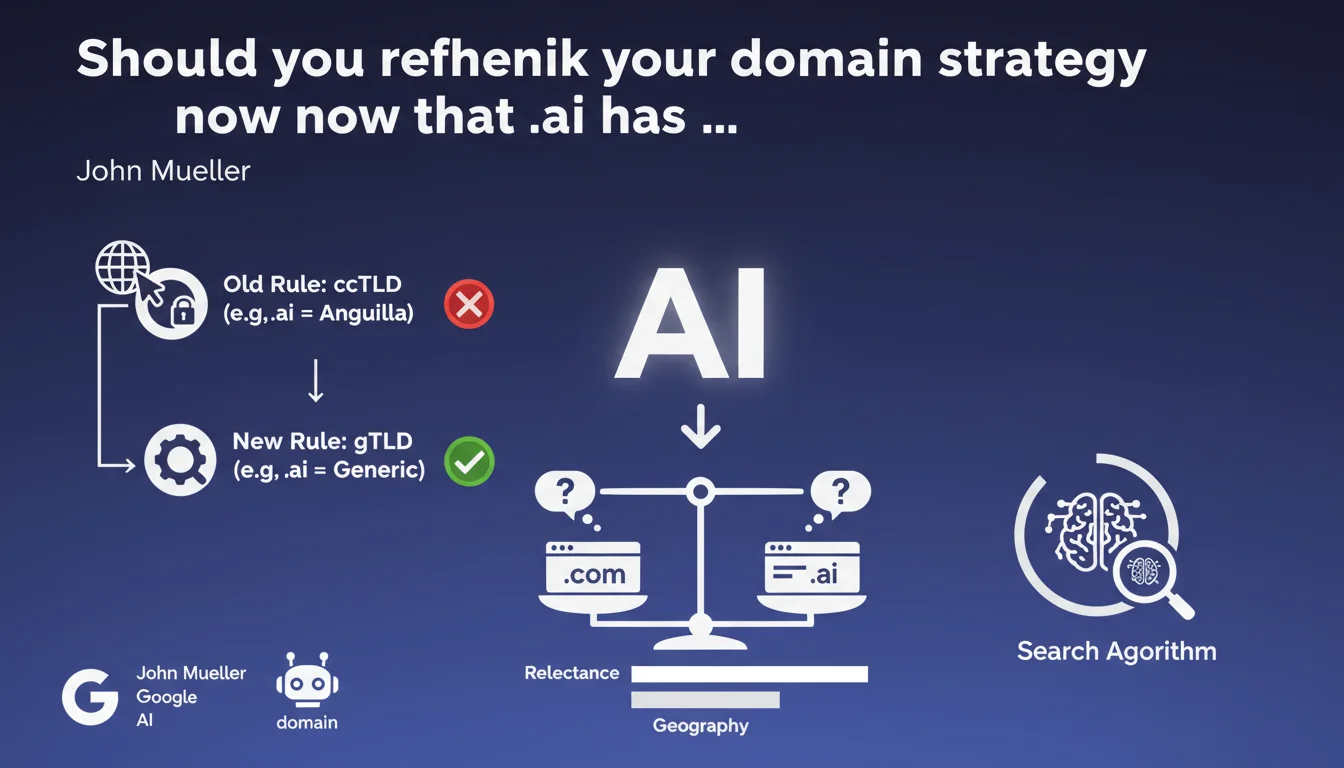
Google now treats .ai as a generic ccTLD in its search engine, just like .co or .eu. In practice, an .ai domain is no longer automatically geolocalized to Anguilla by default, but can target any geographic region via Search Console. This evolution responds to the explosion of .ai sites that have no connection to this Caribbean territory.
What you need to understand
What is a generic ccTLD and why does it change everything?
A ccTLD (country code top-level domain) is normally a domain associated with a specific country — .fr for France, .de for Germany, .ai for Anguilla. By default, Google geolocalizes these domains to their country of origin.
A generic ccTLD is a domain that, despite its geographic origin, has become so popular for international use that Google releases it from this constraint. Classic examples include .co (Colombia), .tv (Tuvalu), .me (Montenegro). Now, .ai joins this category.
Why did Google make this decision now?
The acronym AI (Artificial Intelligence) has exploded. Thousands of tech companies have registered .ai domains with no connection to Anguilla. Forcing geotargeting to this Caribbean territory no longer made any sense.
By treating .ai as generic, Google acknowledges the real market usage. It's a pragmatic adaptation to evolving practices, not a technical revolution.
Which ccTLDs are already considered generic?
Google maintains an official list in its documentation. It includes notably: .co, .eu, .asia, .tv, .me, and now .ai. These extensions can target any region via Search Console.
- .ai is no longer automatically geolocalized to Anguilla
- You can set manual geographic targeting in Search Console
- If no targeting is defined, Google determines geographic relevance through usual signals (content, backlinks, server IP, hreflang)
- This change impacts only Google Search, not necessarily other search engines
- Existing .ai domains suffer no penalty, but their targeting may become less clear if not configured
SEO Expert opinion
Is this statement consistent with what we observe in the field?
Absolutely. For months now, we've seen .ai sites rank easily on international queries, including in France or the United States. Google was already applying some flexibility in practice.
This announcement simply formalizes an existing reality. John Mueller confirms what empirical testing was showing: .ai is no longer treated as a strict Anguillian domain. No surprise, just a welcome clarification.
What nuances should be applied to this announcement?
Google isn't saying all ccTLDs will become generic. The transition happens case by case, depending on observed usage. If tomorrow the .io (British Indian Ocean Territory) explodes for another marketing use, it could follow. But this isn't automatic.
Another point: this change concerns Google Search only. Bing, Yandex, or other search engines may have their own logic. If your audience is multi-engine, verify their respective rules. [To verify]: no public data on .ai treatment by Bing or Baidu after this announcement.
In what cases could this rule cause problems?
If you had intentionally chosen a .ai to target Anguilla or the Caribbean — an ultra-rare but theoretically possible case — you lose this automatic signal. You'll need to compensate with local content, regional backlinks, and well-configured hreflang.
Another edge case: sites that were relying on geographic ambiguity to rank in multiple countries without effort. The generalization of .ai forces you to be more explicit about actual targeting, which can dilute visibility if poorly managed.
Practical impact and recommendations
What should you do concretely if you have a .ai domain?
First step: log into Google Search Console and check your international targeting settings. From the "Settings" menu > "Geographic targeting", explicitly define the target country if you haven't already.
If your site targets multiple countries, leave targeting set to "Not set" and rely on robust hreflang, subdirectories by language (/en/, /fr/, /de/), and local backlinks. The .ai now behaves like a .com: neutral by default, but moldable according to your signals.
What mistakes should you avoid with this new situation?
Don't change anything if your .ai domain is already performing well. Switching to a .com or .fr just because "it's become generic" would be a strategic error — you'd lose your history, backlinks, and authority.
Also avoid neglecting other geographic signals. The fact that .ai is generic doesn't exempt you from having a server close to your audience, localized content, and consistent mentions (address, phone, currencies).
How do you verify that your configuration is optimal?
Audit your site with this checklist. If several items aren't checked, there's work to be done.
- Check the geographic targeting parameter in Search Console
- Audit hreflang tags if your site is multilingual or multiregional
- Control hosting location (server IP) using tools like WhoIs or IPLocation
- Analyze your backlink profile: do they come from sites in your target country?
- Verify consistency of local citations (address, number, currency) in footer and contact pages
- Test search result behavior from different geolocations (VPN or simulation tools)
- Ensure main content is written in the target country's language, with local expressions
❓ Frequently Asked Questions
Dois-je changer mon domaine .ai pour un .com maintenant qu'il est générique ?
Le .ai peut-il désormais cibler la France aussi bien qu'un .fr ?
Est-ce que Bing et les autres moteurs traitent aussi le .ai comme générique ?
Si je laisse le ciblage géographique sur 'Non défini', Google va-t-il me pénaliser ?
Cette modification impacte-t-elle les domaines .ai déjà en ligne ou seulement les nouveaux ?
🎥 From the same video 11
Other SEO insights extracted from this same Google Search Central video · published on 05/07/2023
🎥 Watch the full video on YouTube →
💬 Comments (0)
Be the first to comment.