
Official statement
Other statements from this video 11 ▾
- □ Les Core Web Vitals influencent-ils vraiment le classement du contenu utile ?
- □ Pourquoi Google abandonne-t-il le FID au profit de l'INP dans les Core Web Vitals ?
- □ Les Core Web Vitals ne suffisent-ils vraiment pas à garantir une bonne expérience utilisateur ?
- □ Search Generative Experience (SGE) : comment l'IA générative de Google va-t-elle bouleverser les SERPs ?
- □ Le rich results test avec édition de code change-t-il vraiment la donne pour tester vos données structurées ?
- □ Search Console Insights sans Google Analytics : la fin d'une dépendance contraignante ?
- □ Le rapport d'indexation vidéo de Google révèle-t-il enfin les vrais problèmes bloquants ?
- □ Faut-il vraiment arrêter d'utiliser le ping endpoint pour soumettre vos sitemaps ?
- □ Pourquoi Google documente-t-il un nouveau crawler générique et révèle-t-il ses adresses IP ?
- □ Le nouveau rapport de spam de Google change-t-il vraiment la donne pour les SEO ?
- □ Faut-il revoir sa stratégie de noms de domaine maintenant que le .ai devient un ccTLD générique ?
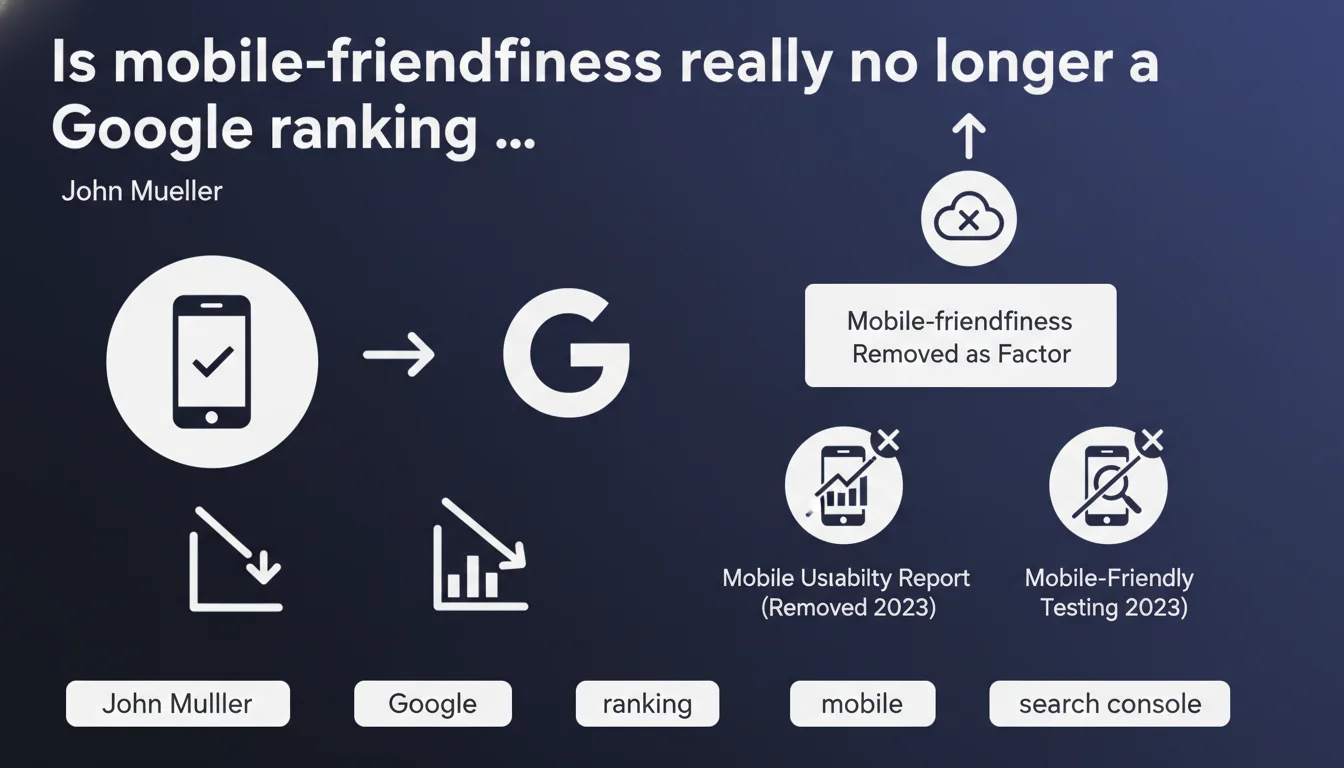
Google officially removes mobile-friendliness from ranking factors, citing that nearly all websites are now responsive. Mobile-friendly testing tools and the mobile usability report disappear from Search Console. However, be aware: mobile user experience remains under scrutiny through Core Web Vitals and other indirect metrics.
What you need to understand
Google announced the removal of mobile-friendliness as an explicit ranking criterion. This decision marks a symbolic turning point, nearly ten years after the launch of Mobilegeddon and mobile-first indexing.
The official reasoning? Victory is achieved: more than 95% of indexed sites would be correctly adapted to mobile devices. As a result, this signal loses its discriminatory value.
What does this actually change for SEO?
In practice, nothing fundamentally changes. Mobile-first indexing remains the standard: Google continues to crawl and index the mobile version of your pages as a priority. A non-responsive site will not be explicitly penalized by a "mobile factor," but will suffer indirect consequences: high bounce rate, poor Core Web Vitals, catastrophic engagement signals.
In other words, Google no longer penalizes you directly on mobile-friendliness, but you'll lose traffic and rankings through user experience metrics. The final result remains identical.
Why remove mobile-friendly testing tools now?
Google believes these tools have fulfilled their mission. The mobile usability report and mobile-friendly test have helped fix millions of sites over the past decade. Their disappearance from Search Console reflects this "normalization."
But be careful: this does not mean Google stops monitoring mobile experience. Data still flows back through Core Web Vitals, the page experience report, and behavioral signals collected via Chrome.
Should you still care about your site's mobile version?
Absolutely. Google's statement should not be interpreted as a green light to neglect mobile. Mobile now represents over 60% of global web traffic in most sectors. A poorly optimized mobile site will lose traffic, revenue, and rankings—regardless of what Google says about its "ranking factors."
The issue is no longer binary (mobile-friendly or not), but qualitative: speed, interactivity, readability, and content architecture adapted to small screens.
- Mobile-first indexing remains active: Google always prioritizes indexing the mobile version of your pages
- Core Web Vitals measure mobile experience (LCP, FID, CLS) and influence rankings
- Behavioral signals (bounce rate, session duration) penalize non-mobile-optimized sites
- Tool disappearance: the mobile-friendly test and mobile usability report will be removed from Search Console
- Mobile represents 60% of traffic: neglecting this dimension means sacrificing the majority of your potential audience
SEO Expert opinion
Is this statement consistent with observed practices in the field?
Partially. Google is right on one point: the vast majority of recent sites are indeed responsive. Modern frameworks (WordPress, Shopify, React, Next.js) generate mobile-friendly code by default. The Mobilegeddon battle is won... on paper.
But in the field, we still observe occasional regressions: poorly tested redesigns, hidden features on mobile, invasive overlays, truncated content. These issues are no longer detected by Google via a "mobile factor," but they kill user engagement—and therefore SEO. [To verify]: Google claims 95% of sites are compliant, but this aggregate metric masks significant sectoral disparities (e-commerce, media, local SMBs).
What nuances should be added to this announcement?
First point: removing a ranking factor does not mean abandoning the issue. Google has simply shifted measurement toward finer and less binary criteria. Core Web Vitals, engagement signals, scroll depth, time spent—all of this indirectly reflects mobile experience quality.
Second point: the absence of an explicit factor makes diagnosis more difficult. Previously, a non-mobile-friendly site received clear warning in Search Console. Now, SEO professionals must cross-reference multiple data sources (CrUX, Analytics, third-party tools) to identify mobile issues.
Third point: this decision may encourage some clients to underinvest in mobile, thinking "Google doesn't care anymore." This is a strategic error. Mobile is no longer an isolated SEO criterion, but the web experience standard. Neglecting mobile means neglecting your audience.
In what cases does this rule not apply?
Google's statement concerns consumer-facing websites. But certain sectors still partially escape this logic:
Complex web applications (SaaS, back-offices, professional tools) are often designed for desktop with degraded or non-existent mobile experience. Google doesn't penalize them frontally, as their target audience primarily uses computers. But watch out for accidental mobile traffic: it will generate negative signals.
Legacy or institutional sites (government agencies, universities, intranets) can still operate on non-responsive architectures. Their low organic traffic volume and captive audience protect them from immediate consequences—but that's a reprieve, not an exemption.
Practical impact and recommendations
What should you do concretely after this announcement?
First reflex: don't change your mobile strategy. Google removes an explicit factor, but the issue remains. Keep optimizing mobile user experience as if nothing had changed—because fundamentally, nothing has changed.
Next, adjust your diagnostic tools. The mobile-friendly test and mobile usability report will disappear. Switch to Core Web Vitals (CrUX report in Search Console), Google Analytics 4 (mobile/desktop segmentation), and third-party tools like PageSpeed Insights, Lighthouse, or WebPageTest.
Finally, educate your clients and stakeholders. This announcement will be misinterpreted by some decision-makers ("Google no longer cares about mobile, so we can save on responsive design"). Explain that abandoning a ranking factor doesn't mean abandoning mobile—quite the opposite, it reveals that mobile has become the standard, not an option.
What mistakes should you avoid after this announcement?
Mistake #1: stop systematically testing on mobile. Under the pretext that Google no longer penalizes explicitly, some teams relax vigilance. Result: regressions go unnoticed and progressively degrade user experience.
Mistake #2: stop auditing mobile/desktop parity. Mobile-first indexing remains in effect. If your mobile version hides content, masks internal links, or degrades HTML structure, Google will index this impoverished version—with the consequences you can imagine.
Mistake #3: ignore mobile Core Web Vitals. Google shifted measurement, not the issue. A slow or unstable site on mobile will lose traffic through engagement metrics, even without an official "mobile penalty."
How do you verify that your site remains mobile-optimized?
Set up regular monitoring of Core Web Vitals via Search Console ("Page experience" tab). Segment data by device type to detect gaps between desktop and mobile.
Cross-reference with Google Analytics 4: compare bounce rate, session duration, and conversions between mobile and desktop. A significant gap often reveals an ergonomics or performance issue.
Perform regular manual tests on multiple devices and browsers (iPhone Safari, Android Chrome, tablets). Automate these tests with tools like BrowserStack or LambdaTest to cover heterogeneous device pools.
- Continue optimizing mobile experience as if nothing has changed
- Switch to Core Web Vitals and Google Analytics for mobile monitoring
- Educate your clients: abandoning the factor doesn't mean abandoning mobile
- Systematically test every production deployment on mobile and desktop
- Verify content parity between mobile and desktop (mobile-first indexing)
- Monitor engagement metrics (bounce rate, session duration) by device
- Automate cross-device testing with tools like BrowserStack
- Regularly audit mobile Core Web Vitals via Search Console and CrUX
The removal of mobile-friendliness as a ranking factor changes nothing about the strategy to adopt: mobile remains central. Google has simply shifted measurement toward finer criteria (Core Web Vitals, engagement). The issue is now qualitative, not binary.
These technical optimizations and monitoring adjustments can prove complex to orchestrate, especially if your site relies on a custom architecture or specific tech stack. If you're looking to secure your mobile performance without mobilizing internal resources long-term, working with a specialized SEO agency can save you time and avoid costly mistakes. Personalized support helps identify priorities, automate checks, and ensure that each site evolution preserves mobile experience.
❓ Frequently Asked Questions
Google indexe-t-il toujours en priorité la version mobile des sites ?
Les Core Web Vitals remplacent-ils le facteur mobile-friendly ?
Faut-il continuer à tester son site sur mobile après cette annonce ?
Que se passe-t-il si mon site n'est pas responsive après cette annonce ?
Quels outils utiliser maintenant que le test mobile-friendly disparaît ?
🎥 From the same video 11
Other SEO insights extracted from this same Google Search Central video · published on 05/07/2023
🎥 Watch the full video on YouTube →
💬 Comments (0)
Be the first to comment.