
Official statement
Other statements from this video 11 ▾
- □ La compatibilité mobile n'est-elle vraiment plus un facteur de classement Google ?
- □ Pourquoi Google abandonne-t-il le FID au profit de l'INP dans les Core Web Vitals ?
- □ Les Core Web Vitals ne suffisent-ils vraiment pas à garantir une bonne expérience utilisateur ?
- □ Search Generative Experience (SGE) : comment l'IA générative de Google va-t-elle bouleverser les SERPs ?
- □ Le rich results test avec édition de code change-t-il vraiment la donne pour tester vos données structurées ?
- □ Search Console Insights sans Google Analytics : la fin d'une dépendance contraignante ?
- □ Le rapport d'indexation vidéo de Google révèle-t-il enfin les vrais problèmes bloquants ?
- □ Faut-il vraiment arrêter d'utiliser le ping endpoint pour soumettre vos sitemaps ?
- □ Pourquoi Google documente-t-il un nouveau crawler générique et révèle-t-il ses adresses IP ?
- □ Le nouveau rapport de spam de Google change-t-il vraiment la donne pour les SEO ?
- □ Faut-il revoir sa stratégie de noms de domaine maintenant que le .ai devient un ccTLD générique ?
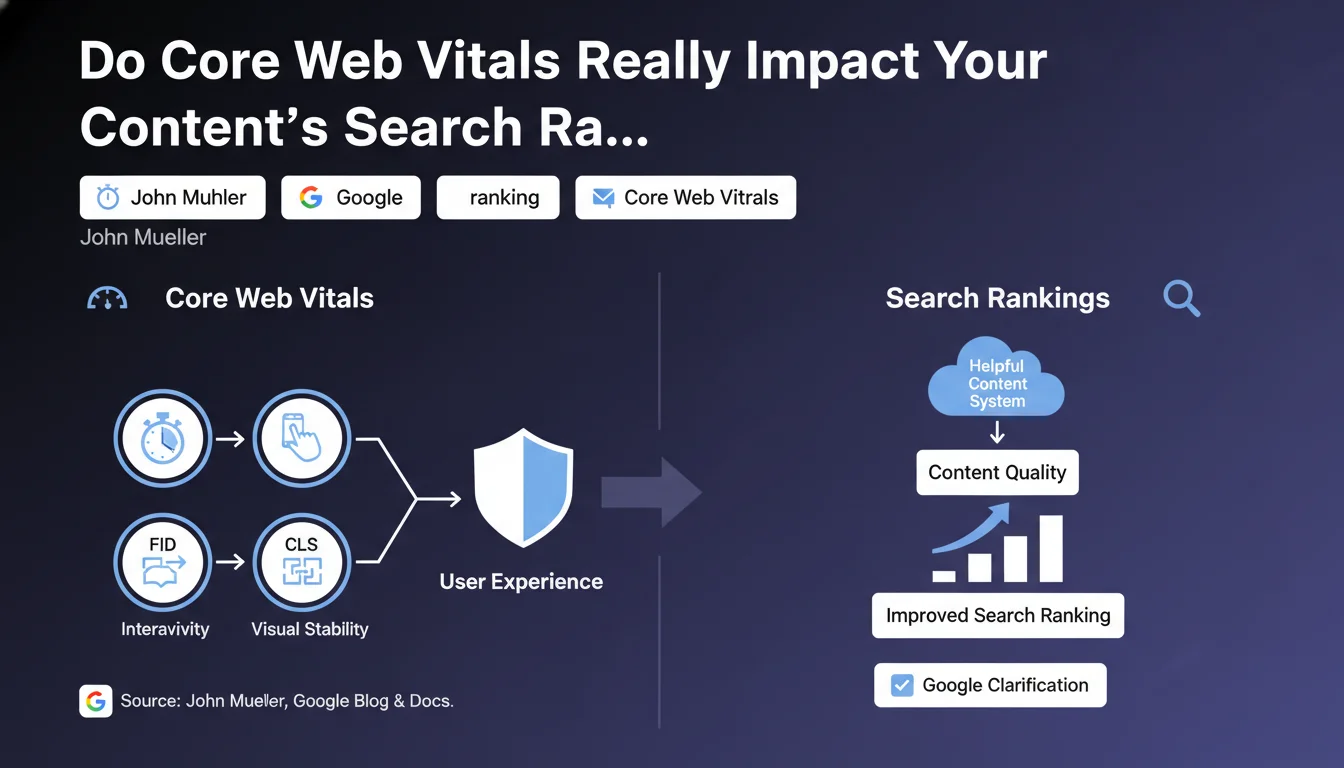
Google has confirmed that Core Web Vitals are integrated into its helpful content ranking system. This statement merges two major signals: perceived content quality and technical user experience. In practice, content deemed relevant but displaying poor technical performance could see its ranking penalized.
What you need to understand
What does this Core Web Vitals integration really mean?
Google has long maintained a blurry distinction between its different ranking systems. Mueller's announcement clarifies — partially — that the helpful content system no longer merely evaluates pure editorial quality.
The Core Web Vitals (LCP, INP, CLS) become a weighting factor in the overall evaluation of a page's "usefulness." In other words: an exhaustive mobile article that loads in 8 seconds is no longer considered "useful" by Google's standards.
Is this merger a novelty or simply a clarification?
The question remains open. Google often communicates about practices that have been in place for months. Nothing proves this integration is recent.
What changes is the official confirmation that these two systems do not operate in silos. For practitioners, this means optimizing content without worrying about technical performance becomes a shaky strategy.
What is the real weight of Core Web Vitals in this system?
Mueller points to "the blog and documentation" without providing precise figures. Classic. Google never quantifies the weight of a ranking signal.
Field observations show that impact varies considerably depending on sectors. E-commerce sites seem more affected than informational blogs. [To verify]: no official data confirms this sectoral correlation.
- Core Web Vitals are no longer an isolated signal but integrated into useful content evaluation
- Quality content with poor technical performance can be demoted
- Google does not specify the relative weight of each signal in the hybrid system
- The recommendation to consult the blog and documentation suggests increased system complexity
SEO Expert opinion
Is this statement consistent with observed practices?
Yes and no. Audits have shown for months that technically impeccable sites with mediocre content stagnate. Conversely, content-rich but slow sites lose ground to better-optimized competitors.
What's problematic: Google continues to rank sites with catastrophic Core Web Vitals if their content is deemed essential. Topical authority still seems to take precedence in some cases. [To verify]: the tolerance threshold varies depending on query competitiveness.
What nuances should be applied to this announcement?
First, Mueller does not say that Core Web Vitals become the main criterion of the helpful content system. He confirms their usage, not their dominance.
Second, the phrasing "it is recommended to consult the blog" is a classic evasion tactic. Translation: the rules are too complex to be summed up in a tweet. This suggests variable weightings depending on query context, content type, and competition.
In what cases does this rule not apply?
Sites with dominant authority in their niche seem to benefit from increased tolerance. Example: a Wikipedia article with mediocre LCP continues to rank in first position.
Informational queries with low competition also show less sensitivity to Core Web Vitals. But as soon as you enter commercial or transactional verticals, the impact becomes brutal. [To verify]: no official documentation confirms this segmentation by intent.
Practical impact and recommendations
What concrete steps should you take to adapt?
First step: audit editorial quality and technical performance simultaneously. Stop treating them as two separate projects. Content being written should integrate load constraints, weight considerations, and visual stability from the design stage.
Second step: prioritize strategic pages. It's impossible to optimize an entire site at once. Focus on pages that generate organic traffic and whose Core Web Vitals are in the red zone according to Search Console.
What mistakes should you absolutely avoid?
Don't sacrifice content richness to gain a few tenths on LCP. An abbreviated article that loads fast but doesn't answer search intent will lose ground.
Avoid focusing solely on Lighthouse scores. These lab metrics don't always reflect real-world data (CrUX). A 95 score in the lab can correspond to a catastrophic experience for your actual users on 3G mobile.
How can you verify your site meets the new requirements?
Use the Core Web Vitals report in Search Console as your primary reference. It's the only source that reflects real data Google uses for ranking.
Cross-reference this data with qualitative content analysis: depth, relevance, answer to search intent. A tool like Screaming Frog lets you identify long pages (potentially rich) with poor performance.
- Audit Core Web Vitals via Search Console (real CrUX data)
- Identify strategic pages with poor technical performance
- Optimize image weight and defer loading of non-critical resources
- Test the impact of changes on a sample of pages before global deployment
- Monitor organic traffic evolution after optimization (timeframe: 4-8 weeks)
- Do not degrade editorial quality to gain performance
❓ Frequently Asked Questions
Les Core Web Vitals deviennent-ils le critère principal du helpful content system ?
Un site avec d'excellents Core Web Vitals mais un contenu médiocre peut-il bien ranker ?
Faut-il privilégier les données Lighthouse ou CrUX pour l'optimisation ?
Quel délai pour observer l'impact d'une optimisation des Core Web Vitals ?
Les sites avec une forte autorité sont-ils exemptés de ces exigences ?
🎥 From the same video 11
Other SEO insights extracted from this same Google Search Central video · published on 05/07/2023
🎥 Watch the full video on YouTube →
💬 Comments (0)
Be the first to comment.