
Official statement
Other statements from this video 11 ▾
- □ Les Core Web Vitals influencent-ils vraiment le classement du contenu utile ?
- □ La compatibilité mobile n'est-elle vraiment plus un facteur de classement Google ?
- □ Pourquoi Google abandonne-t-il le FID au profit de l'INP dans les Core Web Vitals ?
- □ Search Generative Experience (SGE) : comment l'IA générative de Google va-t-elle bouleverser les SERPs ?
- □ Le rich results test avec édition de code change-t-il vraiment la donne pour tester vos données structurées ?
- □ Search Console Insights sans Google Analytics : la fin d'une dépendance contraignante ?
- □ Le rapport d'indexation vidéo de Google révèle-t-il enfin les vrais problèmes bloquants ?
- □ Faut-il vraiment arrêter d'utiliser le ping endpoint pour soumettre vos sitemaps ?
- □ Pourquoi Google documente-t-il un nouveau crawler générique et révèle-t-il ses adresses IP ?
- □ Le nouveau rapport de spam de Google change-t-il vraiment la donne pour les SEO ?
- □ Faut-il revoir sa stratégie de noms de domaine maintenant que le .ai devient un ccTLD générique ?
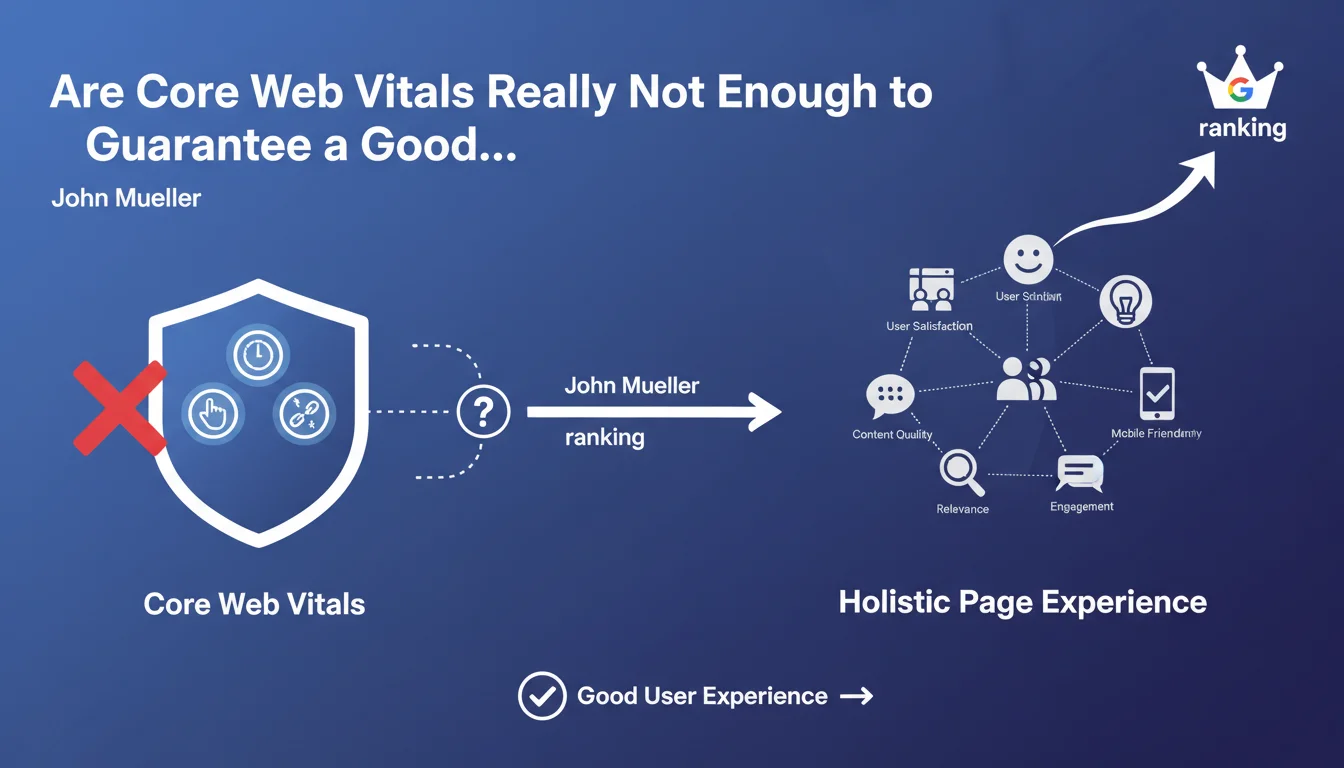
Google reminds us that page experience extends far beyond Core Web Vitals. While these metrics influence rankings, other user experience factors come into play — without us knowing exactly which ones or their respective weight. A comprehensive approach to UX remains the only concrete recommendation.
What you need to understand
Why Is Google Emphasizing This Distinction Now?
Since the rollout of the Page Experience Update, many SEO professionals have focused exclusively on Core Web Vitals: LCP, FID, CLS. John Mueller's statement comes to recalibrate expectations.
Google wants to prevent the industry from reducing user experience to three technical metrics. In reality, the search engine also evaluates aspects that are not directly quantifiable: intuitive navigation, accessibility, perceived content quality, absence of intrusive elements.
What Are These "Many Other Elements" They're Referring To?
Mueller remains deliberately vague. We can assume he's talking about information architecture, clarity of calls-to-action, visual consistency, absence of aggressive pop-ups.
But concretely? No numerical data. No exhaustive list. This imprecision complicates optimization: it's hard to prioritize when you don't know the exact criteria or their weighting.
How Does This Holistic Approach Align with Ranking Signals?
Google clarifies that "good experience aligns with what ranking systems seek to reward". In other words: improving overall UX should naturally serve SEO.
The problem: this alignment remains theoretical as long as we ignore the exact weight of each component. Will a site with perfect CWV but chaotic navigation be penalized? To what extent?
- Core Web Vitals remain a confirmed ranking signal, but with low weight compared to content relevance
- Other experience factors (mobile-friendliness, HTTPS, absence of intrusive interstitials) are documented
- Many UX aspects are not directly measured by Google but influence user behaviors (bounce rate, session duration)
- The recommended holistic approach means not sacrificing real experience for artificially optimized scores
SEO Expert opinion
Does This Statement Really Bring New Information?
Let's be honest: no. Since the launch of Core Web Vitals, Google has repeatedly stated that these metrics are just one element among many. This reminder seems mostly like an attempt to temper the industry's obsession with these three indicators.
We regularly observe sites with mediocre CWV that rank very well thanks to exceptional content and strong backlinks. Conversely, technically flawless sites stagnate due to lack of relevance. The hierarchy of signals remains clear: content first, experience second.
What Gray Areas Persist in This Message?
The major problem: complete lack of granularity. Mueller talks about "holistic approach" without defining the components or their relative importance. No concrete examples. No alternative metrics proposed. [To verify]
This imprecision leaves the door open to all interpretations. Does WCAG accessibility weigh as much as LCP? Does visual hierarchy count for Google or only through indirect behavioral signals? Impossible to say with certainty.
In What Contexts Does This Rule Really Change the Game?
For e-commerce and media sites, this distinction matters a lot. A smooth conversion funnel, efficient internal search, intuitive faceted navigation — all of this impacts conversions and time spent, thus indirectly SEO performance.
But for a simple blog or brochure site? The gap between "optimize CWV" and "holistic approach" remains marginal in practice. Most obvious UX optimizations are already covered by standard technical criteria.
Practical impact and recommendations
What Specifically Should You Optimize Beyond Core Web Vitals?
Start by auditing real user journeys. Analyze heatmaps, session recordings, exit rates by page. Identify friction points: overly long forms, invisible CTAs, confusing navigation.
On the technical side, verify real mobile compatibility — not just Google's test, but actual usage across multiple devices. Test content readability, clickable area sizes, absence of unwanted horizontal scroll.
What Mistakes Should You Avoid in This Quest for Holistic Experience?
Don't sacrifice performance for superfluous animations. A smooth transition is nice, but a site that takes 4 seconds to load because of parallax effects is counterproductive.
Also avoid overoptimizing metrics at the expense of real experience. For example: lazy-loading so aggressive that images never appear, or fonts that display in Comic Sans for 2 seconds to improve LCP.
How Can You Verify That Your Holistic Approach Is Working?
Behavioral metrics remain your best indicators: adjusted bounce rate, pages per session, average duration, conversion rate. If these figures improve after your UX optimizations, you're on the right track.
Complement with qualitative user testing. Five people testing your checkout flow will reveal friction points that PageSpeed Insights will never detect.
- Audit user journeys with heatmaps and session recordings
- Verify mobile compatibility across multiple real devices
- Eliminate intrusive pop-ups and aggressive interstitials
- Optimize visual hierarchy and content readability
- Test accessibility (contrast, keyboard navigation, screen readers)
- Measure behavioral metrics (bounce rate, pages/session, conversions)
- Conduct regular qualitative user testing
- Balance technical performance with richness of experience
❓ Frequently Asked Questions
Les Core Web Vitals restent-ils un facteur de classement après cette déclaration ?
Quels autres éléments d'expérience Google prend-il en compte ?
Un site avec des CWV médiocres peut-il bien se classer ?
Comment mesurer cette approche holistique de l'expérience ?
Faut-il arrêter d'optimiser les Core Web Vitals ?
🎥 From the same video 11
Other SEO insights extracted from this same Google Search Central video · published on 05/07/2023
🎥 Watch the full video on YouTube →
💬 Comments (0)
Be the first to comment.