
Official statement
Other statements from this video 11 ▾
- □ Les Core Web Vitals influencent-ils vraiment le classement du contenu utile ?
- □ La compatibilité mobile n'est-elle vraiment plus un facteur de classement Google ?
- □ Pourquoi Google abandonne-t-il le FID au profit de l'INP dans les Core Web Vitals ?
- □ Les Core Web Vitals ne suffisent-ils vraiment pas à garantir une bonne expérience utilisateur ?
- □ Search Generative Experience (SGE) : comment l'IA générative de Google va-t-elle bouleverser les SERPs ?
- □ Search Console Insights sans Google Analytics : la fin d'une dépendance contraignante ?
- □ Le rapport d'indexation vidéo de Google révèle-t-il enfin les vrais problèmes bloquants ?
- □ Faut-il vraiment arrêter d'utiliser le ping endpoint pour soumettre vos sitemaps ?
- □ Pourquoi Google documente-t-il un nouveau crawler générique et révèle-t-il ses adresses IP ?
- □ Le nouveau rapport de spam de Google change-t-il vraiment la donne pour les SEO ?
- □ Faut-il revoir sa stratégie de noms de domaine maintenant que le .ai devient un ccTLD générique ?
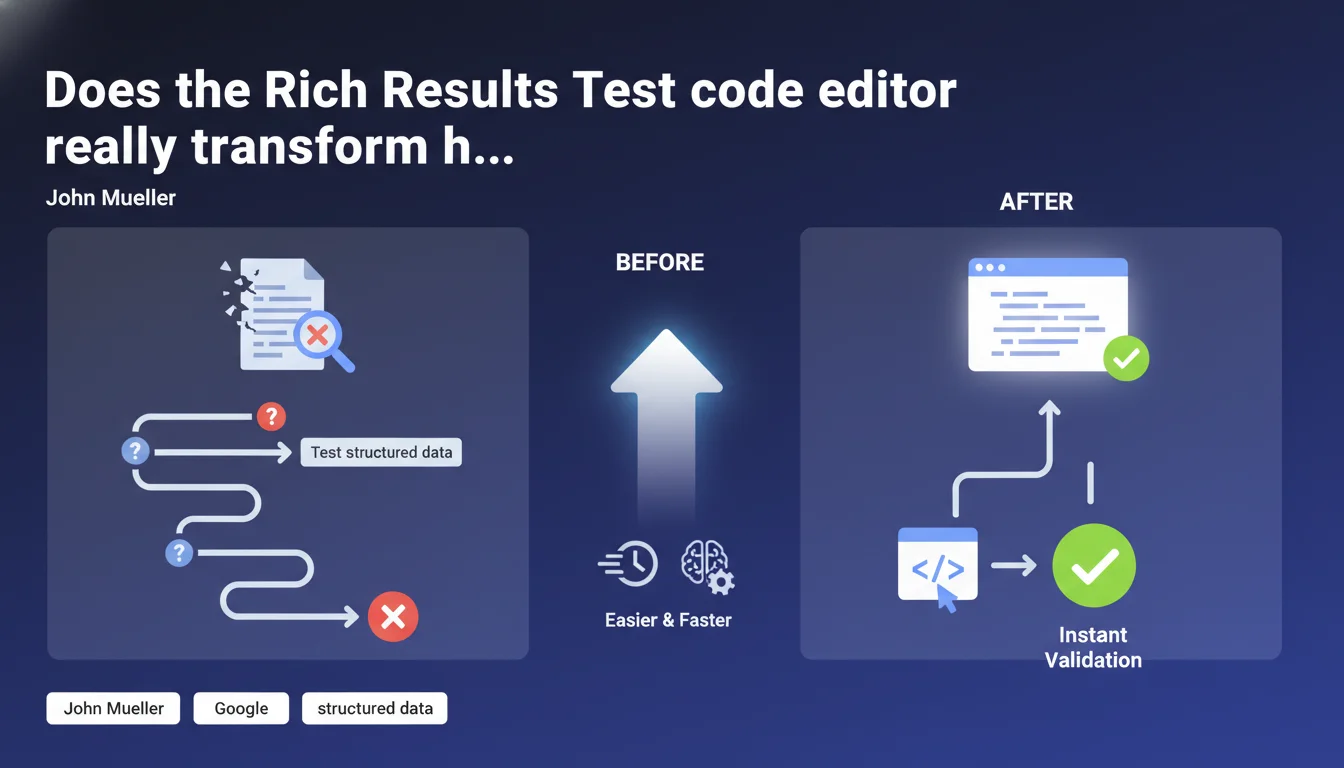
Google has integrated a code editor directly into the Rich Results Test. You can now modify your structured markup on the fly and test corrections instantly without going back through your CMS. A significant time-saver for rapid iteration on your schema.org implementations.
What you need to understand
What exactly does this Rich Results Test update change?
Until now, testing a structured markup fix meant a tedious back-and-forth process: modify the code in your CMS, deploy it, wait for indexing or use the URL Inspection Tool, then rerun the test. Direct editing within the tool bypasses this entire workflow.
You paste your URL, Google retrieves the markup, and you can immediately edit the JSON-LD, Microdata, or RDFa to see if your corrections pass validation. This is especially useful when you're debugging syntax errors or testing different schema.org variants.
Why is Google rolling out this tool now?
Structured data has become central to SERP display — recipes, FAQs, products, events, reviews. As more webmasters deploy schema.org, markup errors are multiplying exponentially.
Google wants to simplify the test-correct-validate cycle to accelerate adoption of clean markup. A more user-friendly tool means fewer support tickets, fewer broken markups in the index, and better rich snippets overall.
What are the limitations of this built-in editor?
The tool validates syntax and eligibility for rich results, but it won't tell you if your markup is semantically coherent with your actual content. You can technically modify anything in the editor — including falsifying data — and still pass validation tests.
Let's be honest: this isn't a substitute for production validation. It's a sandbox for rapid iteration before you deploy for real.
- Real-time editing of structured markup without touching your site's source code
- Instant validation of syntax corrections and rich results eligibility
- Substantial time savings when debugging complex schema.org errors
- Does not replace testing in actual production environment
- Useful for testing markup variants before final implementation
SEO Expert opinion
Does this tool fundamentally change our validation workflow?
Yes and no. For a quick audit or one-off correction, it's undeniably a win. You spot an error in Search Console, open the Rich Results Test, edit directly, validate. That saves you from needing to pull a developer for a missing quotation mark.
But — and this is where it gets tricky — the tool only tests what Google sees at crawl time. If your markup is injected client-side via JavaScript, or if you're using a complex templating system that generates variations based on user-agent, you risk getting misleading results.
Do the data changes in the editor reflect what's actually indexed?
No. And this is crucial to understand. You can fix a broken schema.org in the interface, get a nice "eligible for rich results" verdict, then deploy to production only to discover Google still ignores your markup because it's crawling a different version.
[Worth verifying] — Google doesn't specify whether modifications made in the editor persist anywhere or influence other tools (URL Inspection, Search Console). Spoiler: they probably don't. It's an isolated environment.
In what scenarios does this tool become truly essential?
When you manage high-volume template sites — e-commerce, directories, news sites — and you're rolling out markup changes progressively. You test first on a pilot URL in the editor, validate syntax, then scale out.
Also invaluable for training editorial or product teams who don't code but need to understand what properly-formed markup looks like. You can show them live how a misplaced comma breaks everything.
Practical impact and recommendations
What should you concretely do to leverage this update?
Integrate the Rich Results Test with editing into your QA process before deployment. Before rolling out a template modification that touches structured data, test a representative URL, edit the markup in the tool to simulate your changes, validate.
Also use it to quickly diagnose errors reported in Search Console. Rather than spending 20 minutes reading the schema.org docs to understand why your Review snippet isn't showing, paste the URL, edit, test different configurations until you find one that passes.
What pitfalls should you avoid with this tool?
Don't blindly trust the results. The tool validates formal compliance, not semantic relevance. If you mark a blog post as a recipe with all the required fields, it'll pass the test — but Google will never display it as a rich result and might even penalize you for spam.
Another trap: modify the markup in the editor then forget to port those changes back to your source code. It sounds silly, but it happens more often than you'd think, especially when multiple people are working on the same project.
How do you verify that your structured data is actually working?
Validation testing is just the first step. Once deployed, monitor the Search Console "Enhancements" report to see if Google detects and properly indexes your rich results. Cross-reference with performance data to measure real CTR impact.
Compare URLs with and without rich snippets displaying in the SERPs. If you have perfect markup but no rich results showing, it means Google decided your content or authority doesn't justify the preferential treatment — and at that point, the problem is no longer technical.
- Systematically test markup modifications before deploying to production
- Use the editor to debug errors surfaced by Search Console
- Never stop at technical validation — verify actual display in the SERPs
- Train non-technical teams to use the tool for early problem detection
- Document validated markup configurations to ensure consistency
- Monitor the CTR impact of deployed rich results via Search Console
❓ Frequently Asked Questions
Les modifications faites dans l'éditeur du rich results test sont-elles sauvegardées ?
Peut-on tester des données structurées injectées en JavaScript avec cet outil ?
Un balisage validé dans le rich results test garantit-il l'affichage d'un rich snippet ?
Cet outil remplace-t-il le schema markup validator de schema.org ?
Peut-on éditer tous les types de balisage structuré (JSON-LD, Microdata, RDFa) ?
🎥 From the same video 11
Other SEO insights extracted from this same Google Search Central video · published on 05/07/2023
🎥 Watch the full video on YouTube →
💬 Comments (0)
Be the first to comment.