
Official statement
Other statements from this video 9 ▾
- □ Does user experience really impact SEO rankings, or just conversions?
- □ Is a high bounce rate really a red flag for your SEO performance?
- □ Is your SEO expertise blinding you to what your users actually need?
- □ Is your site losing traffic because of poor UX? Here's how to know when research is critical for SEO.
- □ Are your pages' negative ratings a hidden SEO signal worth investigating?
- □ Should you really start with heuristic evaluation before testing with real users?
- □ Can cognitive walkthrough really boost your SEO through better user experience?
- □ Why do five users truly unlock 85% of UX problems for SEO professionals?
- □ How can qualitative-quantitative triangulation transform your UX research into a powerful SEO lever?
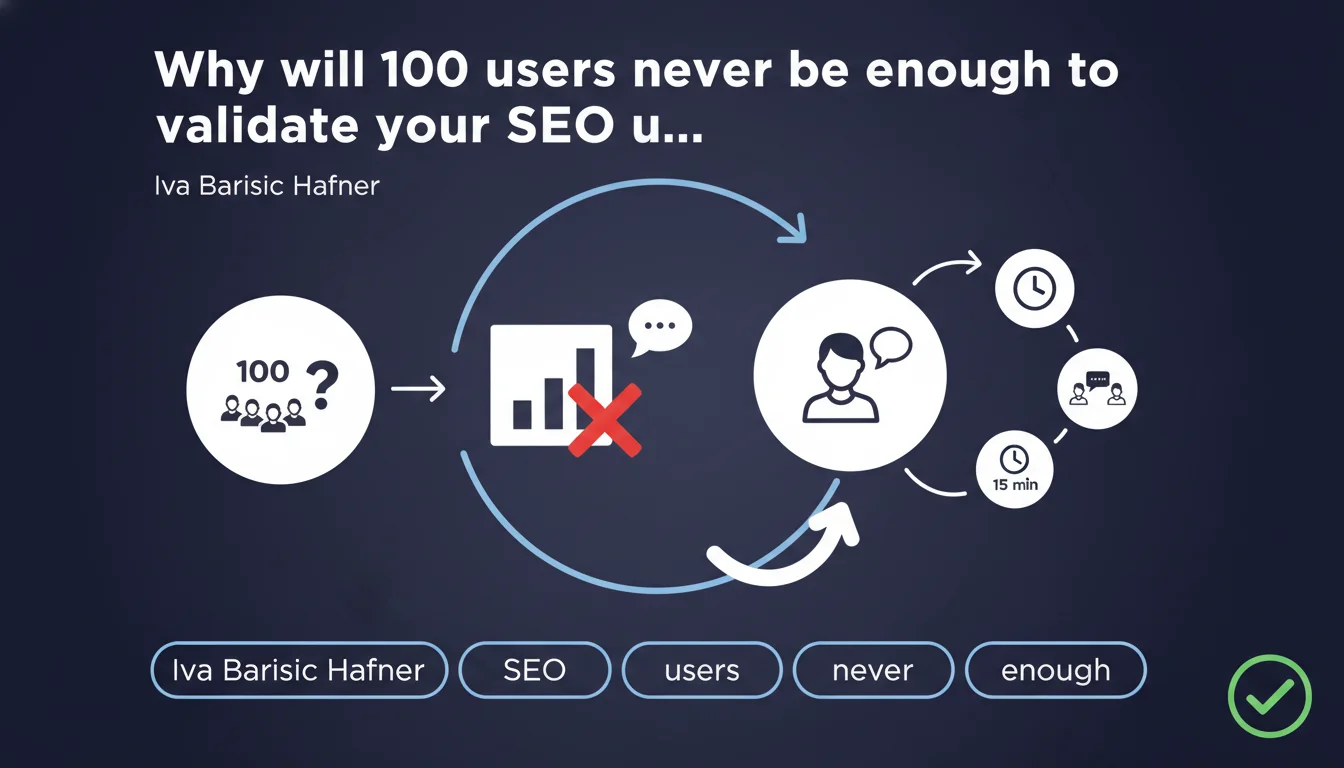
Google states that with only 100 users, it's impossible to obtain statistically reliable data through a survey. It's better to prioritize individual 15-minute interviews for this sample size. This statement reminds us that UX must be based on robust signals, not biased micro-samples.
What you need to understand
Why does Google insist on a minimum sample size?
Iva Barisic Hafner establishes a fundamental principle in user research: statistical reliability requires a sufficient volume of responses. With 100 total users, the survey response rate typically hovers around 10-20%. You end up with 10 to 20 usable responses — a volume too small to identify significant trends or eliminate noise.
This statement fits into the context of Core Web Vitals and user experience signals, where Google values real field data. If your UX analysis relies on skeletal samples, you risk optimizing in the wrong direction. Outliers weigh too heavily, real patterns disappear in the variance.
What does Google specifically recommend for small audiences?
Faced with a limited pool of users, Google recommends individual qualitative interviews lasting 15 minutes. This format allows you to dig deeper into behaviors, understand the "why", and identify UX friction points that quantitative metrics never capture.
These interviews often reveal insights that no heatmap or A/B test will detect with 100 visitors. A user explaining why they abandon your conversion funnel provides more value than 50 aggregated Analytics sessions.
How does this approach impact technical SEO and conversion path optimization?
SEOs optimizing information architecture or Landing Pages sometimes fall into the premature testing trap. Launching an A/B test with 200 visitors/month SEO traffic per variant is statistically nonsensical — yet I see it regularly.
Google reminds us that below a certain threshold, qualitative methods dominate quantitative ones. For SEO, this means: prioritize ergonomic audits, moderated user tests, targeted session recording analysis — before deploying heavy statistical tools.
- 100 total users = sample size too small for statistically reliable surveys
- Prioritize qualitative 15-minute interviews to understand real UX friction points
- Qualitative insights are worth more than quantitative metrics biased by low volume
- Never launch SEO A/B tests with fewer than several thousand sessions per variant
- Google values robust UX signals, not conclusions drawn from micro-samples
SEO Expert opinion
Is this recommendation consistent with practices observed in the field?
Yes, and it's actually basic methodological common sense that many forget. I've seen e-commerce sites redesign their navigation based on a survey sent to 500 customers, with 18 usable responses. Result: ergonomics that satisfy 18 people… and destroy the conversion rate for the other 50,000.
SEOs working on B2B niches with limited traffic know this dilemma well. Impossible to obtain classical statistical significance — but qualitative interviews regularly reveal internal linking obstacles, misunderstandings about industry vocabulary, poorly positioned CTAs.
What nuances should be added to this statement?
Google doesn't specify the exact threshold where surveys become viable. Is it 500 users? 1000? 5000? [To verify]. In academic UX research, it's generally considered necessary to have at least 200-300 complete responses to begin drawing reliable trends — but this depends heavily on response variance.
Another point: 15-minute interviews are effective… if you know how to conduct them. Many professionals ask leading questions, confirm their biases, or don't dig into spontaneous responses. A poorly conducted qualitative interview can be as misleading as an under-dimensioned survey.
Finally, this statement concerns declarative surveys. Behavioral data (analytics, scroll depth, click tracking) remains exploitable even with low volume — provided you accept a larger margin of error and don't over-interpret micro-variations.
In what cases does this rule not apply?
If your site generates 10,000 organic sessions/day with a homogeneous audience, you can perfectly well send a survey and obtain a representative sample of 500+ responses. Google's rule targets small user bases, not high-traffic sites.
Similarly, certain ultra-targeted qualitative tests (eye-tracking on 5 users to identify attention zones) bring value even with a micro-sample — because the goal isn't statistical generalization, but detection of recurring visual patterns.
Practical impact and recommendations
What should you concretely do to leverage this recommendation?
Stop sending generic surveys to your small bases. If you have fewer than 1000 active users, switch to direct qualitative mode: contact 10-15 people for 15-minute interviews via Zoom/Teams. Prepare a structured interview guide, but leave room for exploration.
For SEO sites with moderate traffic (500-2000 sessions/day), combine approaches: use session recordings to identify behavioral friction points, then validate your hypotheses through targeted qualitative interviews. Only launch quantitative surveys if you anticipate at least 200-300 complete responses.
What errors must you absolutely avoid?
Never draw definitive conclusions from a sample smaller than 100 responses — especially if your total audience is heterogeneous. SEO e-commerce professionals optimizing product sheets based on 20 customer responses risk destroying UX signals that work for the 98% who are silent.
Another classic mistake: confusing quality with quantity. A poorly conducted interview with 50 people brings less value than a structured interview with 8 well-chosen users. If you've never done qualitative interviews, train yourself or get professional support — it's a specialized skill.
How do you validate that your UX methodology aligns with Google's expectations?
Verify that your UX data (Core Web Vitals, bounce rate, session depth) relies on statistically significant volumes. If your Google Analytics report shows "insufficient data" on certain strategic pages, dig deeper with qualitative research before modifying anything.
Systematically cross-reference multiple sources: behavioral analytics, heatmaps, interviews, customer support. A UX friction detected through 3 different channels carries much more weight than an isolated figure in a dashboard.
- Only launch a survey if you anticipate 200+ complete responses minimum
- Prioritize qualitative 15-minute interviews for user bases < 1000 people
- Use session recordings to detect behavioral friction points before questioning users
- Train yourself in qualitative interview methods or get support from a UX specialist
- Always cross-reference multiple data sources before validating a UX hypothesis
- Never over-interpret micro-variations on samples < 100 sessions
- Document your UX methodologies to justify your optimization decisions
❓ Frequently Asked Questions
Quel est le nombre minimum d'utilisateurs pour lancer une enquête fiable selon Google ?
Les entretiens qualitatifs de 15 minutes peuvent-ils remplacer les données Analytics pour le SEO ?
Peut-on faire des tests A/B SEO avec peu de trafic organique ?
Comment sélectionner les utilisateurs pour des entretiens qualitatifs UX ?
Les Core Web Vitals sont-ils concernés par cette règle d'échantillonnage ?
🎥 From the same video 9
Other SEO insights extracted from this same Google Search Central video · published on 31/10/2024
🎥 Watch the full video on YouTube →
💬 Comments (0)
Be the first to comment.