
Official statement
What you need to understand
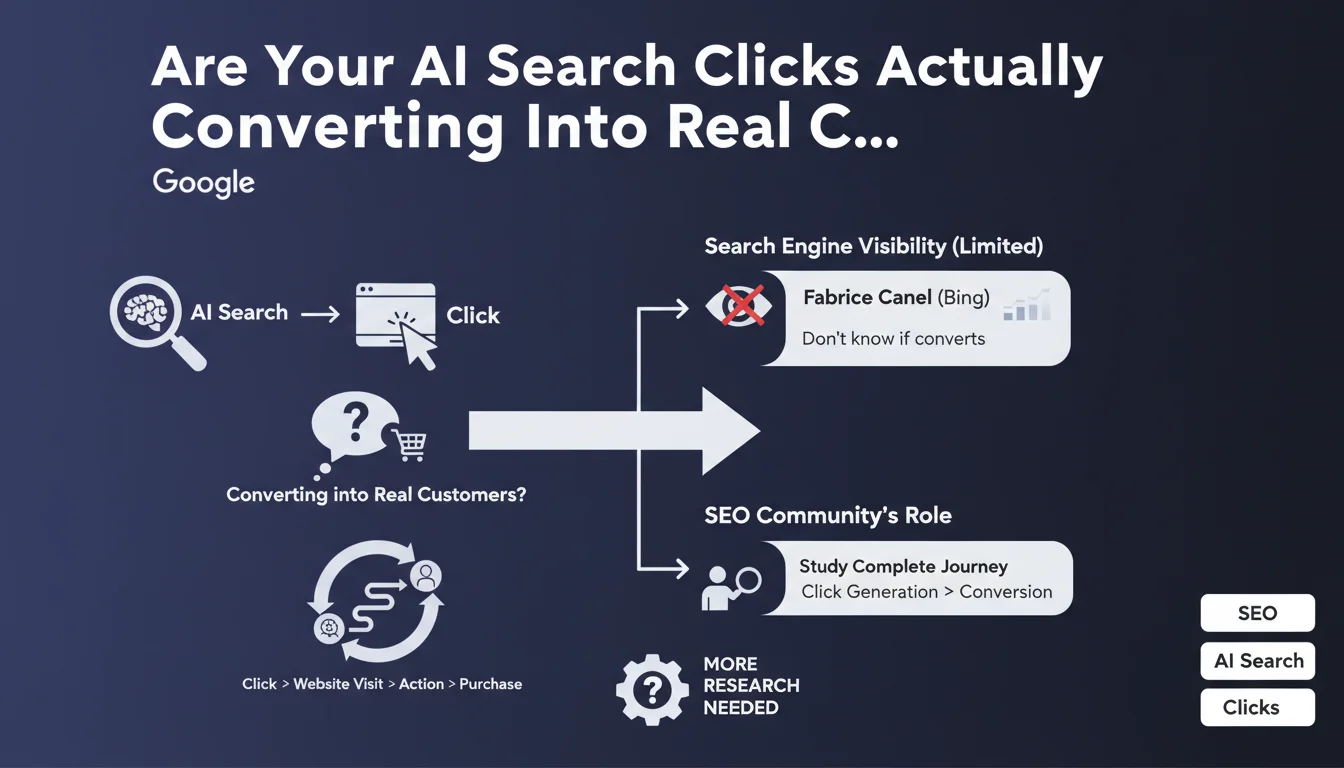
AI search engines like Bing and Google generate clicks to websites, but they have no visibility into what happens next: does the visitor actually convert?
This statement marks a major turning point in SEO analysis. Traditionally, search engines measure the quality of a result through signals like quick return rate to results (pogo-sticking) or click stability. These metrics are no longer sufficient in the AI search era.
AI-generated answers (such as SGE or Bing Chat) create a new type of traffic potentially different from classic organic traffic. Users arrive with different intentions and contexts.
- Search engines acknowledge their measurement limitations regarding the actual effectiveness of AI clicks
- Analysis responsibility shifts toward SEO practitioners and marketers
- Conversion metrics become the key indicator, not just click volume
- An explicit call to develop new analysis methodologies adapted to AI
SEO Expert opinion
This statement is extremely revealing and consistent with what I've been observing since the emergence of AI search experiences. Search engines indirectly admit that their understanding of the user journey is incomplete.
Concretely, this means that AI-generated traffic must be segmented in your analytics tools. In my practice, I indeed find that visitors from conversational or AI searches have distinct behaviors: often shorter sessions but sometimes more qualified, different bounce rates.
An important nuance: this approach applies mainly to transactional and service websites. For media sites whose model relies on display advertising, the logic remains different because the click itself has value, regardless of conversion.
Practical impact and recommendations
- Immediately segment your traffic in Google Analytics 4 to isolate AI search sources (UTM parameters, specific referrers)
- Create distinct conversion goals to specifically measure AI traffic performance versus classic organic traffic
- Analyze user journeys: time on site, page views, navigation depth for AI traffic
- Establish internal benchmarks comparing conversion rates, average order value, and ROI between traffic sources
- Optimize your landing pages based on AI arrival context: these users have often already obtained a partial answer
- Invest in advanced tracking tools (heatmaps, session recordings) to understand specific behaviors
- Test different types of content designed to appear in AI answers and measure their impact on conversions
- Stop focusing exclusively on positions in classic SERPs, but on the quality of generated traffic
In summary: The AI search era demands a complete overhaul of your performance indicators. The click is no longer an end in itself; conversion becomes the true barometer of success.
This profound transformation of SEO analysis requires advanced technical skills in analytics, deep understanding of user journeys, and the ability to interpret complex data in a constantly evolving context.
For businesses facing these new challenges, guidance from a specialized SEO agency can prove valuable. These transformations affect your entire digital strategy and often require dedicated resources to implement the right measurement and optimization methodologies tailored to your specific sector.
💬 Comments (0)
Be the first to comment.