
Official statement
Other statements from this video 9 ▾
- □ Does user experience really impact SEO rankings, or just conversions?
- □ Is a high bounce rate really a red flag for your SEO performance?
- □ Is your SEO expertise blinding you to what your users actually need?
- □ Are your pages' negative ratings a hidden SEO signal worth investigating?
- □ Should you really start with heuristic evaluation before testing with real users?
- □ Can cognitive walkthrough really boost your SEO through better user experience?
- □ Why do five users truly unlock 85% of UX problems for SEO professionals?
- □ How can qualitative-quantitative triangulation transform your UX research into a powerful SEO lever?
- □ Why will 100 users never be enough to validate your SEO user experience strategy?
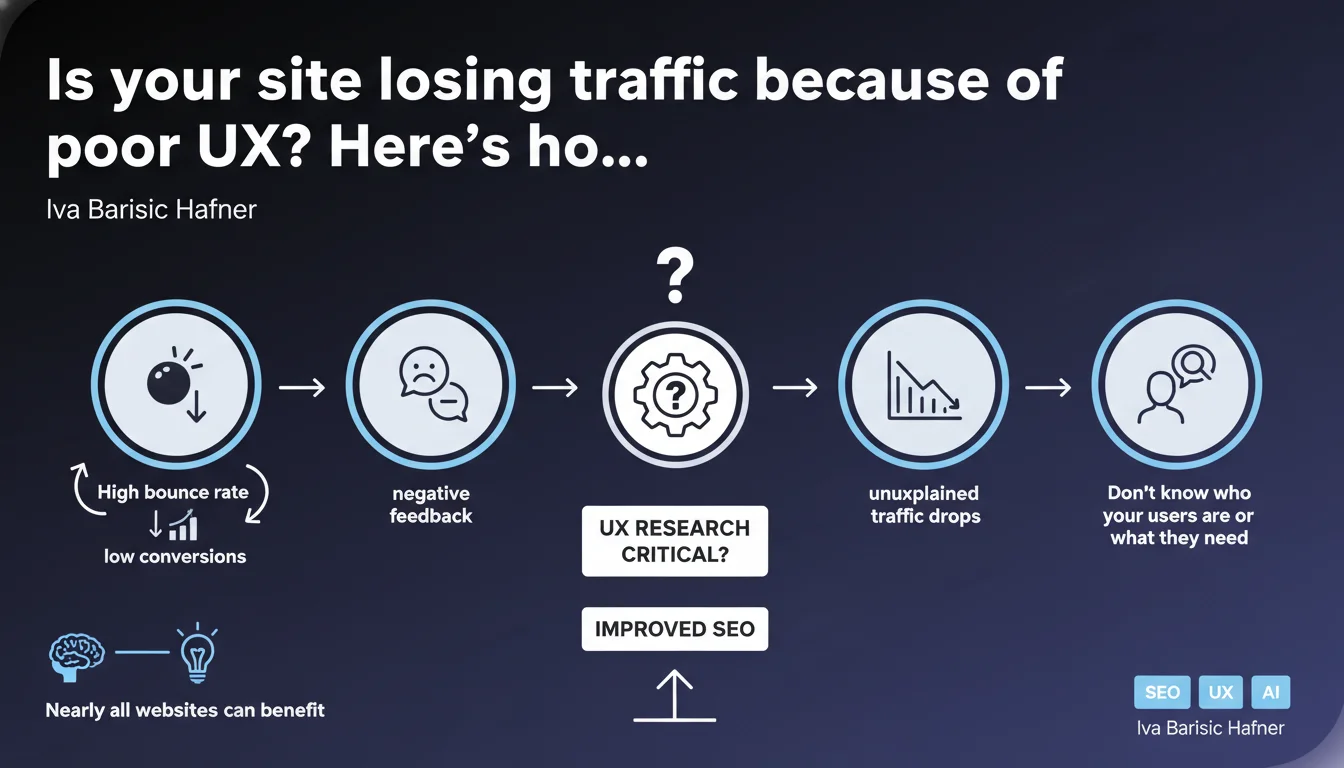
Google identifies five signals that should trigger UX research: high bounce rates, low conversions, negative feedback, unexplained traffic drops, or lack of user understanding. Nearly every website would benefit from some form of user research — a message that explicitly links UX and SEO performance.
What you need to understand
This statement from Iva Barisic Hafner positions UX research as an essential diagnostic tool in the face of weakness signals. Google isn't talking about algorithms or technical criteria here, but rather an investigative approach centered on the user.
The underlying message? SEO problems aren't always solved by technical tweaks. Sometimes it's the site experience itself that's broken.
Why does Google connect UX to organic traffic?
Because behavioral signals — time on site, bounce rate, interactions — feed into quality assessment models. When users flee, Google interprets it as a sign that content or interface doesn't match search intent.
Barisic Hafner doesn't explicitly mention Core Web Vitals or engagement metrics, but the link is obvious. Poor UX degrades these indicators, which in turn impact rankings.
What does Google mean by "user research"?
The term is intentionally broad. It can range from qualitative interviews with real users to heatmap analysis, A/B testing, or accessibility audits.
The core idea: understand who uses the site, why, and where it breaks down. No imposed methodology, but rather an investigative mindset.
Are all five signals equally important?
No. Google blends quantitative metrics (bounce rate, conversions, traffic) with qualitative issues (negative feedback, user knowledge gaps).
Some signals are measurable in Analytics in ten seconds. Others require interviews or surveys — and that's exactly where most sites cut corners.
- High bounce rate : watch for false positives (e.g., single-product pages where users find what they need and leave)
- Low conversions : can reveal a disconnect between search intent and actual offer
- Negative feedback : often underutilized, yet rich with actionable insights
- Unexplained traffic drop : UX research can reveal mobile usability issues that went unnoticed
- User knowledge gaps : the most strategic signal, rarely addressed seriously
SEO Expert opinion
Is this statement consistent with observed practices?
Yes, but with a caveat: Google frames UX research as a diagnostic tool, while in practice it's often seen as a cost or luxury reserved for large sites.
In reality, most SEO audits stop at technical metrics and content. UX gets mentioned, rarely explored deeply. Barisic Hafner puts this topic back at center stage — and it's relevant.
What nuances should we consider?
First point: the five signals listed are symptoms, not root causes. High bounce rate can stem from catastrophic UX, but also from poorly qualified traffic, a misleading SEO promise, or disastrous load times.
Launching UX research without first checking technical fundamentals and semantic consistency is putting the cart before the horse.
Second nuance: Google says "nearly all websites can benefit from some form of user research." [To verify] — this phrasing is so broad it becomes meaningless. A personal blog with 200 monthly visitors doesn't need an ethnographic study.
What's missing from this statement: prioritization. When does UX research become a priority lever compared to other SEO work?
When doesn't this rule apply?
If problems are clearly technical (crawl blocked, indexation failing, massive cannibalization), UX research won't solve anything. It might even divert resources from more urgent actions.
Similarly, if traffic drops following an identified algorithm update (Helpful Content, Core Update), the priority is adjusting content strategy, not launching user interviews.
Practical impact and recommendations
What should you do concretely?
First step: map the symptoms. Gather data from Google Analytics, Search Console, Hotjar or equivalent. Identify pages with the highest bounce rates, conversion paths that break, queries where your CTR collapses.
Second step: confront this data with real user feedback. This can involve tools like Userlytics, recorded user testing sessions, or simply phone interviews with 5 to 10 customers.
Third step: cross-reference UX insights with SEO data. A page that ranked well but lost traffic can reveal a mismatch between what Google thinks you offer and what users actually find.
What mistakes should you avoid?
Don't confuse UX research with simple metrics analysis. Looking at figures in Analytics is data analysis, not user research. Research means talking to people, observing their behavior, understanding their frustrations.
Another trap: launching UX research without prior hypotheses. If you don't know what you're looking for, you'll only find noise. Start by formulating specific questions : why don't users click this CTA? Why do they leave this page after 10 seconds?
Finally, avoid separating UX from SEO. UX teams often optimize for engagement without thinking about crawl, indexation, or Core Web Vitals. SEOs optimize for Google without always listening to users. The approach must be integrated.
How do you know if your site warrants UX research?
Ask yourself these questions:
- Does my bounce rate exceed 70% on key pages meant to convert?
- Are my users abandoning at a specific step in the conversion funnel?
- Have I received recurring negative feedback about usability or navigation?
- Is my organic traffic curve dropping with no clear technical explanation?
- Can I accurately describe who my users are and what they really seek?
- Do my pages rank well but fail to convert — why?
If you answered yes to two or more questions, targeted UX research makes sense. Not necessarily a six-month study, but at minimum a series of interviews or user tests on strategic pages.
Google explicitly links SEO performance and user experience. Behavioral signals impact rankings, and poor UX inevitably translates to degraded metrics.
Concretely: if your site shows one or more of the five signals mentioned, invest in focused user research. This can range from qualitative interviews to A/B testing to heatmap analysis.
These initiatives require cross-functional skills spanning UX, analytics, and SEO — a field where partnering with a specialized agency can mean the difference between a cosmetic diagnosis and genuine performance transformation.
❓ Frequently Asked Questions
La recherche UX remplace-t-elle un audit SEO technique ?
Un taux de rebond élevé est-il toujours un signal négatif ?
Combien de temps dure une recherche UX pertinente pour un site e-commerce ?
Peut-on mener une recherche UX avec un budget limité ?
Google utilise-t-il directement le taux de rebond comme facteur de ranking ?
🎥 From the same video 9
Other SEO insights extracted from this same Google Search Central video · published on 31/10/2024
🎥 Watch the full video on YouTube →
💬 Comments (0)
Be the first to comment.