
Official statement
Other statements from this video 11 ▾
- □ Does Google Search Central Documentation Get Special Treatment in Search Results?
- □ Do you really need to check Search Console every single day?
- □ Should you always use a 301 redirect for a permanent URL change, or are there exceptions that work better?
- □ Should you really fix every single 404 error on your website?
- □ Should you really segment your sitemaps beyond 50,000 URLs?
- □ Should you really automate hreflang tags to manage multilingual websites?
- □ Do titles and meta descriptions really influence SEO beyond just improving click-through rates?
- □ Does Google really rewrite your title tags however it sees fit?
- □ Should you really be using nofollow links in your client case studies?
- □ How can you convince a development team to prioritize Core Web Vitals?
- □ How can you accurately measure SEO success when you're making multiple changes at once?
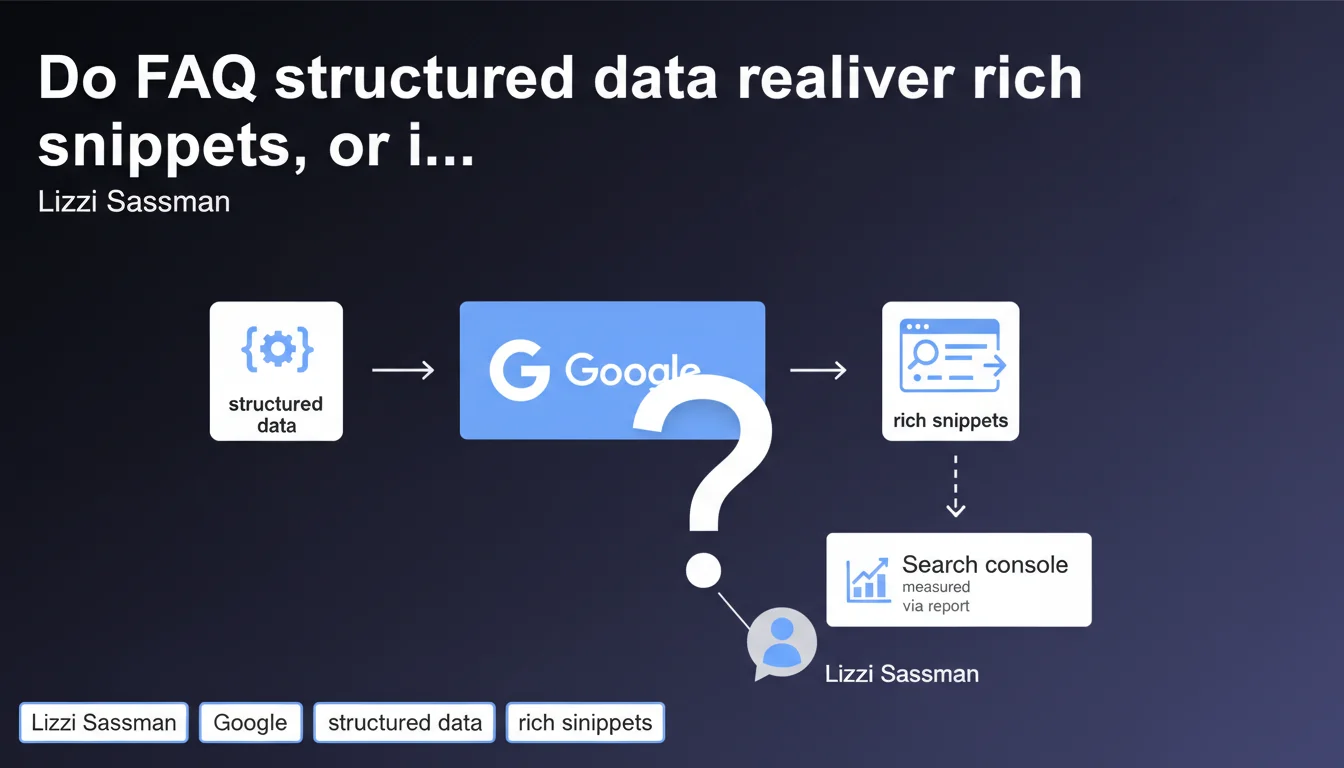
Google confirms that FAQ structured data enables rich appearance in search results. Success is tracked via the dedicated Search Console report for search features. Measuring success therefore requires verifying actual display, not just markup implementation.
What you need to understand
What exactly does Google mean by this statement?
Google is reminding us here of a mechanism that many SEO professionals know about, but whose actual effectiveness varies depending on context. Adding FAQPage structured data is not an automatic guarantee of rich display — it's an eligibility.
The crucial point lies in the second part: the real success indicator is the Search Console report. Not the markup validator. Not the fact that your code is technically correct. But the actual activation of rich appearance in the SERPs.
Why does Google emphasize Search Console over markup validation?
Because Google can decide not to display your rich snippet even if the code is perfect. Possible reasons: content deemed not relevant, FAQ duplication across pages, sector subject to restrictions (health, finance), or simply an opaque algorithmic decision.
Search Console thus becomes the final arbiter. If your page doesn't appear in the active features report, it means Google has chosen not to display it — regardless of your technical implementations.
What are the prerequisites for this to work?
- Valid markup: correct JSON-LD syntax or microdata, complying with Schema.org guidelines
- Content relevance: questions and answers must provide real value, not disguised keyword stuffing
- Uniqueness: avoid repeating the same FAQ across multiple site pages
- Guideline compliance: no misleading content, violence, medical content without sources, etc.
- GSC verification: regular monitoring of the « Rich Results » report to confirm activation
SEO Expert opinion
Is this statement consistent with real-world observations?
Yes and no. On paper, it's true: structured FAQ can generate rich snippets. In practice, we're observing a progressive erosion of their display over recent years.
Google has tightened restrictions on several verticals. FAQs appear less often in competitive sectors where Google Ads dominates, less often on mobile where space is limited, and almost never when Google prefers to push its own widgets (People Also Ask, Knowledge Panel, etc.).
What nuances should we add?
First point: FAQ visibility varies enormously depending on the query. On uncompetitive long-tail keywords, it can still work. On money keywords, it's become extremely rare. [To verify]: Google publishes no statistics on actual FAQ display rates by sector.
Second nuance: even when displayed, the impact on CTR isn't always positive. Some users find their answer directly in the snippet and don't click through. Google's « success » isn't necessarily your success in terms of traffic.
In what cases is this approach still worthwhile?
Structured FAQs remain relevant in three specific situations. First, on e-commerce product pages where questions are recurring and legitimate (shipping, returns, warranty). Second, on local service pages where competition is less fierce. Third, from a defensive perspective: if your competitors have them, not having them can disadvantage you.
But never bet everything on this lever. It's a complement, not a strategy.
Practical impact and recommendations
What should you concretely do to maximize display chances?
Start by identifying pages where FAQs make real sense. Not all your pages. Not to fill space. Only those where you answer questions that users actually ask themselves — and where you can prove it (Google Analytics, customer support, forums).
Implement markup in JSON-LD (it's cleaner and less risky than microdatas). Verify with Google's Rich Results Test, then wait for indexation and monitor GSC. If after a few weeks nothing appears in the report, ask yourself about content relevance or your sector.
What mistakes must you absolutely avoid?
- Don't duplicate the same FAQ across multiple pages — Google will either pick one at random or none
- Don't use FAQ for keyword stuffing — it disqualifies the page
- Don't ignore official guidelines (no medical content without sources, no disguised promotion)
- Don't neglect regular GSC monitoring — display can disappear without warning
- Don't rely solely on FAQ for visibility — diversify your levers (featured snippets, PAA, etc.)
How do you verify your site is compliant and optimized?
Use the Rich Results Test to validate syntax. Then check in Search Console, « Rich Results » section, if your pages appear in the report with « Valid » status. If yes, that's a good sign — but it doesn't guarantee permanent display.
Also perform manual searches on your target keywords to see if FAQ actually displays. Compare with competitors. If no one has them in your sector, it may mean Google has turned off the tap for this vertical.
Structured data FAQ remain an interesting lever, but their effectiveness has eroded. Technical implementation is simple, but obtaining actual display depends on opaque criteria that Google doesn't detail. Search Console verification is essential, but insufficient to guarantee ROI.
For complex sites or sensitive sectors, implementing a coherent structured data strategy requires deep expertise and constant monitoring. If you lack internal resources or want to maximize display chances, consulting a specialized SEO agency can help you avoid costly mistakes and accelerate results.
❓ Frequently Asked Questions
Les FAQ structurées améliorent-elles le classement dans Google ?
Pourquoi mes FAQ ne s'affichent-elles pas alors que le balisage est valide ?
Faut-il mettre des FAQ sur toutes les pages du site ?
Quel format de balisage utiliser pour les FAQ ?
Combien de temps avant que les FAQ s'affichent dans les résultats ?
🎥 From the same video 11
Other SEO insights extracted from this same Google Search Central video · published on 20/10/2022
🎥 Watch the full video on YouTube →
💬 Comments (0)
Be the first to comment.