
Official statement
Other statements from this video 11 ▾
- □ Does Google Search Central Documentation Get Special Treatment in Search Results?
- □ Should you always use a 301 redirect for a permanent URL change, or are there exceptions that work better?
- □ Should you really fix every single 404 error on your website?
- □ Should you really segment your sitemaps beyond 50,000 URLs?
- □ Should you really automate hreflang tags to manage multilingual websites?
- □ Do titles and meta descriptions really influence SEO beyond just improving click-through rates?
- □ Does Google really rewrite your title tags however it sees fit?
- □ Should you really be using nofollow links in your client case studies?
- □ How can you convince a development team to prioritize Core Web Vitals?
- □ Do FAQ structured data really deliver rich snippets, or is Google overselling the feature?
- □ How can you accurately measure SEO success when you're making multiple changes at once?
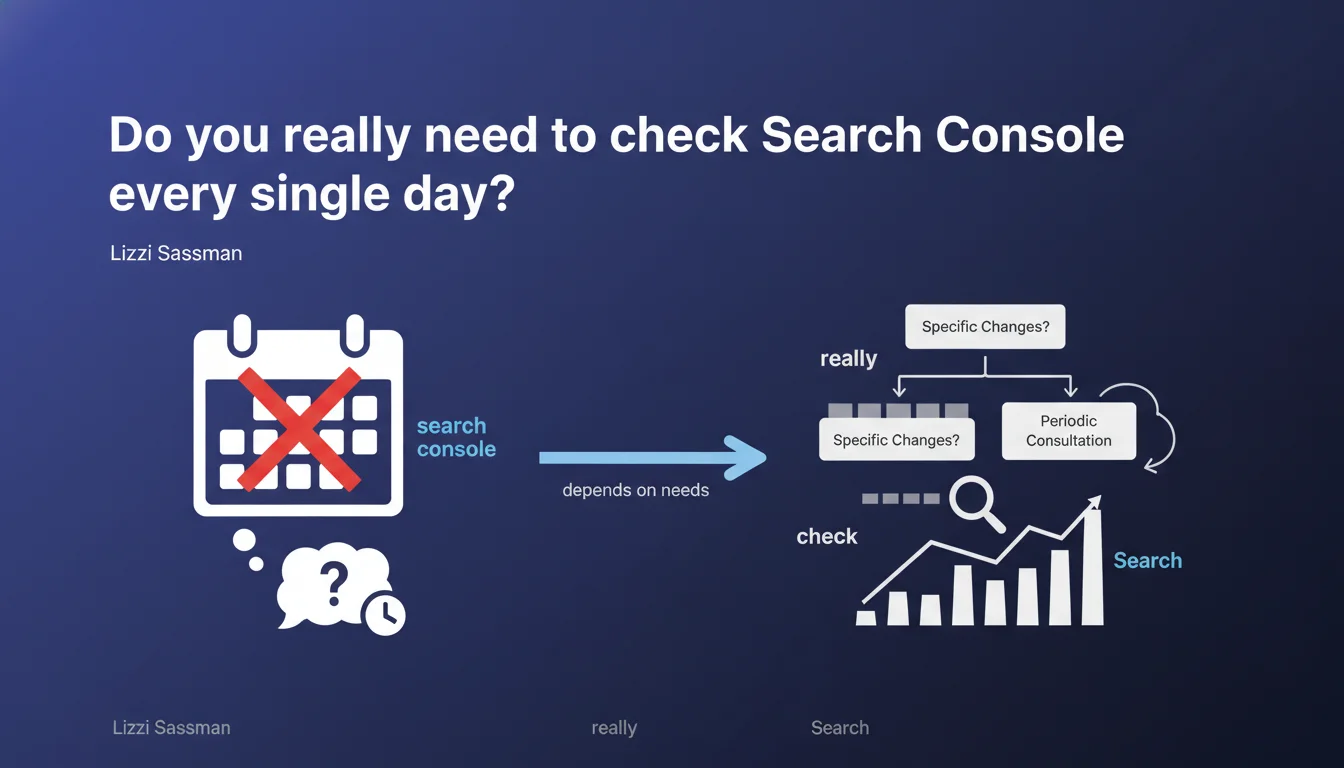
Google states that daily Search Console consultation is not necessary. The frequency depends on your objectives and site activity. A periodic approach, focused on analyzing specific changes, is sufficient according to Lizzi Sassman.
What you need to understand
Why does Google downplay the importance of daily monitoring?
This statement reflects Google's effort to defuse the anxiety that some webmasters feel facing natural fluctuations in metrics. Google knows that Search Console data varies constantly, often without alarming reasons.
The objective is to refocus attention on what matters most: underlying trends rather than daily micro-variations. A sudden drop in impressions on a Tuesday doesn't necessarily indicate a problem — it might just be a seasonal effect or a data processing lag.
What does "periodic consultation" actually mean in practice?
Google deliberately remains vague about the exact frequency. "Periodic" can mean weekly, bi-weekly, or monthly depending on your site's context. A news outlet won't operate on the same schedule as a corporate site publishing one article per quarter.
The central idea: check Search Console when you have a specific reason to do so. A content launch, a technical migration, a traffic drop detected in Analytics — these are legitimate triggers, not the compulsive habit of daily checking.
Does this position challenge current monitoring practices?
Not really. Google isn't saying monitoring is useless, but that it should be geared toward investigation, not passive surveillance. Automated alerts on key metrics remain relevant — what's being challenged is the manual daily connection "just to see what's there."
- Search Console is not a real-time dashboard — data often has a 24-48 hour lag
- Daily variations are normal and don't always warrant deep analysis
- Effective usage consists of investigating significant changes, not passive monitoring
- The optimal frequency depends on publishing rhythm, site size, and technical operations in progress
SEO Expert opinion
Does this statement actually reflect real-world practices?
Let's be honest: most experienced SEO professionals don't actually check Search Console daily, except during crises or migrations. Professional agencies have implemented automated alert systems that flag anomalies — the rest of the time, Analytics serves as the primary barometer.
But here's the catch: Google is generalizing advice that doesn't apply uniformly. An e-commerce site with thousands of products and high competitive volatility can't afford a relaxed approach. Algorithm changes, negative SEO attacks, indexing errors — all of this can explode in 24-48 hours.
What nuances should we add to this position?
The statement overlooks a crucial point: Search Console remains the sole official source for certain critical data. Crawl errors, manual penalties, Core Web Vitals issues — none of this appears elsewhere with such detail.
Saying "no need to check daily" assumes you've already automated monitoring of sensitive indicators. Without alerts configured via the API or third-party tools, this relaxed approach becomes risky. [To verify]: Google doesn't specify whether this recommendation applies to sites that recently suffered sanctions or unexplained traffic drops.
In which cases does this recommendation become dangerous?
During a technical migration, after a domain change, during the rollout of a major redesign — in these contexts, a daily check isn't a luxury, it's basic professionalism. A mislonfigured robots.txt directive can deindex 50% of your site overnight.
The same goes for sites with recurring indexation issues or content highly sensitive to timing (news, events). Google's advice clearly targets stable, mature sites without major technical operations underway — not all scenarios.
Practical impact and recommendations
What should you concretely do to optimize your Search Console usage?
First step: identify your site profile. A personal blog publishing three articles per month doesn't need a daily check. A media publishing 20 articles per day does. The consultation frequency should be proportional to your content evolution rate and the business criticality of organic traffic.
Second reflex: automate whatever can be automated. Configure alerts via the Search Console API to be notified in case of sudden click drops, explosion of 404 errors, coverage issues. Tools like Google Apps Script, Data Studio, or third-party solutions allow you to create consolidated dashboards.
Which mistakes should you avoid in your monitoring approach?
Don't fall into the trap of "daily checking out of habit" without a specific objective. If you connect mechanically, glance at the graphs without taking action, that's indeed a waste of time — Google is right on that point.
But conversely, don't drift to sleep on your laurels by claiming that Google says it's not necessary. Lack of regular consultation doesn't exempt you from having structured a monitoring process. If you have neither automatic alerts nor a weekly analysis routine, you're flying blind.
How should you adapt your consultation frequency to project phases?
Adopt a flexible approach. In normal times, a weekly or bi-weekly review is sufficient for stable sites. But intensify temporarily during sensitive phases: migration, redesign, launch of a new section, detection of an anomaly in Analytics.
Create yourself an analytical ritual that's structured rather than a compulsive connection. For example: every Monday morning, review the previous week's performance, analyze newly discovered queries, check coverage errors. It's more effective than 7 quick connections that lead nowhere.
- Define a baseline frequency adapted to your publishing rhythm and site criticality
- Set up automatic alerts on key metrics (click drops, 404 errors, indexing issues)
- Document a structured analysis protocol for periodic review sessions
- Temporarily increase frequency during sensitive technical phases (migration, redesign, infrastructure changes)
- Consolidate Search Console data with Analytics and server logs for a complete picture
- Train teams to distinguish normal variation from anomalies requiring investigation
❓ Frequently Asked Questions
Si je ne consulte pas Search Console quotidiennement, comment détecter rapidement un problème d'indexation ?
Quelle fréquence de consultation Google recommande-t-il exactement ?
Cette recommandation s'applique-t-elle aussi pendant une migration de site ?
Les données de Search Console sont-elles suffisamment à jour pour se passer d'un check quotidien ?
Un e-commerce avec forte concurrence peut-il se permettre une consultation hebdomadaire ?
🎥 From the same video 11
Other SEO insights extracted from this same Google Search Central video · published on 20/10/2022
🎥 Watch the full video on YouTube →
💬 Comments (0)
Be the first to comment.