
Official statement
Other statements from this video 11 ▾
- □ Does Google Search Central Documentation Get Special Treatment in Search Results?
- □ Do you really need to check Search Console every single day?
- □ Should you always use a 301 redirect for a permanent URL change, or are there exceptions that work better?
- □ Should you really fix every single 404 error on your website?
- □ Should you really segment your sitemaps beyond 50,000 URLs?
- □ Should you really automate hreflang tags to manage multilingual websites?
- □ Do titles and meta descriptions really influence SEO beyond just improving click-through rates?
- □ Does Google really rewrite your title tags however it sees fit?
- □ Should you really be using nofollow links in your client case studies?
- □ Do FAQ structured data really deliver rich snippets, or is Google overselling the feature?
- □ How can you accurately measure SEO success when you're making multiple changes at once?
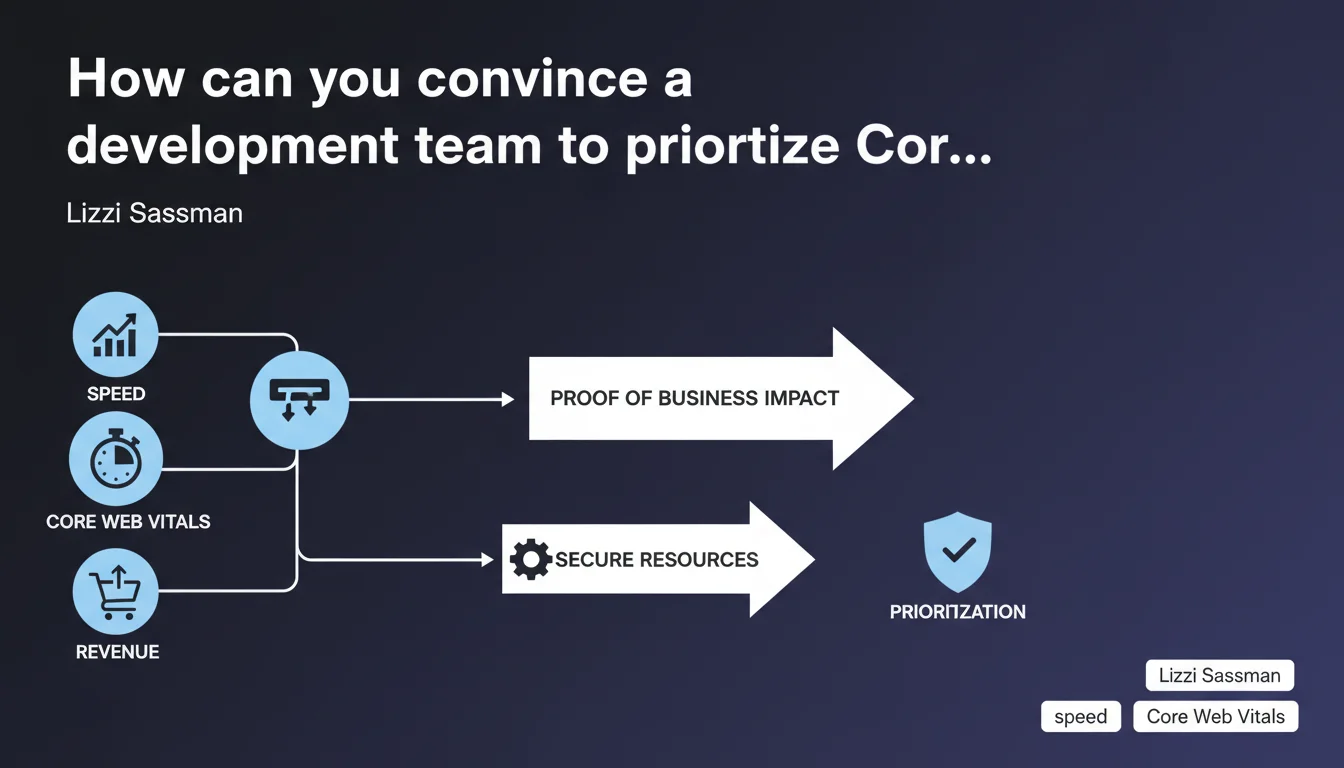
Google officially acknowledges that convincing development teams to work on Core Web Vitals requires proof of business impact. Without concrete data on ROI, obtaining technical resources remains difficult — even when Google says it's important.
What you need to understand
Why is Google formalizing an internal organizational problem faced by companies?
This statement by Lizzi Sassman isn't about an algorithm or technical directive. It acknowledges a ground-level reality: Core Web Vitals don't deploy themselves. You need to convince developers, product managers, business stakeholders — and that requires arguments that go beyond "Google said so".
Google is admitting here that its own communication about the importance of CWV isn't enough to mobilize internal teams. It's an indirect confession: SEO impact alone doesn't carry much weight against product or functional priorities in many organizations.
What does "proof of business impact" actually mean?
We're talking about quantifiable data: conversions, revenue, bounce rate, sessions per user, average order value. Not just "LCP dropped by 200ms". Developers and decision-makers want to know: how much does it make or how much does it cost not to do it.
This requires building A/B tests, tracking cohorts, correlating technical performance with business KPIs. In other words: serious analytics work, which is often missing in organizations where SEO is confined to an operational role.
What's the underlying message for SEOs?
Google is telling you indirectly: stop complaining that developers won't listen to you. If you want resources, bring proof. It's your job to build the business case, not Google's.
It's also a reminder that SEO isn't an end in itself. Core Web Vitals aren't an objective — they're a means. The objective is growth, conversion, engagement. If you don't connect the two, you'll remain unheard.
- CWV doesn't deploy without dev resources — and those resources are scarce, contested, expensive.
- Google's authority argument no longer suffices: you need measurable proof of business impact.
- SEO must learn to speak analytics and ROI, not just technical and ranking language.
- This statement validates ground-level difficulties — but doesn't solve them.
SEO Expert opinion
Is this statement consistent with what we observe in the field?
Absolutely. In 80% of companies I work with, Core Web Vitals are blocked not by lack of technical expertise, but by lack of strategic priority. The product owner wants the new conversion funnel, marketing wants their campaign, the CTO wants to reduce technical debt. CWV? "We'll look at it in Q3."
Google is acknowledging what all SEOs know: we don't have decision-making power over the development roadmap. What's new is that Google explicitly says it — and it implies that the ranking impact of CWV alone isn't strong enough to justify internal mobilization. Interesting, isn't it?
What's the trap in this communication?
Google tells you "prove business impact", but gives you no tools to do it properly. Search Console data is patchy, Google Analytics 4 is a complex beast, and properly correlating CWV with revenue requires an analytics setup that few sites have.
Worse: Google doesn't share aggregate data on the average impact of CWV on conversion or revenue. [To be verified] A few Google case studies exist (like The Economic Times), but they remain anecdotal and difficult to generalize. You're told "prove it", but you're not given the means to prove it at scale.
Should we conclude that CWV are less important than Google claims?
Not necessarily. But this statement confirms that the direct ranking impact of CWV is marginal — otherwise, SEO teams would already have the proof in hand. What really matters is UX impact, and therefore indirect impact on business metrics.
In other words: CWV won't catapult you from page 3 to position 1. But a fast site converts better, engages better, satisfies better. The SEO argument is weak; the business argument can be strong — if you build it properly.
Practical impact and recommendations
How do you build a convincing business case for CWV?
First step: measure the current state. Segment your pages by CWV performance (good / needs improvement / poor) and compare conversion rates, bounce rates, time on page, average order value. Use Google Analytics 4, Looker Studio, or an internal BI tool.
Second step: correlate performance with revenue. If pages with good LCP convert 15% better than those with poor LCP, you've got your argument. Quantify the lost opportunity: "We're losing X€ per month because 40% of our pages are too slow."
Third step: project potential gains. If improving CWV moves the conversion rate from 2% to 2.3%, calculate what that means in annual revenue. That's the number that will convince a decision-maker, not a PageSpeed score.
What mistakes should you avoid when trying to mobilize dev teams?
Don't play the false urgency card. "Google will penalize us if we don't act" — that's false, and developers know it. CWV is one signal among many, not an executioner's axe. If you oversell, you lose credibility.
Don't demand a full overhaul right away. Identify quick wins: lazy loading images, removing unnecessary third-party scripts, font optimization, CDN. Prove impact on a limited scope before asking for a major project.
Don't go it alone. Partner with the analytics team, product, marketing. The more allies and shared data you bring to the table, the more weight you carry.
What should you do concretely right now?
- Segment your pages by CWV performance level in GA4 or your BI tool
- Calculate the conversion difference between fast and slow pages
- Quantify lost revenue or lost qualified leads
- Identify 3 to 5 quick technical optimizations with low development cost
- Plan a small A/B test on a page segment to prove business impact
- Set up monthly tracking of CWV metrics and associated business KPIs
❓ Frequently Asked Questions
Les Core Web Vitals sont-ils vraiment un critère de ranking important ?
Comment prouver que les CWV impactent la conversion sans faire un test A/B complexe ?
Que faire si les équipes de dev refusent de prioriser les CWV malgré les preuves ?
Google fournit-il des données sur l'impact business moyen des CWV ?
Faut-il attendre d'avoir un site parfait en CWV avant de demander des ressources dev ?
🎥 From the same video 11
Other SEO insights extracted from this same Google Search Central video · published on 20/10/2022
🎥 Watch the full video on YouTube →
💬 Comments (0)
Be the first to comment.