
Official statement
Other statements from this video 11 ▾
- □ Does Google Search Central Documentation Get Special Treatment in Search Results?
- □ Do you really need to check Search Console every single day?
- □ Should you always use a 301 redirect for a permanent URL change, or are there exceptions that work better?
- □ Should you really fix every single 404 error on your website?
- □ Should you really segment your sitemaps beyond 50,000 URLs?
- □ Should you really automate hreflang tags to manage multilingual websites?
- □ Does Google really rewrite your title tags however it sees fit?
- □ Should you really be using nofollow links in your client case studies?
- □ How can you convince a development team to prioritize Core Web Vitals?
- □ Do FAQ structured data really deliver rich snippets, or is Google overselling the feature?
- □ How can you accurately measure SEO success when you're making multiple changes at once?
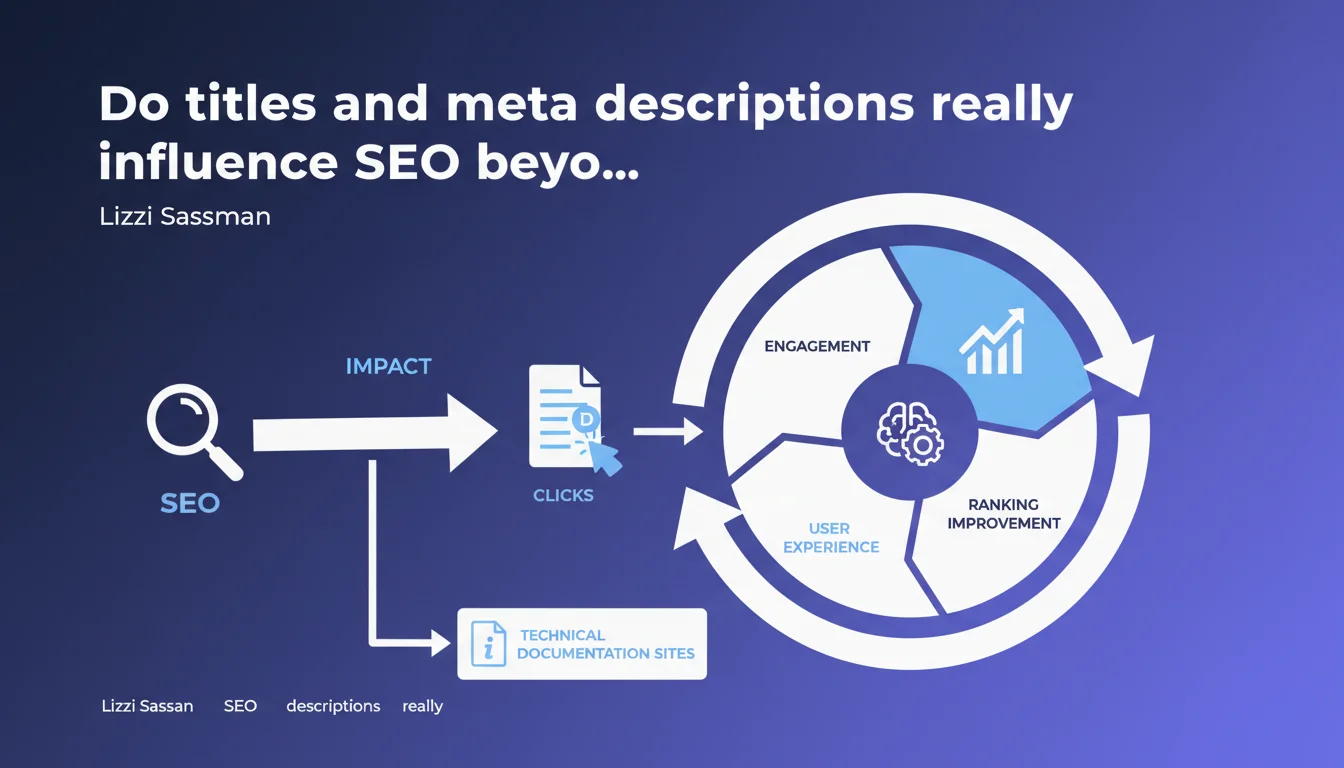
Google confirms that optimizing titles and meta descriptions has a measurable impact on SEO performance, even for technical documentation sites. The message is clear: these elements are not optional—they directly contribute to organic results. The stakes go far beyond simple CTR.
What you need to understand
Why does Google emphasize these basic elements so much?
Because too many sites still neglect these fundamentals. Lizzi Sassman specifically targets technical documentation sites, where you often see generic or missing titles. Google is reminding us that even on "serious" content, optimization remains indispensable.
The "measurable impact" mentioned suggests that Google has internal data showing a correlation between metadata quality and overall performance. It's not just about traffic—we're talking about combined signals that influence rankings.
What does "measurable positive impact" really mean?
The wording is deliberately vague. Google doesn't say whether the impact is direct (ranking factor) or indirect (better CTR → better user behavior signals → better ranking). The nuance matters.
What we know: an optimized title attracts more clicks, a good CTR sends a positive signal to Google. But the statement suggests there's more—perhaps Google analyzes semantic coherence between title, description, and content as a quality indicator.
Do technical sites have specific rules?
No, but they have particular constraints. API documentation, developer guides, knowledge bases: content is often dense and technical. The risk? Producing vague or overly long titles.
Google reminds us that even in these contexts, you must find the balance between technical precision and appeal. A title like "API Reference — Methods" is worthless. "How to use the geolocation API: methods and examples" works much better.
- Metadata influences SEO performance, not just raw traffic
- Google measures their impact but doesn't detail exact mechanisms
- Technical sites are not exempt—in fact, they have more room for improvement
- Optimization must balance precision with appeal
SEO Expert opinion
Does this statement really change anything?
Honestly? No, not for SEOs doing their job correctly. We've known for years that titles and descriptions matter. But the fact that Google repeats this while targeting technical sites shows the problem persists at scale.
What's interesting is the phrase "measurable positive impact." This suggests that Google quantifies the effect of these optimizations in its internal systems. The question remains: is this impact direct (ranking factor) or indirect (CTR → engagement → ranking)? Google doesn't tell us—and that's intentional.
Do real-world data confirm this claim?
Yes, but with caveats. Improving a title can multiply CTR by 2 or 3 on certain queries. Traffic increases mechanically. Then, if users stay and convert, Google interprets that positively.
Where it breaks down: some sites improve their metadata without seeing ranking increases. Why? Because the content behind it doesn't follow through, or competition is too strong. Titles and descriptions are a lever, not a magic wand. [To be verified] whether Google assigns direct weight to meta description quality—officially, they're not a ranking factor, but their indirect impact is undeniable.
When doesn't this rule apply fully?
On queries where Google systematically rewrites titles and descriptions. And it's frequent. You can optimize perfectly, and Google will sometimes display something else instead. Frustrating, but that's how it works.
Another case: navigational or branded queries. If someone types "Stripe API documentation," your title doesn't matter much—Stripe will rank first anyway. Optimization matters less than domain authority and raw content relevance.
Practical impact and recommendations
What should you concretely do on your pages?
Audit every strategic page and verify that titles and descriptions are present, unique, and optimized. No duplication, no generic titles like "Home" or "Page 2." Each element should be crafted for the target query.
For technical sites, translate complexity into clarity. If your page documents an obscure API function, the title should explain what it does, not just name it. "authenticate() function" becomes "How to authenticate users via the API: authenticate() method."
What common mistakes must you absolutely avoid?
Titles that are too long (Google cuts off beyond ~60 characters), empty or duplicated descriptions, and above all, promises you can't keep. If your title says "Complete Guide," the content must back it up.
Another trap: over-optimizing with keyword stuffing. "SEO Agency Paris | Paris SEO | Paris SEO Consultant"—that doesn't work anymore. Google detects and penalizes it. Prioritize readability and user intent.
How do you verify your optimizations are working?
Monitor CTR in Google Search Console. Compare before and after modifications. If CTR increases without traffic growth, your ranking isn't improving—content needs to be enhanced in parallel.
Also watch for Google rewrites. If your titles are systematically ignored, that's a signal: either they're poorly calibrated, or Google judges the content inadequate for the query.
- Audit all strategic pages: unique titles, descriptions present
- Keep titles to 60 characters, descriptions to 155-160
- Integrate the main keyword naturally, without forcing
- Verify coherence between title → description → content
- Test variations and measure CTR impact in GSC
- Avoid keyword stuffing and exaggerated claims
- Adapt tone: even on technical content, stay accessible
❓ Frequently Asked Questions
Google utilise-t-il toujours mes titres et descriptions ?
Les meta descriptions sont-elles un facteur de ranking direct ?
Faut-il optimiser les pages peu stratégiques ?
Combien de temps avant de voir l'impact d'une optimisation ?
Les sites techniques doivent-ils adapter leur vocabulaire ?
🎥 From the same video 11
Other SEO insights extracted from this same Google Search Central video · published on 20/10/2022
🎥 Watch the full video on YouTube →
💬 Comments (0)
Be the first to comment.