
Official statement
Other statements from this video 11 ▾
- □ La documentation Google Search Central bénéficie-t-elle d'un avantage dans les résultats de recherche ?
- □ Faut-il vraiment consulter Search Console tous les jours ?
- □ Faut-il vraiment toujours utiliser une redirection 301 pour un changement d'URL permanent ?
- □ Faut-il vraiment corriger tous les 404 de votre site ?
- □ Faut-il vraiment segmenter vos sitemaps au-delà de 50 000 URLs ?
- □ Faut-il vraiment automatiser les balises hreflang pour gérer le multilingue ?
- □ Les titres et meta descriptions influencent-ils vraiment le SEO au-delà du CTR ?
- □ Faut-il vraiment utiliser des liens nofollow dans vos études de cas clients ?
- □ Comment convaincre une équipe de développement de prioriser les Core Web Vitals ?
- □ Les FAQ en structured data sont-elles vraiment efficaces pour générer des rich snippets ?
- □ Comment mesurer le succès SEO quand vous modifiez plusieurs éléments en même temps ?
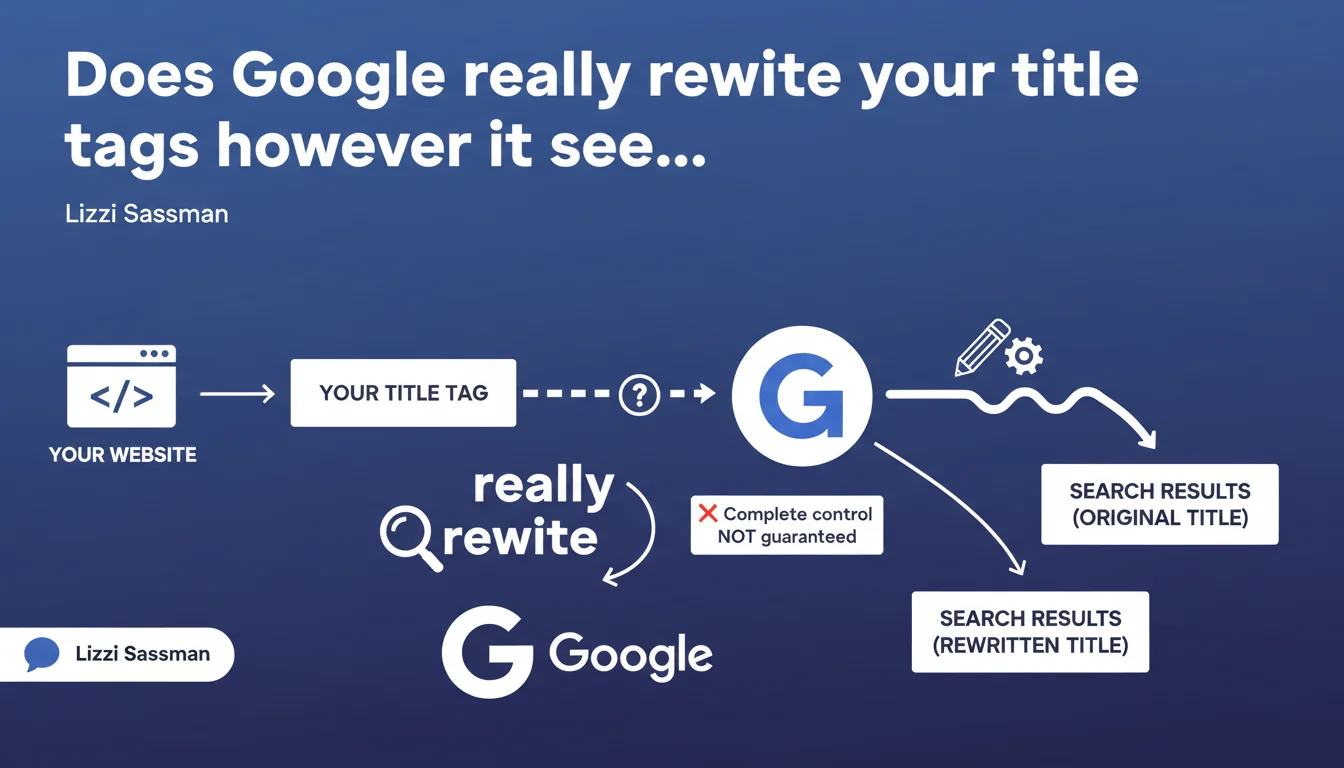
Google reserves the right to rewrite your title tags in search results, even on its own sites. No absolute control is guaranteed, regardless of how well you've implemented them. The search engine prioritizes what it deems most relevant for the user, not necessarily what you've defined.
What you need to understand
Why does Google rewrite title tags?
Google rewrites title tags to improve the perceived relevance of the result relative to the user's search query. The search engine sometimes estimates that the original title doesn't reflect the page content well enough or lacks clarity for certain search intents.
This rewrite is not a bug or anomaly. It's a documented behavior that has existed for years, but Google remains very vague about the exact criteria that trigger this modification. The algorithm draws from several sources: H1 tags, visible text content, internal or external link anchors.
What sources does Google use to rewrite a title?
Google can extract the new title displayed in search results from several elements on your page: the main H1, text fragments deemed representative, link anchors pointing to that URL, or even structured data.
The search engine doesn't follow a strict hierarchy. An external anchor can sometimes take precedence over your H1, especially if it better matches the detected search intent. This fuzzy logic makes any total control strategy illusory.
Does this rewriting affect all sites in the same way?
No. Some sites see their titles rewritten extensively, others very little. Google claims to apply the same rules to everyone, including its own properties, which confirms there's no exception or favoritism.
Sites with overly generic titles, keyword-stuffed or poorly aligned with actual content are the first affected. But even carefully implemented titles are not immune.
- Google rewrites titles to better match search intent
- Sources used include H1, text, anchors, structured data
- Even Google's own sites experience these rewrites
- No guarantee of total control exists, regardless of title quality
- Overly generic or keyword-stuffed titles are most affected
SEO Expert opinion
Is this statement consistent with what we observe in the field?
Absolutely. Field reports confirm that Google rewrites titles far more often than most realize. Some independent studies mention rewrite rates exceeding 60% on certain page corpora.
The problem is that Google provides no clear metrics in Search Console to identify these modifications. You have to manually compare your title tags with what actually appears in search results — and at scale on a large site, that's unmanageable.
What nuances should be added to this claim?
Google says it rewrites titles "sometimes," but deliberately remains vague about the precise criteria that trigger this action. [To be verified]: impossible to know if length, presence of pipes or dashes, word order actually play a decisive role.
Some SEOs have observed that very short titles (less than 30 characters) or very long ones (more than 70) are rewritten more often. But nothing is officially documented. The only certainty: semantic alignment between title, H1, and content reduces risk without eliminating it.
In what cases does this rule almost never apply?
Pure brand pages (like homepage "Brand Name | Tagline") are rarely rewritten, unless the tagline is misleading or off-topic. Very short and ultra-descriptive titles resist better.
However, as soon as you try to finely optimize a title to capture multiple intents or insert keyword variations, you increase rewrite risk. Google prefers perceived simplicity to SEO sophistication.
Practical impact and recommendations
What should you do concretely to limit rewrites?
Start by aligning title, H1, and main content. If these three elements tell the same story with similar wording, Google will have less reason to intervene.
Avoid overly long or generic titles. A 50-60 character title that's descriptive and close to your H1 limits risks. If you see massive rewrites, inspect the external link anchors pointing to your pages: they can provide contradictory signals.
What mistakes should you absolutely avoid?
Don't stuff your titles with keywords separated by pipes or dashes. Google hates that and will rewrite systematically. Also avoid hollow marketing formulas like "Best X in France | Top 10".
Don't rely on structured data (like Organization or WebSite) to force your title display. Google uses them sometimes, but without guarantees. And most importantly: don't blindly trust your title tag to measure your CTR. Verify what actually appears.
How do you verify that your titles are being displayed correctly?
Perform manual searches on your priority queries and compare with your title tags. For a large site, automate with SERP scraping tools or browser extensions that compare source title vs. displayed title.
If you spot rewrites, analyze the pattern: Is Google pulling from the H1, an anchor, text content? Adjust accordingly. Sometimes a simple title shortening is enough to regain control.
- Align title, H1, and opening paragraphs of content
- Keep your titles to 50-60 characters, descriptive and clear
- Avoid keyword stuffing and keyword lists separated by pipes
- Regularly verify what actually displays in search results
- Inspect external link anchors that can influence rewrites
- Automate monitoring to detect changes at scale
❓ Frequently Asked Questions
Google réécrit-il les titres de toutes les pages ou seulement certaines ?
Puis-je forcer Google à afficher exactement mon title tag ?
Quelles sources Google utilise-t-il pour réécrire un titre ?
Les données structurées peuvent-elles empêcher la réécriture du titre ?
Comment savoir si mes titres sont réécrits dans les SERP ?
🎥 From the same video 11
Other SEO insights extracted from this same Google Search Central video · published on 20/10/2022
🎥 Watch the full video on YouTube →
💬 Comments (0)
Be the first to comment.