
Official statement
Other statements from this video 11 ▾
- □ La documentation Google Search Central bénéficie-t-elle d'un avantage dans les résultats de recherche ?
- □ Faut-il vraiment consulter Search Console tous les jours ?
- □ Faut-il vraiment toujours utiliser une redirection 301 pour un changement d'URL permanent ?
- □ Faut-il vraiment corriger tous les 404 de votre site ?
- □ Faut-il vraiment segmenter vos sitemaps au-delà de 50 000 URLs ?
- □ Les titres et meta descriptions influencent-ils vraiment le SEO au-delà du CTR ?
- □ Google réécrit-il vraiment vos balises title comme bon lui semble ?
- □ Faut-il vraiment utiliser des liens nofollow dans vos études de cas clients ?
- □ Comment convaincre une équipe de développement de prioriser les Core Web Vitals ?
- □ Les FAQ en structured data sont-elles vraiment efficaces pour générer des rich snippets ?
- □ Comment mesurer le succès SEO quand vous modifiez plusieurs éléments en même temps ?
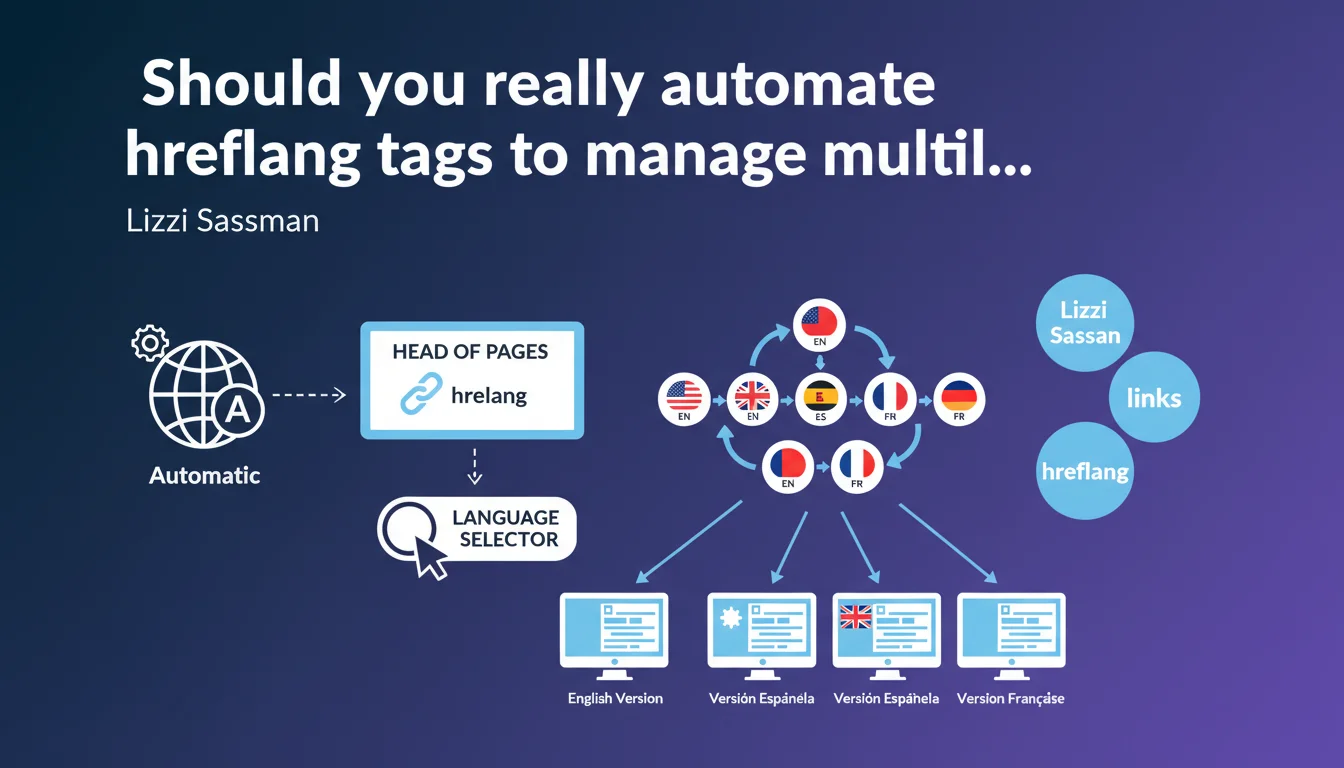
Google confirms that hreflang tags can be automatically generated in the <head> of pages to manage language versions. Clickable links in language selectors also help Googlebot discover alternative versions. In other words: automation is legitimate, but it doesn't replace a clear navigation architecture.
What you need to understand
Is hreflang automation officially validated by Google?
Yes, unambiguously. Google acknowledges that automatic implementation of hreflang tags in the
of pages is a valid practice for declaring language or regional versions of content. This applies particularly to sites using CMS platforms, frameworks, or server-side scripts that dynamically generate these tags based on page context.This statement resolves certain questions: there's no need to hardcode each tag manually. The essential requirement is that the final HTML code sent to the browser (and to Googlebot) contains properly formatted hreflang tags, regardless of whether they come from a template, plugin, or script.
Why does Google also mention clickable links in the language selector?
Because Googlebot discovers pages by following links. If a language selector contains clickable links (<a href="...">) pointing to alternative versions, the crawler can follow them and index these variants even without hreflang tags.
It's a safety net. Hreflang tags tell Google which version to serve to which audience, but they don't guarantee initial discovery. Navigable links ensure all versions are crawled. Google takes a redundant approach here: semantic signal (hreflang) + discovery signal (links).
What is the exact scope of this statement for a complex multilingual website?
It validates the technical approach but specifies nothing about the reliability of automatic implementation. A script that generates incorrect hreflang tags (wrong language codes, loops, orphaned versions) remains problematic — automation is not a guarantee of quality.
Google says "you can automate," not "automation solves everything." Responsibility remains on the implementation side: verify that generated tags are consistent, bidirectional, and complete.
- Hreflang automation is officially recognized as a valid method by Google
- Tags can be dynamically generated by CMS, plugin, or server-side script
- Clickable links in the language selector help Googlebot discover alternative versions
- Implementation quality remains critical: automating does not exempt you from validating annotation consistency
- Google combines two signals: hreflang for geo-linguistic relevance, links for crawling
SEO Expert opinion
Is this statement really a novelty or just a simple confirmation?
Confirmation. Practitioners have used automated solutions for years (Polylang, WPML, custom scripts, Next.js i18n, etc.). What changes here is that Google states it explicitly: no ambiguity about the fact that a dynamically generated tag has the same value as a manually written one.
However — and this is where it gets tricky — Google says nothing about common automation errors: duplicate hreflang, redirect loops, non-crawlable versions referenced, invalid language codes. Automation also facilitates error propagation at scale.
In what cases can automation create problems?
First case: sites with hybrid architecture. For example, a site where some pages exist in 5 languages, others in 3, others in just one. A poorly configured script can generate hreflang to 404 pages or create orphaned annotations (page A declares page B, but B doesn't declare A).
Second case: XML sitemaps with hreflang. If you automatically generate hreflang in both the
and the sitemap, and the two sources diverge (configuration error, cache, different generation timing), Google sees contradictory signals. It will likely prioritize HTML, but you're creating unnecessary noise.Third case: sites with client-side language management (JavaScript). If hreflang tags are injected after initial load (pure CSR), Googlebot may not see them, or may see them late. Automation must imperatively be server-side or SSR.
Does Google remain deliberately vague on certain aspects?
Yes. No mention of error tolerance, or of thresholds from which incorrect hreflang tags are ignored or penalize international indexing. We know from field experience that Google can ignore hreflang annotations if they're too inconsistent, but there's no official metric. [To verify] based on actual large-scale tests.
Another evasive point: the mention of "clickable links" doesn't specify whether Googlebot systematically follows these links or whether their presence influences crawl budget differently from regular internal links. We assume yes, but Google quantifies nothing.
Practical impact and recommendations
What must you do concretely to automate hreflang without risk?
First step: map your multilingual structure. List all pages, all language/regional versions available for each. Verify that each URL has a proper crawlable and indexable equivalent in other languages (no 404s, no redirects to the homepage).
Next, configure your system (CMS, framework, script) to automatically generate hreflang tags in the of each page. Ensure that each page declares all its variants, including itself (x-default if applicable). Test on a representative sample before global deployment.
Third point: make the language selector links clickable (using <a href> tags, not JavaScript buttons without href). This doubles the chance of Googlebot discovery. If your selector is in JavaScript, hydrate it server-side or via SSR so the initial HTML already contains the links.
What errors must you absolutely avoid during automation?
Error #1: Generating hreflang to URLs that are canonicalized elsewhere. If your FR page canonicalizes to another URL, it's that canonical URL which should receive the hreflang, not the non-canonical version. Otherwise Google ignores everything.
Error #2: Forgetting bidirectionality. If page A (FR) declares page B (EN), then page B must absolutely declare page A. A poorly configured script can generate one-way annotations — Google ignores them.
Error #3: Using invalid or ambiguous language codes. en-uk instead of en-gb, fr to target France when content is also relevant for French-speaking Belgium (in that case, fr-fr is more precise). Google tolerates certain approximations, but you might as well be rigorous.
How do you verify that automatic implementation works correctly?
Crawl your site with Screaming Frog, OnCrawl, or Sitebulb. Enable hreflang tag extraction. Export results and verify: does each page declare all its variants? Are declared URLs accessible (200)? Are language codes valid?
Also use Google Search Console, "International Targeting" section. Google flags hreflang errors detected there: orphaned pages, invalid codes, loops. Address each alert quickly — an hreflang problem can degrade geographic targeting for weeks.
Test manually by searching your content from different countries (VPN, search operators site: + &gl= parameter). Verify that Google serves the correct version based on location. If not, it's either an hreflang issue or a stronger competing signal (server geolocation, ccTLD, Search Console geo-targeting).
- Map all language/regional versions and their URLs
- Configure automatic hreflang generation in the
<head>(server-side or SSR) - Make language selector links clickable with
<a href>tags - Verify bidirectionality: each page must declare all its variants and be declared by them
- Validate language codes (ISO 639-1 for language, ISO 3166-1 Alpha 2 for country)
- Avoid hreflang on pages canonicalized to another URL
- Crawl the site to detect errors, orphaned pages, broken links in annotations
- Monitor Google Search Console (International Targeting) to address alerts
- Test actual geographic targeting via multi-localized Google search
❓ Frequently Asked Questions
Peut-on utiliser à la fois des hreflang dans le HTML et dans le sitemap XML ?
Les balises hreflang générées en JavaScript côté client sont-elles prises en compte par Google ?
Faut-il inclure une balise x-default dans les hreflang automatisés ?
Combien de temps faut-il à Google pour prendre en compte des hreflang nouvellement implémentés ?
Un site avec un sous-domaine par langue doit-il quand même utiliser hreflang ?
🎥 From the same video 11
Other SEO insights extracted from this same Google Search Central video · published on 20/10/2022
🎥 Watch the full video on YouTube →
💬 Comments (0)
Be the first to comment.