
Official statement
Other statements from this video 11 ▾
- □ Does Google Search Central Documentation Get Special Treatment in Search Results?
- □ Do you really need to check Search Console every single day?
- □ Should you always use a 301 redirect for a permanent URL change, or are there exceptions that work better?
- □ Should you really fix every single 404 error on your website?
- □ Should you really segment your sitemaps beyond 50,000 URLs?
- □ Should you really automate hreflang tags to manage multilingual websites?
- □ Do titles and meta descriptions really influence SEO beyond just improving click-through rates?
- □ Does Google really rewrite your title tags however it sees fit?
- □ How can you convince a development team to prioritize Core Web Vitals?
- □ Do FAQ structured data really deliver rich snippets, or is Google overselling the feature?
- □ How can you accurately measure SEO success when you're making multiple changes at once?
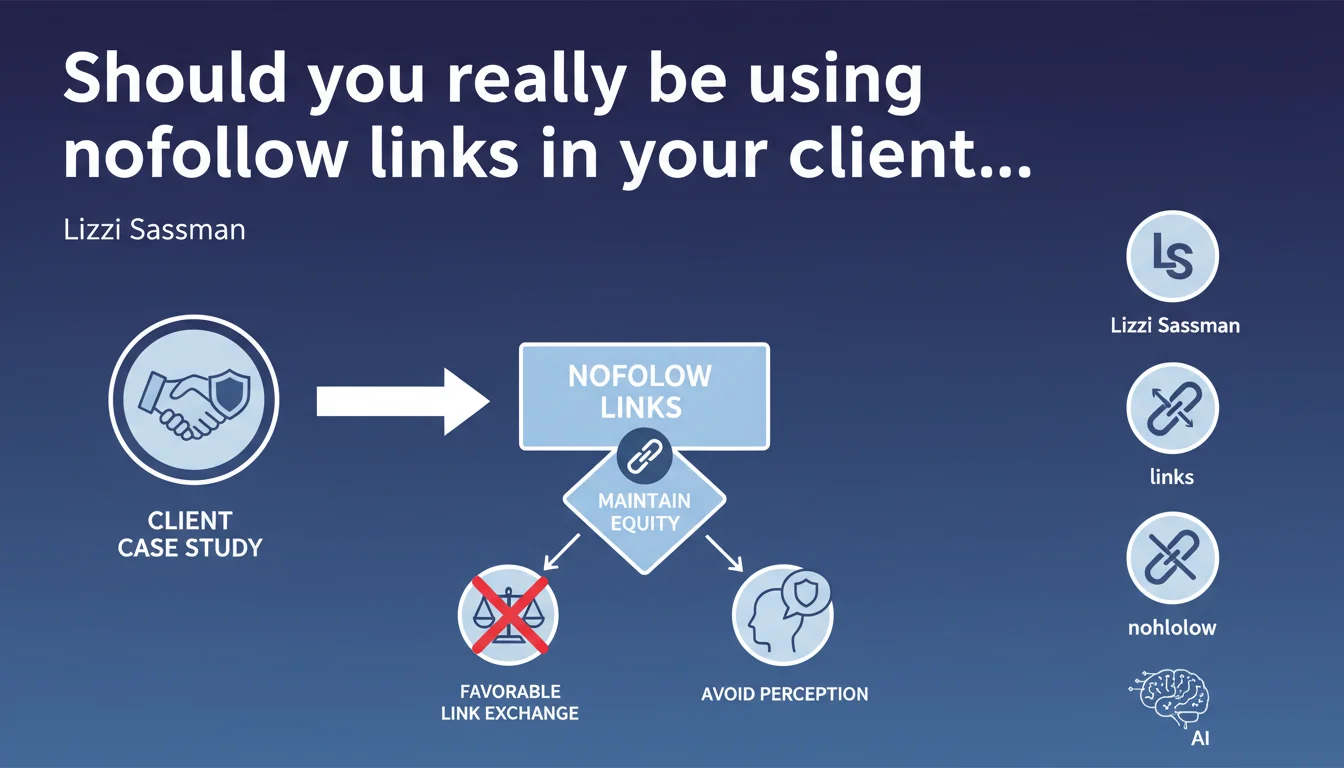
Google recommends applying the nofollow attribute to outbound links in case studies to avoid any suspicion of favorable link exchange. This directive aims to maintain fairness between featured clients and those who are not, but raises practical questions about PageRank management and partnership valorization.
What you need to understand
Why does Google care about links in case studies?
Case studies are a widely used marketing format by agencies, SaaS solution providers, and service providers. They showcase successes achieved with specific clients, often including a link to their website.
The problem? These links can be perceived as a selectively granted SEO advantage — a form of reward for clients who agree to testify publicly. Google believes this practice creates inequality: why should certain clients benefit from a dofollow backlink simply because they agreed to participate in a case study, while others don't?
What's the risk if you don't use nofollow?
Technically, nothing prevents you from using dofollow links in a case study. But Google may interpret this practice as a link scheme designed to manipulate rankings. If your site regularly publishes case studies with dofollow links, the algorithm could see a suspicious pattern.
In practice, the risk is mostly theoretical — few sites have been penalized solely for links in case studies. But Google's directive is clear: to avoid any perception of favorable exchange, it's better to qualify these links with the nofollow or sponsored attribute.
In which cases does this rule apply strictly?
- SEO and marketing agencies publishing client testimonials with systematic links
- SaaS publishers presenting user success stories on their blog
- Service providers showcasing their achievements through online portfolios
- Rating or review platforms highlighting certain profiles
- Corporate sites listing their partners or client references with hyperlinks
SEO Expert opinion
Is this directive consistent with real-world practices?
Honestly, most SEO professionals don't systematically apply nofollow to links in their case studies. Why? Because the SEO impact of these links is generally negligible. A well-written case study brings credibility and conversion above all — link juice is secondary.
But let's be clear: Google is right on principle. If you publish 50 case studies per year with dofollow links to your clients, you're creating a disguised link exchange program. The client gets a backlink, you get credibility-building content. This is exactly the type of scheme that guidelines condemn.
What nuances should be added to this recommendation?
It all depends on the editorial context. A natural mention in a blog article analyzing a use case without consideration poses no problem in dofollow. Conversely, a systematic link in a "Clients" or "Success Stories" section clearly falls under reciprocal promotion.
The distinction is subtle but essential: a one-off editorial link remains a legitimate trust signal. A repeated pattern of links to clients who testify becomes a scheme. [To verify] Google has never published a precise threshold beyond which this practice becomes problematic — that's the whole ambiguity of this directive.
When does this rule not apply?
If your case study mentions a client without a hyperlink, no problem. If you cite an external source to support your arguments — for example an industry report or statistic — the link can remain dofollow because it serves the documentary quality of your content.
Practical impact and recommendations
What should you do concretely on an existing site?
Review your published case studies and identify all outbound links to client sites. Apply the rel="nofollow" or rel="sponsored" attribute depending on whether the relationship is purely editorial or involves a commercial consideration (for example, a negotiated testimonial).
If you use a CMS like WordPress, certain plugins allow you to automate this modification in bulk. Otherwise, a well-constructed regular expression can handle dozens of pages in minutes. However, be careful not to nofollowify legitimate editorial links that have nothing to do with your clients.
What errors should you avoid during compliance?
Don't settle for a simple blind find-and-replace. Some links in your case studies may point to third-party resources (industry studies, tools, media) that deserve a dofollow link. The goal is to qualify only links to your clients or commercial partners.
Another trap: don't stack attributes without reason. A rel="nofollow sponsored" link only makes sense if both qualifications apply. In most cases, sponsored alone is sufficient for a client case study.
How can you verify that your site complies with this recommendation?
- Audit all "Case Studies", "Testimonials", "References" or "Portfolio" pages
- Identify outbound links to client or partner sites
- Apply the
rel="sponsored"orrel="nofollow"attribute depending on context - Document your internal editorial policy for future content
- Train your writers to distinguish between editorial and promotional links
- Monitor new publications to maintain consistency
❓ Frequently Asked Questions
Dois-je mettre tous les liens de mes études de cas en nofollow ?
Quelle différence entre nofollow et sponsored pour les liens dans les case studies ?
Risque-t-on une pénalité si on ne met pas de nofollow sur ces liens ?
Faut-il appliquer cette règle rétroactivement sur l'ensemble du site ?
Un lien nofollow dans une étude de cas a-t-il encore de la valeur SEO ?
🎥 From the same video 11
Other SEO insights extracted from this same Google Search Central video · published on 20/10/2022
🎥 Watch the full video on YouTube →
💬 Comments (0)
Be the first to comment.