
Official statement
Other statements from this video 11 ▾
- □ Is old content really killing your search rankings?
- □ Can old content still rank well despite its age?
- □ Should you really fix broken links in your older content?
- □ Should you really add warning banners to your older content pieces?
- □ Should you really update all your old content for SEO?
- □ Should you really let your old articles stay with their original mistakes?
- □ Should you really delete outdated content instead of simply marking it as deprecated?
- □ Is using the canonical tag as a hidden redirect costing you your SEO rankings?
- □ Why does Google discourage crypto-redirects for your site migrations?
- □ Should you redirect or create an explanatory page when discontinuing a tool?
- □ Is auditing your documentation regularly really essential to maintain strong SEO performance?
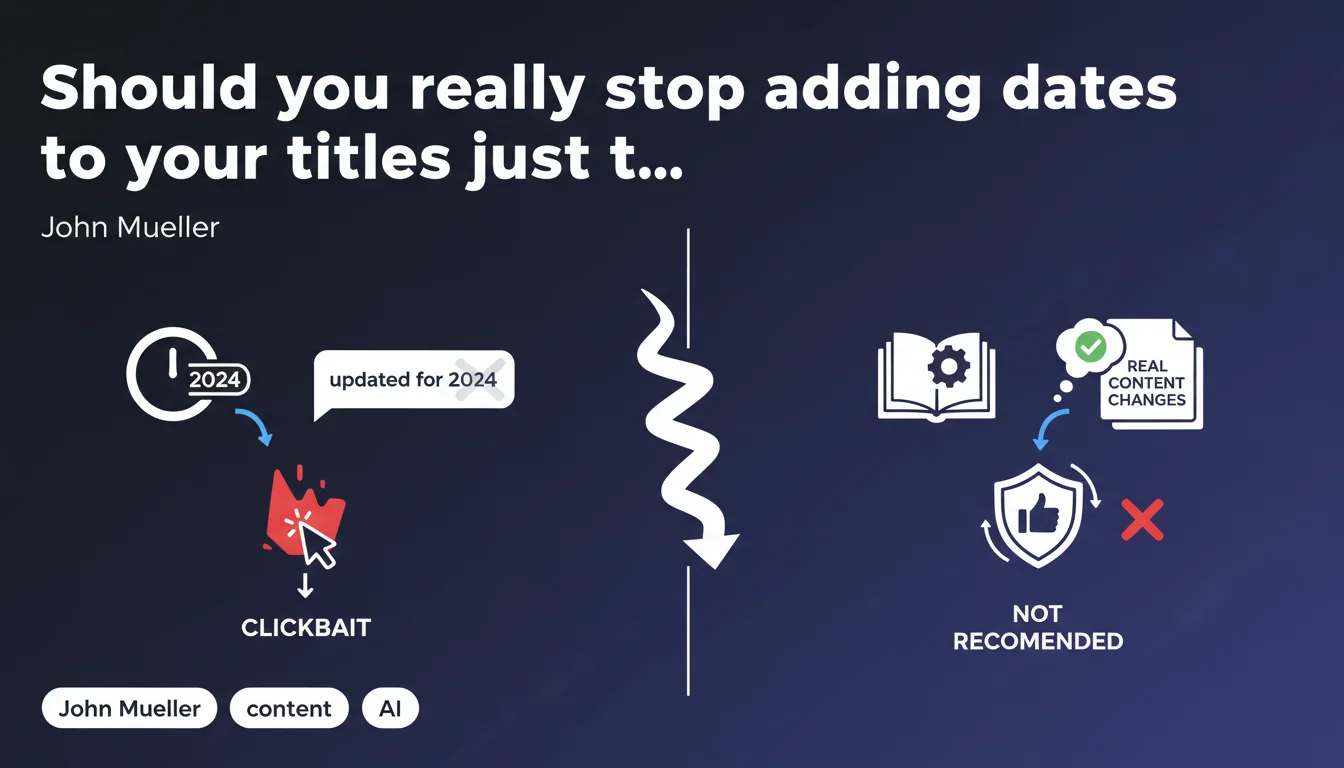
John Mueller advises against artificially adding "updated for [year]" to titles without genuinely modifying the content in depth. This practice is perceived as deceptive and resembles clickbait. Google favors authentic freshness signals rather than cosmetic tricks in title tags.
What you need to understand
Why is Google making this statement now?
Google has been fighting manipulative tactics designed to fake content freshness for years. Systematically adding dates to titles — without actual text updates — has become a widespread low-effort technique to trick the algorithm and attract clicks.
Mueller reminds us that Google analyzes far more than the title tag to assess freshness: DOM modifications, changes to text content, new backlinks, behavioral signals. A simple coat of paint in the <title> doesn't fool anyone.
What distinguishes a legitimate update from a gimmick?
The nuance lies in the scale of modifications. Revamping an in-depth article, updating statistics, adding new sections — that justifies an "updated" mention. Simply changing the year in the title without touching the body? That's outright clickbait.
Google doesn't condemn date mentions per se. It targets practices disconnected from editorial reality. The risk: being categorized as a low-value site, with all that implies for visibility.
Which freshness signals does Google actually prioritize?
Freshness algorithms (Query Deserves Freshness, notably) rely on a constellation of data: crawl frequency, volume of HTML modifications, ratio of new text to existing text, velocity of external mentions.
Authentically updated content naturally generates these signals — no need to force it in the title. Conversely, a misleading title creates dissonance between promise and reality, which engagement metrics (bounce rate, session duration) quickly reveal.
- Real freshness: substantial content modifications, addition of recent data, structural overhaul
- Temporal clickbait: cosmetic year change without body text editing
- Main risk: loss of algorithmic trust and degradation of behavioral metrics
- Valued signals: consistency between title, content, and external signals (backlinks, mentions, shares)
SEO Expert opinion
Is this position consistent with real-world observations?
Yes and no. On paper, Google is right: fake updates pollute search results. In practice, reality is more nuanced. Many industries — finance, tech, health — still see sites manipulating dates and titles without visible penalties.
The real blind spot? Google doesn't specify the modification threshold for an update to be considered legitimate. Do you need to rework 10% of the text? 30%? Is adding a section enough? [To verify] As long as Google stays vague, interpretation remains arbitrary.
In what cases does this rule not really apply?
Intrinsically temporal content: tax guides, laws, technical standards, software tutorials. Here, mentioning the year isn't clickbait — it's critical information for the user. Nobody wants to apply a 2015 Photoshop tutorial.
Another exception: pages like "Best of" or "Top X." They're updated annually by design. As long as the list actually changes, the title with year stays justified. The problem is when the list stays unchanged but the title pretends it did.
What's the real risk if you continue anyway?
Short-term? Probably nothing. Google won't blacklist a site for a dated title. But medium-term, the accumulation of negative signals — high bounce rate, low reading time, absence of real freshness signals — can degrade your domain's overall ranking.
The most insidious risk: erosion of trust. If Google classifies your site among those abusing cosmetic tactics, you lose crawl priority, indexing frequency, and benefit of the doubt during algorithm updates. It's a slippery slope.
Practical impact and recommendations
What should you concretely do with existing titles?
Start with a audit of titles containing temporal mentions. Identify those where the date isn't justified by substantial updates. Rework these titles by removing the date or replacing it with an evergreen but engaging formulation.
For genuinely updated content, keep the mention — but ensure your body text reflects this change. Add a visible editorial note ("Last updated: [date]") to reinforce consistency.
How do you avoid falling into the temporal clickbait trap?
Establish a clear editorial rule: any date mention in a title must correspond to at least 20-30% content modification. Document changes in an internal changelog to justify displayed freshness.
Use structured data (dateModified, datePublished) to explicitly signal genuine updates to Google. It's cleaner and less subject to interpretation than a title hack.
What absolute mistakes should you avoid going forward?
Don't script automatic year addition to titles. It's detectable, it looks bad, and it screams "manipulation" from every angle. If your CMS does this by default, disable that function.
Also avoid lazy recycling: take a 2019 article, change three words, and rebrand it as "2025 Guide." Google compares crawled versions — if it detects 95% similarity, you'll get no benefit.
- Audit all titles with date mentions lacking justification
- Define a minimum modification threshold (20-30% of content) to validate an update
- Add visible editorial notes specifying the date and nature of changes
- Use structured data (dateModified, datePublished) to signal updates
- Disable any automatic date addition to titles via CMS or script
- Document modifications in an internal changelog for traceability
❓ Frequently Asked Questions
Peut-on encore mentionner une année dans un title sans risque ?
Google pénalise-t-il automatiquement les titles avec année artificielle ?
Quel pourcentage de modification justifie une mention 'mis à jour' ?
Les structured data suffisent-elles à signaler la fraîcheur ?
Faut-il retirer toutes les dates des anciens articles ?
🎥 From the same video 11
Other SEO insights extracted from this same Google Search Central video · published on 09/05/2024
🎥 Watch the full video on YouTube →
💬 Comments (0)
Be the first to comment.