
Official statement
Other statements from this video 11 ▾
- □ Do Core Web Vitals Really Impact Your Content's Search Rankings?
- □ Is mobile-friendliness really no longer a Google ranking factor?
- □ Is Google really switching from FID to INP in Core Web Vitals — and should you worry?
- □ Are Core Web Vitals Really Not Enough to Guarantee a Good User Experience?
- □ Is Google's Search Generative Experience (SGE) about to completely transform how organic traffic works?
- □ Does the Rich Results Test code editor really transform how you validate structured data?
- □ Does Search Console Insights really work without Google Analytics? A game-changer for site owners?
- □ Does Google's improved video indexing report finally reveal the real blocking issues?
- □ Should you really stop using the ping endpoint to submit your sitemaps?
- □ Why is Google documenting a new generic crawler and revealing its IP addresses?
- □ Should you rethink your domain strategy now that .ai has become a generic ccTLD?
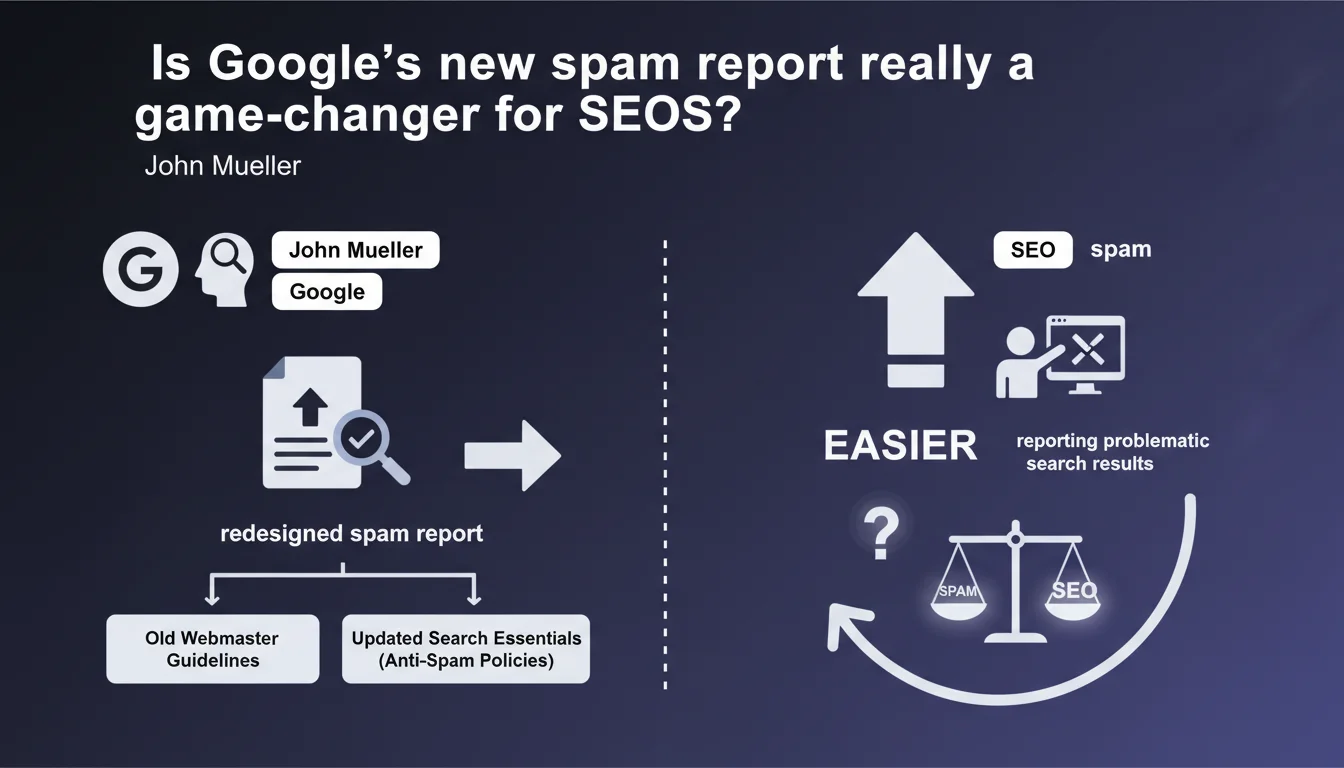
Google is redesigning its spam report in Search Console and updating its anti-spam policies (formerly Webmaster Guidelines, now Search Essentials) to simplify the reporting of problematic search results. The stated goal: make it easier for users and SEOs to report content that violates the rules. In practical terms, this means Google wants to involve users and SEOs more actively in spam detection — and potentially enforce its policies more strictly.
What you need to understand
Why is Google redesigning its spam report now?
Google has never stopped refining its anti-spam tools, but this redesign comes at a time when the volume of automatically generated content is exploding. The company is betting on a collaborative signal: the simpler reporting becomes, the more effective spam detection is at scale.
The change in vocabulary — Search Essentials instead of Webmaster Guidelines — also marks a desire to modernize the discourse. We're moving from a prescriptive tone to a framework of essential recommendations, meant to be clearer for newcomers.
What does this policy update actually contain?
Search Essentials now group together technical rules, content best practices, and explicit prohibitions (cloaking, hidden text, link networks, mass-generated content, etc.). The documentation has been restructured for better readability, with more examples and direct links to Search Console reports.
The spam report itself offers a more intuitive interface to report a suspicious result: fewer required fields, simplified navigation, faster feedback. Google is trying to lower the barrier to entry so that more stakeholders report problematic cases.
What are the direct implications for a site already in compliance?
If your site respects the fundamentals — no black hat techniques, original content, clean link building — this update doesn't change your day-to-day operations. It clarifies gray areas for those still testing certain borderline practices.
On the other hand, it increases pressure on sites playing at the edges of policy. Google is sharpening its detection tools and counting on the community to identify blind spots. Expect manual actions to increase in the coming months, especially against AI content farms and poorly disguised PBNs.
- Redesign of the spam report to facilitate reporting by users and SEOs
- Search Essentials replaces Webmaster Guidelines, with reorganized documentation
- Clarification of prohibitions: cloaking, hidden text, mass-generated content, link networks
- Collaborative signal: Google relies on the community to detect spam at scale
- No immediate impact for compliant sites, but increased pressure on borderline practices
SEO Expert opinion
Is this statement consistent with what we observe in the field?
Yes and no. Google has indeed intensified manual actions in recent months, particularly on minimally reworked AI content and satellite sites. The spam report redesign fits this logic of increased severity. But — and this is where it gets sticky — we still see content farms ranking smoothly on competitive queries, while clean sites get penalized for minor infractions.
The problem isn't so much the clarity of the rules as their unequal application. Making reporting easier won't help if the algorithm or manual reviewers keep letting flagrant cases through. [To verify] whether this redesign comes with strengthened manual review teams or if it's just a cosmetic makeover.
What nuances should we add to this official message?
Google presents this update as a gesture of openness — "we're simplifying, clarifying, listening to you." Let's be honest: it's also a way to delegate part of the detection work to the community. More reports = fewer internal resources needed to identify abuse.
Another nuance: Search Essentials remain intentionally vague on certain points. For example, the boundary between "useful content generated with AI assistance" and "automated spam" is still not operationally defined. Google reserves the right to interpret on a case-by-case basis — leaving an uncomfortable gray area for practitioners who want to play clean.
In what cases doesn't this rule really apply?
Large players — authority sites, established media, tech platforms — always benefit from greater tolerance. We see it in the field: practices that would warrant manual action on a medium-sized site pass without issue at an established publisher. Google talks about fairness, but the algorithm incorporates a de facto premium for notoriety.
Similarly, certain verticals — finance, health — are closely scrutinized, while other sectors seem less monitored. If you operate in an unmonetized or low-profile niche, the chances that obvious spam will be quickly detected remain low, even with an improved reporting tool.
Practical impact and recommendations
What should you actually do after this announcement?
Re-audit your content practices in light of the updated Search Essentials. Verify that your pages respect explicit prohibitions: no hidden text, no cloaking, no deceptive redirects. If you have automatically generated content, make sure it provides real and differentiating value, otherwise mark it as noindex or remove it.
Review your inbound link profile. PBNs, massive link exchanges, over-optimized anchors are in the crosshairs. Disavow toxic backlinks and prioritize an organic link-building strategy based on authentic editorial relationships.
What mistakes should you avoid to stay out of the firing line?
Don't play with unreworked AI content. Google knows how to spot automatic generation patterns, especially if the text lacks editorial structure or verifiable sources. Every article should be reviewed, enriched, sourced — and most importantly, answer a specific user intent.
Also avoid on-page over-optimization tactics: keyword stuffing, repetitive internal anchors, clone satellite pages. Google has decades of data on these practices. They don't work anymore — or barely — and the risk isn't worth it.
How do I verify my site complies with the new requirements?
Check the spam report in Search Console. If you have a manual action in progress, fix it immediately and request a reconsideration. If everything looks green, stay vigilant: the absence of notification doesn't mean your site is safe from future reports.
Conduct a comprehensive SEO audit by cross-referencing multiple sources: Screaming Frog to detect technical issues, Ahrefs or Majestic to analyze your link profile, Google Analytics and Search Console to identify low-engagement pages (potential signal of weak content). Cross-reference this data with the Search Essentials criteria.
- Re-audit automatically generated content and rework or deindex it
- Verify the absence of hidden text, cloaking, deceptive redirects
- Clean up your link profile: disavow toxic backlinks, avoid PBNs
- Review and enrich every AI article before publication
- Consult the spam report in Search Console regularly
- Conduct a complete technical and editorial SEO audit every quarter
- Avoid keyword stuffing and on-page over-optimization
❓ Frequently Asked Questions
Le rapport de spam remplacé permet-il de signaler un concurrent ?
Les Search Essentials sont-elles plus strictes que les anciennes Webmaster Guidelines ?
Faut-il s'attendre à plus d'actions manuelles dans les prochains mois ?
Un contenu généré par IA est-il automatiquement considéré comme spam ?
Comment savoir si mon site a été signalé par un tiers ?
🎥 From the same video 11
Other SEO insights extracted from this same Google Search Central video · published on 05/07/2023
🎥 Watch the full video on YouTube →
💬 Comments (0)
Be the first to comment.