
Official statement
Other statements from this video 11 ▾
- □ Does Google really index your PDFs, or does it transform them first?
- □ Does content weight really vary based on its location in HTML versus PDF?
- □ Does Google really depend on Adobe to properly index your PDFs?
- □ Does Google really index source code files the same way as regular text content?
- □ Should you really stop storing all your PDFs in a single /pdfs/ folder?
- □ Does Google Really Never Index a Single Image Without a Hosting Page?
- □ Does Google really index images and videos separately from text content?
- □ Does Google really filter out personal data before indexing your pages?
- □ Does your file extension (.html, .php, .txt) really impact Google SEO rankings?
- □ Does Google really index all your XML files?
- □ Can you really get JSON and plain text files indexed in Google search results without metadata?
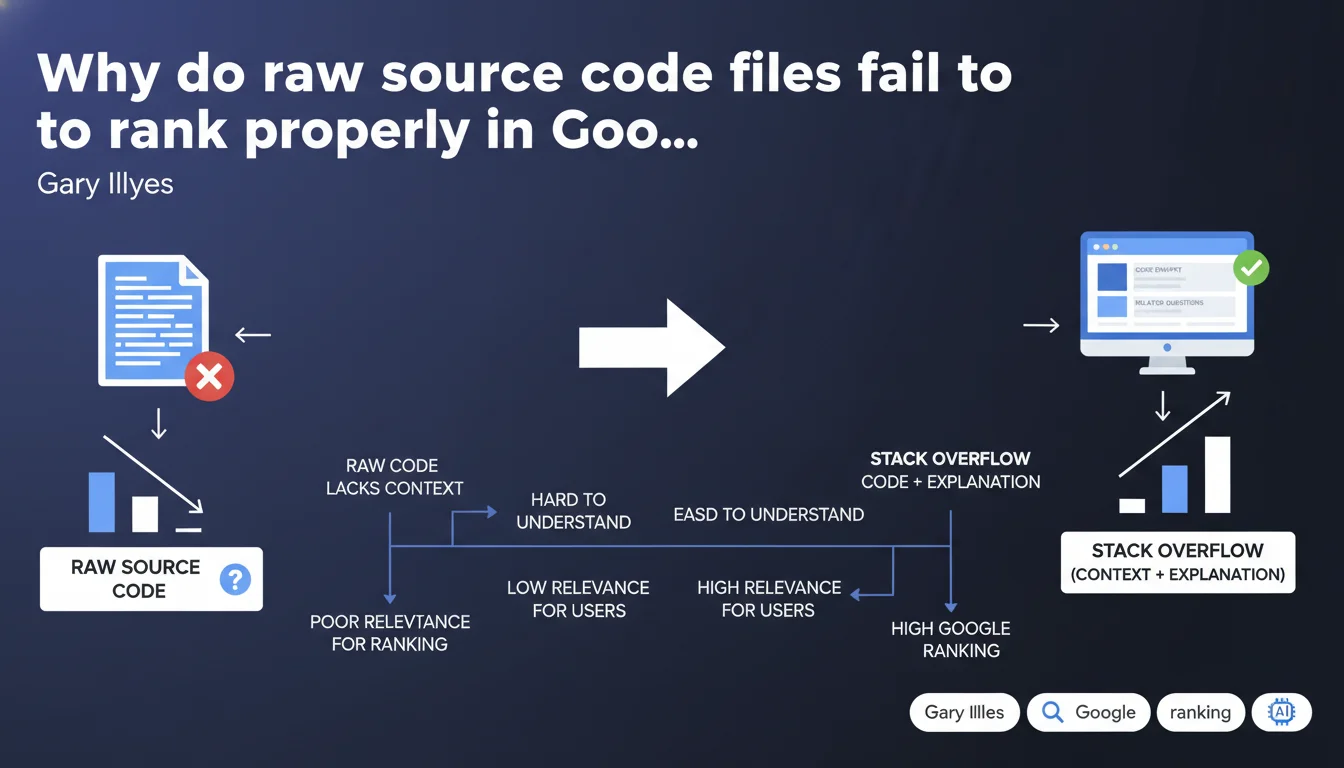
Google explains that raw source code files struggle to rank well due to their technical structure and lack of editorial context. Platforms like Stack Overflow are favored because they frame code with explanations, discussions, and contextual content that help the algorithm understand user search intent.
What you need to understand
Why does Google penalize raw code files?
Gary Illyes' statement highlights a structural limitation of the search engine when facing pure source code. An isolated JavaScript, Python, or CSS file contains no editorial signals — no explicit title, no meta description, no semantic context.
Google doesn't technically "penalize" these files, but its algorithm lacks reference points to evaluate relevance against a user query. A `.js` or `.php` file hosted alone says nothing about the problem it solves or its use cases.
What distinguishes Stack Overflow from a GitHub file?
Stack Overflow provides what raw code lacks: an editorial framework. Each code snippet is accompanied by a question, an answer explaining the logic, comments, and community votes.
This structure allows Google to identify the intent behind the code ("how to sort an array in JavaScript"), evaluate quality through social signals, and deliver an actionable answer for the user.
What signals does Google use to rank technical content?
Beyond the code itself, Google relies on contextual signals: page titles, `
` tags, descriptions, surrounding text, internal links, and discussion depth.
A GitHub repo with a structured README, commented examples, and technical documentation has better chances of ranking than an isolated `.py` file. Context transforms code into an indexable resource.
- Raw code files lack editorial signals for Google to assess their relevance
- Platforms like Stack Overflow add context: questions, answers, votes, explanations
- Google prioritizes pages that frame code with semantic elements (titles, descriptions, discussions)
- A repository with detailed documentation performs better than an isolated file
SEO Expert opinion
Does this statement really reflect what we observe in practice?
Yes, and it's consistent with indexed behaviors we've seen for years. Code snippets that rank in the top 10 almost always come from editorial pages — tutorials, official documentation, technical forums.
Raw files hosted on GitHub or Bitbucket rarely appear on the first page, unless they're massively linked or mentioned in influential discussions. Even then, Google prefers to display the repo page (with README) rather than the isolated `.js` file.
What nuances should we add to this statement?
Gary Illyes doesn't specify whether Google actively devalues code files or if it's simply a lack of positive signals. [To verify] — the difference matters for technical content strategies.
Another point: certain configuration files (`.htaccess`, `robots.txt`, `sitemap.xml`) are technically code but benefit from specific recognition by Google. Illyes' generalization overlooks this category.
In what cases doesn't this rule apply?
Queries like "[exact filename] GitHub" or "[specific function] source code" can surface raw files if the search intent is explicit. But these cases remain marginal.
Similarly, official documentation pages (MDN, Python.org) that present code in a structured context escape this limitation. Code there is an illustrative element, not the primary content.
Practical impact and recommendations
What should you do if you publish code on your site?
Frame each code snippet with clear editorial context. Add an explicit title (`
`), an introduction explaining the problem solved, and a conclusion paragraph on use cases.
Use `
` tags for code, but don't stop there. Complement with inline comments, implementation examples, and links to official documentation.- Add a descriptive `
` title for each page containing code
- Write a 2-3 paragraph introduction explaining the context and objective
- Use `
` and `` subheadings to structure explanations
- Comment the code directly within snippets for easier understanding
- Include real-world usage examples and practical use cases
- Add an FAQ section to anticipate common questions
- Create internal links to other technical resources on your site
What mistakes should you absolutely avoid?
Never publish an isolated code file without a landing page or README. A `.js` file accessible via direct URL has no chance of ranking on generic queries.
Also avoid duplicating code from GitHub without adding editorial value. Google detects duplicate content, and you'll lose against the original source which already has age and backlinks.
How can you verify that your technical content is optimized?
Test your pages in Google Search Console: if your code snippets generate impressions but zero clicks, that's a signal that the title or meta description lacks contextual clarity.
Compare your rankings with those of Stack Overflow or official documentation on the same queries. If you're systematically below them, it means your page is missing editorial signals.
The key to ranking technical code: transform each snippet into a complete editorial resource. Code should illustrate an explanation, not be its only content. If you're hosting a code library or complex technical documentation, structuring this architecture optimally while preserving user experience requires pointed expertise. For large-scale projects, partnering with an SEO agency specializing in technical content can make the difference between an invisible repo and a sector-wide reference.❓ Frequently Asked Questions
Les fichiers hébergés sur GitHub peuvent-ils quand même apparaître dans Google ?
Faut-il éviter de publier du code directement sur son site ?
Stack Overflow a-t-il un avantage structurel dans Google ?
Les balises de code HTML influencent-elles le classement ?
Peut-on optimiser un fichier de code pour le SEO sans ajouter de texte ?
🎥 From the same video 11
Other SEO insights extracted from this same Google Search Central video · published on 08/09/2022
🎥 Watch the full video on YouTube →
💬 Comments (0)
Be the first to comment.