
Official statement
Other statements from this video 12 ▾
- □ Does Google really rewrite your title tags whenever it wants?
- □ Can heading tags really replace your title tag in the SERPs?
- □ Can external anchor texts really take over your title tags in Google search results?
- □ Can Google really use your alt tags and meta descriptions to build your snippets?
- □ How can you disable snippet display in Google search results using the nosnippet tag?
- □ Can you really control how long your snippets appear in Google search results with max-snippet?
- □ How can you prevent specific content from showing up in your Google snippets?
- □ Does your URL structure really impact how Google displays breadcrumbs in search results?
- □ Can you actually control how your site name appears in search results using structured data?
- □ Does your favicon really impact your site's SEO performance in Google search results?
- □ Does Google really respect your publication dates… or does it just make them up as it goes?
- □ Why does Google display multiple links from the same domain underneath a single search result?
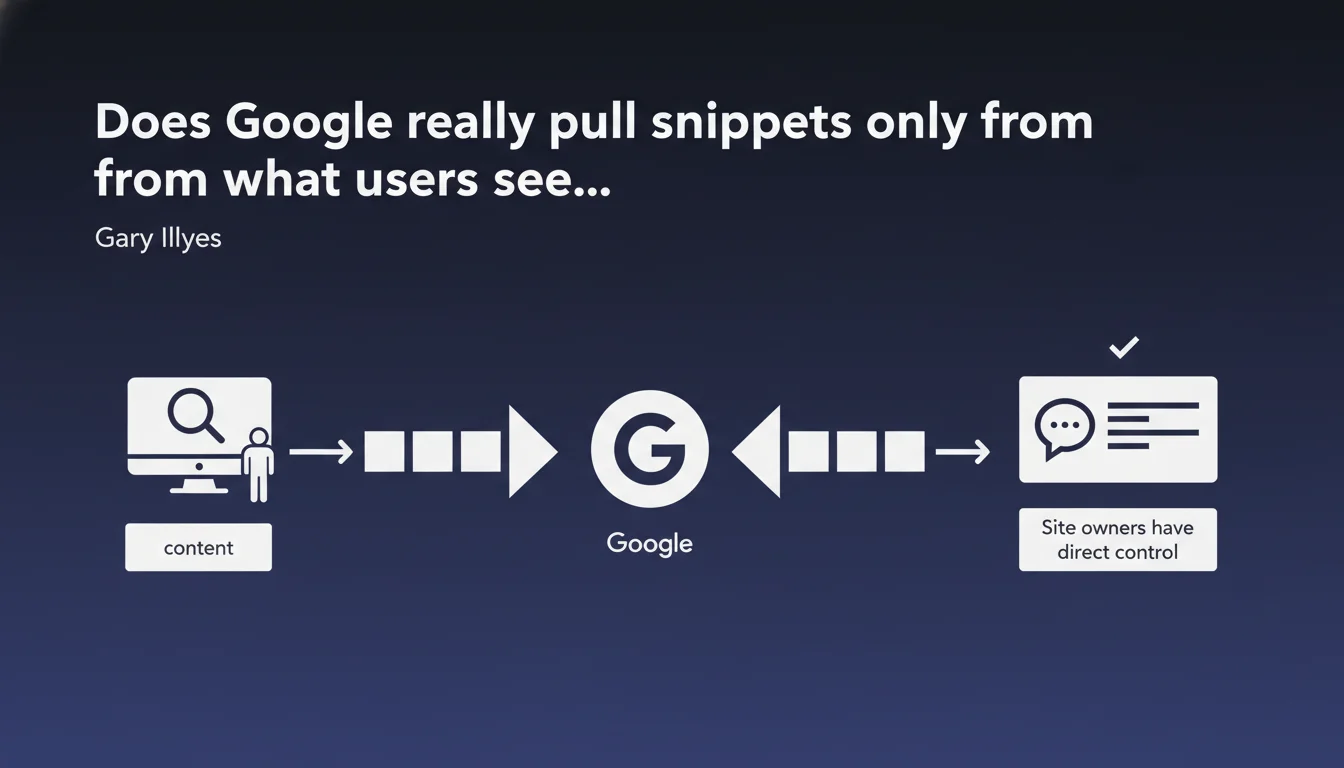
Google claims that snippets displayed in SERPs come exclusively from content visible to the user upon arriving on the page. Site owners therefore have direct control over this text through their content. This statement suggests that no hidden or technical content influences snippet generation.
What you need to understand
What does "visible content" mean to Google?
When Google talks about visible content, it's referring to what a user sees when landing on a page, without any additional interaction. No tab clicks, no infinite scrolling — just the initial viewport.
This definition excludes content hidden via CSS (display:none), JavaScript-loaded content after initial rendering, or text concealed within closed accordions. Google draws from what naturally displays on screen.
Why emphasize direct control?
Gary Illyes insists: you control the snippet because it comes from your content. No external manipulation, no algorithm inventing text from third-party sources. The message is clear: if the snippet doesn't suit you, first look at what your page actually contains.
This statement also serves to remind that meta description tags are merely a suggestion. Google can (and often will) prefer an excerpt from your page content if it deems it more relevant to the search query.
What are the implications for snippet optimization?
If snippets come from visible content, then the editorial structure of your pages becomes critical. First paragraphs, H2/H3 headings, bullet-point lists — everything appearing above the fold or in the first scrolls — can be picked up by Google.
- Snippets are not generated from hidden or technical content
- Meta description remains a lever, but not a guarantee
- Visible content structure directly influences what displays in the SERP
- Google adapts the snippet to the user's query by drawing from your content
SEO Expert opinion
Is this statement consistent with real-world observations?
Broadly speaking, yes. In the majority of cases, snippets we see in SERPs actually correspond to excerpts from the visible content of the page. Google often pulls from opening paragraphs, introductions, or sections that directly answer the search intent.
But — and this is where it gets sticky — this statement is too categorical. We regularly observe snippets that include elements from less visible areas, or even from content loaded via JavaScript after initial rendering. [To be verified] on complex sites with dynamic content.
What nuances should we add?
Gary says "generally," which leaves room for interpretation. In practice, Google can also use structured data (schema.org) to enhance snippets, particularly rich snippets. This data isn't "visible" in the classical sense, but it influences display.
Another point: the notion of "visible" depends on technical context. Content loaded via JavaScript but rendered server-side (SSR) will be considered visible. Content in lazy loading that appears after scrolling can also be picked up if Google has crawled it.
In which cases doesn't this rule apply?
First exception: rich snippets generated from structured data. A recipe, FAQ, or product snippet will draw from schema.org markup, not solely from visible text. Google then assembles an enriched display that goes beyond a simple excerpt.
Second case: answer box snippets (featured snippets). Google may rephrase or extract a very specific portion of content, even if it doesn't appear immediately on screen. Here, semantic relevance takes priority over viewport position.
Practical impact and recommendations
What should you do concretely to optimize snippets?
First rule: care for your above-the-fold content. Your page's opening paragraphs should be clear, concise, and directly address search intent. That's where Google will prioritize drawing from.
Next, write a relevant meta description even if it won't always be used. It serves as a safety net when Google doesn't find a satisfactory text excerpt. Keep it under 155-160 characters to avoid truncation.
Finally, structure your content with clear H2/H3 headings and bullet-point lists. Google loves scannable formats and can directly extract these elements to build a coherent snippet.
What mistakes should you avoid?
Don't hide strategic content in CSS or in accordions closed by default if you want it to appear in a snippet. Google may index it, but likely won't use it for SERP display.
Also avoid hollow or overly long introductions. If your first paragraph is generic filler, that's what Google will display — and your click-through rate will suffer. Be direct from the very first lines.
- Place key information in the first visible paragraphs
- Write a meta description of 155-160 characters, even if it's not guaranteed
- Use clear H2/H3 headings and lists to structure content
- Avoid hidden content (display:none, closed accordions) for strategic information
- Test your snippets in real situations via Google Search Console
- Adapt visible content based on target queries
How do you verify your site is compliant?
Use Google Search Console to see which snippets are currently displayed for your main pages. Compare them with your pages' visible content. If snippets aren't relevant, it's often because your above-the-fold content lacks clarity.
Also test with Google's Rich Results Test tool to verify your structured data is properly recognized. If you're targeting rich snippets, this is essential.
❓ Frequently Asked Questions
Google utilise-t-il toujours la meta description pour le snippet ?
Le contenu dans un accordéon fermé peut-il apparaître en snippet ?
Les données structurées influencent-elles les snippets ?
Comment forcer Google à utiliser ma meta description ?
Le contenu chargé en JavaScript est-il considéré comme visible ?
🎥 From the same video 12
Other SEO insights extracted from this same Google Search Central video · published on 23/04/2024
🎥 Watch the full video on YouTube →
💬 Comments (0)
Be the first to comment.