
Official statement
Other statements from this video 12 ▾
- □ Google réécrit-il vraiment vos balises title à sa guise ?
- □ Les anchor texts externes peuvent-ils vraiment remplacer vos balises title ?
- □ Les snippets proviennent-ils vraiment uniquement du contenu visible de la page ?
- □ Google peut-il vraiment utiliser vos balises alt et meta descriptions pour composer vos snippets ?
- □ Comment désactiver l'affichage des snippets dans les résultats Google avec la balise nosnippet ?
- □ Peut-on vraiment contrôler la longueur des snippets dans les SERP avec max-snippet ?
- □ Comment empêcher un contenu spécifique d'apparaître dans vos snippets Google ?
- □ Faut-il restructurer ses URLs pour optimiser l'affichage du fil d'Ariane dans Google ?
- □ Peut-on vraiment contrôler le nom de son site dans la SERP avec les données structurées ?
- □ Le favicon influe-t-il réellement sur les performances SEO de votre site ?
- □ Google estime-t-il vraiment la date de vos contenus… ou l'invente-t-il ?
- □ Comment Google affiche-t-il plusieurs liens d'un même domaine sous un résultat de recherche ?
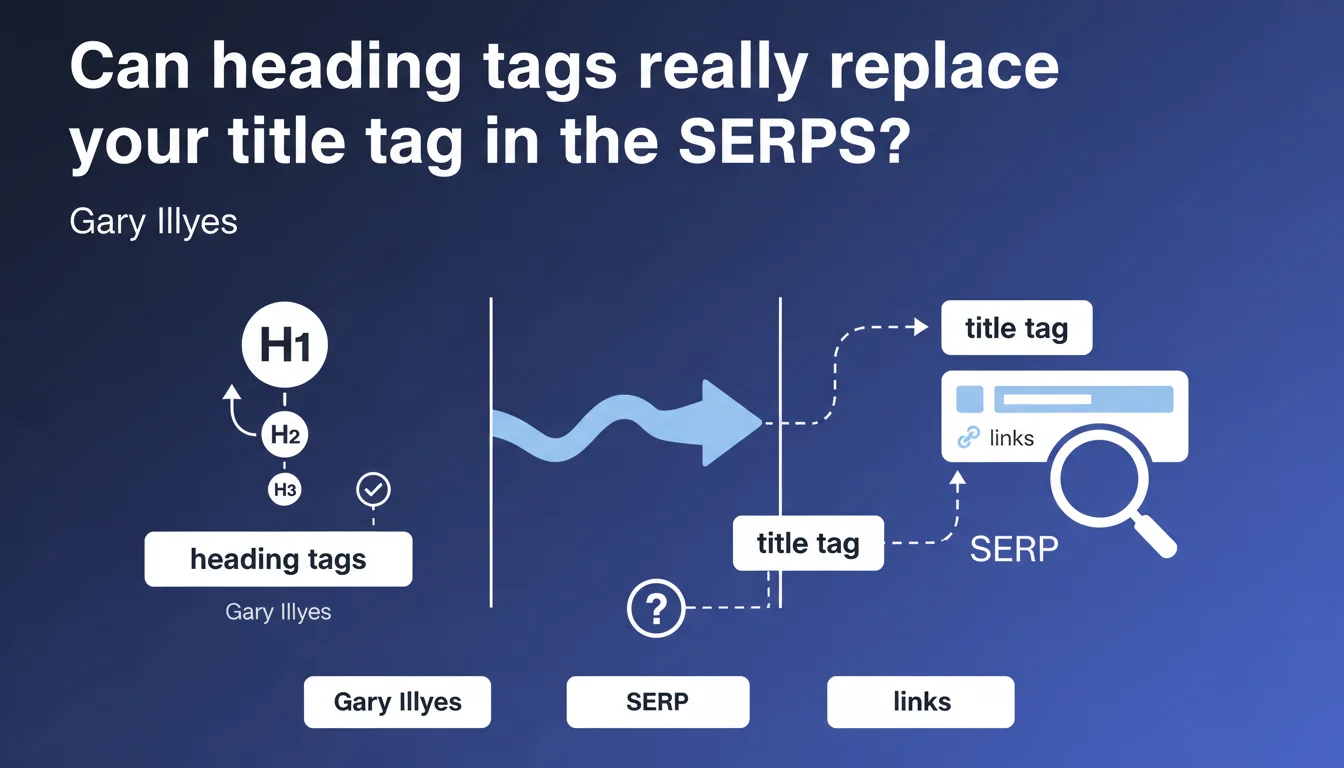
Google can generate the title links displayed in the SERPs from the heading tags (H1, H2, etc.) present on your pages, and not solely from the <title> tag. This means you maintain direct control over these elements — provided you structure your headings strategically. In practice: your H1-H6 are no longer just a matter of semantic hierarchy, they become a lever for optimizing title links.
What you need to understand
Why does Google dig into headings to generate title links?
Google no longer simply blindly copies your <title> tag. For years, the algorithm has been rewriting the titles displayed in the SERPs when it judges that the title tag is too long, stuffed with keywords, or disconnected from the actual content of the page.
Gary Illyes's statement confirms that heading tags (H1, H2, H3, etc.) are among the sources used for this replacement. And it's good news: you can structure your headings to guide what Google will display, instead of suffering an unpredictable algorithmic rewrite.
Which headings does Google prioritize exactly?
Google doesn't specify the exact order of priority, but field observations show that the H1 is often the first candidate, followed by the first H2 if the H1 is deemed insufficient or redundant. H3-H6 rarely come into play, unless the page lacks structuring headings upstream.
What matters: the semantic relevance of the heading relative to the query, its position in the DOM, and its length. An H1 of 120 characters has little chance of being taken up in full — Google will truncate it or look elsewhere.
Does this call into question the importance of the title tag?
No. The <title> tag remains the priority signal for Google, and it is still used in the majority of cases. What this statement confirms is that Google has a fallback system: if your title is problematic, it will look in your headings.
Let's be honest: you cannot control 100% of what Google will display. But by optimizing both your title tag and your headings, you maximize your chances that the final title link will be coherent, attractive, and aligned with your SEO intent.
- Title links can come from H1, H2, and more rarely H3-H6 tags
- Google uses headings as an alternative when the title tag is deemed insufficient or not relevant
- The
<title>tag remains the priority signal in the majority of cases - You maintain direct control over what Google can display by structuring your headings strategically
- A well-formulated heading can improve the CTR if Google chooses it as a title link
SEO Expert opinion
Is this statement consistent with field observations?
Yes, and it only confirms what SEO professionals have been observing for several years. Google rewrites title links in approximately 60 to 80% of cases according to studies, and heading tags are among the most frequent replacement sources — alongside backlink anchor texts and visible page text.
What's interesting here is that Gary Illyes insists on the fact that you maintain direct control. It's an important nuance: Google doesn't generate these titles randomly, it relies on elements that you can structure. But be careful — [To be verified]: the notion of "direct control" remains relative. Even with perfectly optimized headings, Google can still decide to pull from elsewhere.
What are the limitations of this approach?
The problem is that Google gives no guarantees. You can have a perfectly optimized H1, and Google will still choose to rewrite the title link by pulling from a secondary H2, or even from a piece of visible text. The selection criteria are not public, and they vary depending on the queries.
Another point: this statement says nothing about the relative weighting of headings compared to the title tag. We know that <title> remains prioritized, but to what extent? And for which types of queries does Google switch to headings? No clear answer — as usual.
<title> tag by telling yourself that your headings will compensate. Google gives no guarantee, and the title tag remains the most reliable signal to control your title links. Headings are a safety net, not an alternative.Should you therefore optimize all your headings like SERP titles?
No, and that's where it gets tricky. Your headings first have an editorial and structural function: they must organize content for the user, not serve as a reservoir for title links. If you start stuffing your H1-H2 with keywords hoping that Google will display them in the SERPs, you risk degrading user experience.
The healthiest approach: formulate your headings in a natural and informative way, keeping in mind that they may be used as title links. In other words: a good H1 must be understandable out of context, attractive, and contain the main keyword of the page. Exactly like a good title, in short.
Practical impact and recommendations
What should you do concretely to optimize your headings as potential title links?
Start by auditing your strategic pages. For each one, check in Search Console or directly in the SERPs whether Google is rewriting your title links — and if so, where the displayed text comes from. If it's a heading, identify which one and analyze why Google preferred that heading to your title tag.
Next, restructure your headings so they are self-contained: an H1 or an H2 must be readable on its own, without context, and remain attractive. Avoid vague formulations like "Introduction" or "Overview" — prefer descriptive and engaging titles.
Finally, make sure your main headings (H1, first H2) contain the target keyword of the page, ideally at the start of the sentence. Google favors headings that directly answer the query, so the more your heading is semantically aligned with search intent, the better.
What mistakes should you absolutely avoid?
Don't duplicate your title tag identically in your H1 — it's a missed semantic opportunity. If Google rewrites your title link by pulling from the H1 and the two say exactly the same thing, you won't have gained anything. Vary the formulation slightly to broaden the semantic field and capture more related queries.
Another common mistake: placing multiple H1s on the same page. Technically, HTML5 allows it, but in practice, it creates confusion for Google. Favor a single clear and structuring H1, followed by well-organized H2s.
- Audit your strategic pages to identify title links rewritten by Google
- Formulate your H1 and first H2s in a self-contained, attractive and descriptive way
- Integrate the target keyword at the beginning of the heading, without over-optimization
- Don't duplicate your title tag identically in your H1 — vary the formulation
- Limit yourself to a single H1 per page to avoid any ambiguity
- Avoid vague headings ("Introduction", "Conclusion") — favor informative titles
- Test different heading formats and follow the evolution of title links in Search Console
How can you measure the impact of these optimizations?
Monitor your title links in Search Console, "Performance" tab, by enabling the display of queries and pages. Compare the title links displayed with your actual title tags — any discrepancy indicates a rewrite by Google. If this rewrite comes from a heading, you'll be able to adjust its formulation and observe the evolution of the CTR.
In parallel, monitor variations in click-through rate after modifying your headings. If Google starts displaying a better-formulated H2 as a title link and your CTR increases, that means the optimization is working. Conversely, if the CTR drops, it means the new title link is less attractive — a signal to adjust.
❓ Frequently Asked Questions
Google utilise-t-il toujours la balise title en priorité ?
Peut-on forcer Google à afficher un heading spécifique comme title link ?
Est-ce que les H3, H4, H5 et H6 sont utilisés pour les title links ?
Faut-il dupliquer exactement la balise title dans le H1 ?
Comment savoir si Google a réécrit mon title link à partir d'un heading ?
🎥 From the same video 12
Other SEO insights extracted from this same Google Search Central video · published on 23/04/2024
🎥 Watch the full video on YouTube →
💬 Comments (0)
Be the first to comment.