
Official statement
Other statements from this video 12 ▾
- □ Les balises heading peuvent-elles vraiment remplacer votre balise title dans les SERP ?
- □ Les anchor texts externes peuvent-ils vraiment remplacer vos balises title ?
- □ Les snippets proviennent-ils vraiment uniquement du contenu visible de la page ?
- □ Google peut-il vraiment utiliser vos balises alt et meta descriptions pour composer vos snippets ?
- □ Comment désactiver l'affichage des snippets dans les résultats Google avec la balise nosnippet ?
- □ Peut-on vraiment contrôler la longueur des snippets dans les SERP avec max-snippet ?
- □ Comment empêcher un contenu spécifique d'apparaître dans vos snippets Google ?
- □ Faut-il restructurer ses URLs pour optimiser l'affichage du fil d'Ariane dans Google ?
- □ Peut-on vraiment contrôler le nom de son site dans la SERP avec les données structurées ?
- □ Le favicon influe-t-il réellement sur les performances SEO de votre site ?
- □ Google estime-t-il vraiment la date de vos contenus… ou l'invente-t-il ?
- □ Comment Google affiche-t-il plusieurs liens d'un même domaine sous un résultat de recherche ?
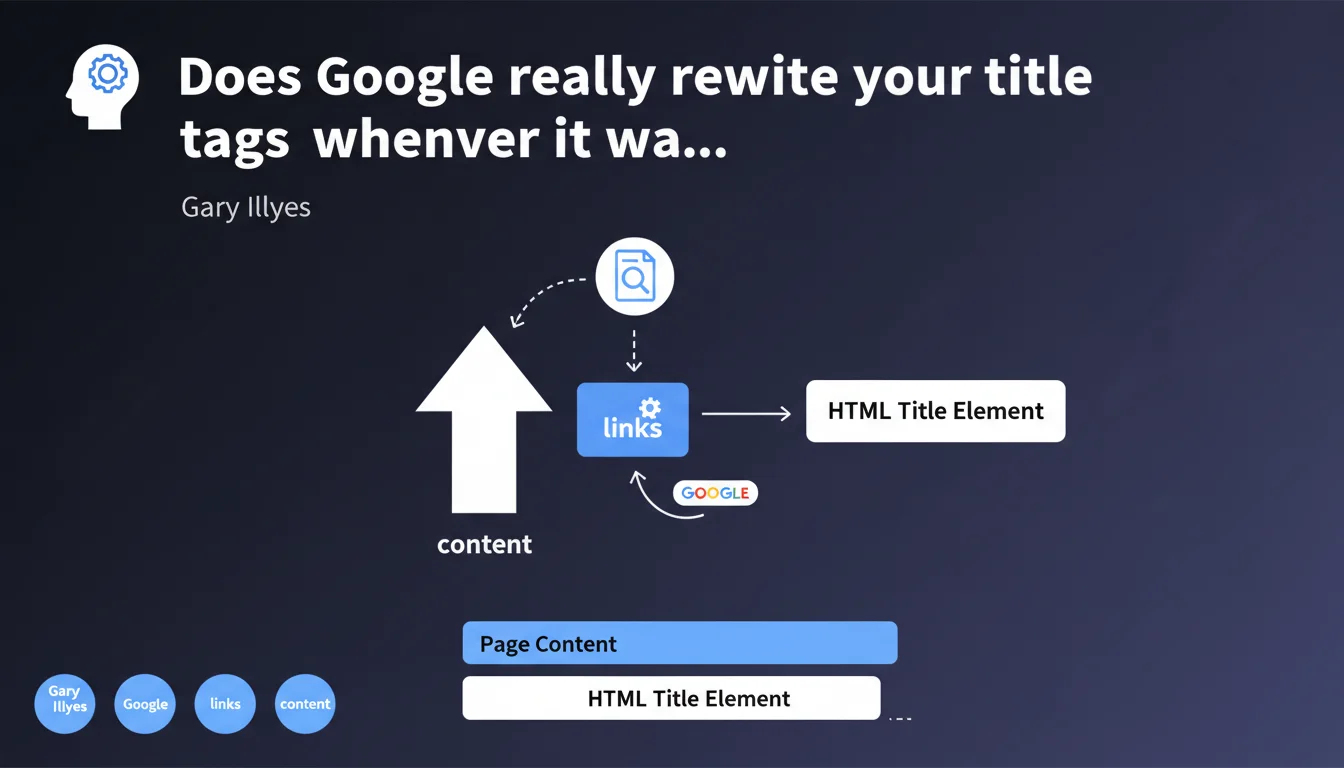
Google generates the title links displayed in SERPs based on the overall page content, not solely on the <title> tag. Even though in many cases the title link matches the HTML tag, Google reserves the right to rewrite it based on what it deems more relevant for the user. Webmaster control over the final display is therefore partial.
What you need to understand
Why doesn't Google always respect the title tag?
Google clearly distinguishes between the HTML title element that you write and the title link it displays in its results. The latter is generated algorithmically from multiple page signals: the title tag certainly, but also H1 headings, anchor text from internal links pointing to that page, visible text content, and sometimes even meta descriptions.
The stated objective? Provide a title that better reflects the page's actual content and is more attractive to the user. In practice, if your title tag is deemed too short, keyword-stuffed, misleading, or not representative of the content, Google replaces it without asking your permission.
In what cases does Google systematically rewrite titles?
Rewrite situations are frequent. Titles that are too long (beyond approximately 60 characters) get truncated or reformulated. Titles that are over-optimized with keyword repetition. Generic titles like "Home" or "Untitled Page".
Google also pulls from your H1 tags if they seem more descriptive. Or from backlink anchors and internal links if they show consensus on the page's topic. Result: the displayed title can differ radically from the one you coded.
What level of control do we actually retain?
Gary Illyes specifies that "in many cases," the title link is identical to the title tag. This vague phrasing gives no percentage. Field observations: approximately 60-70% of title tags are respected when they're properly optimized.
Control is therefore relative. You keep the upper hand if you follow best practices, but Google reserves itself a permanent veto right. It's impossible to force the display of a specific title 100% of the time.
- The title link displayed in SERPs is distinct from the HTML title tag
- Google generates this title from multiple page signals (title, H1, anchors, content)
- Over-optimized, generic, or misleading titles are systematically rewritten
- The rate of title tag respect oscillates between 60-70% when they are well-designed
- No technical way to force Google to display exactly your title
SEO Expert opinion
Does this statement match field observations?
Yes, broadly speaking. Since the update last month (Google revised its title link generation system), we're indeed seeing massive rewriting. Third-party studies show that 50 to 87% of titles are modified depending on sectors. E-commerce sites and news sites are particularly affected.
Here's the catch: Google claims that "in many cases" the HTML title is respected, but the numbers show the opposite. Let's be honest — this vague phrasing masks a less rosy reality. [To be verified]: Google publishes no official metrics on the actual rewrite rate.
What are the gray areas in this announcement?
Illyes remains vague about the precise rewriting criteria. We know that overly long or keyword-stuffed titles are targeted, but what about the nuances? What weighting between the H1, internal anchors, and HTML title? No numerical data.
Another point: Google claims to optimize for "the user," but some rewritten titles are objectively less relevant than the originals. Observed examples: haphazard truncations, duplicate brand name additions, pulling from secondary H1s that are not very representative. The system is far from infallible.
Should we adapt our title writing strategy?
Absolutely. Writing only an optimized title tag is no longer enough. You must now align all signals: title, H1, internal anchors, opening paragraphs. If these elements contradict each other or diverge, Google will make its choice — and it won't necessarily be yours.
Recommended strategy: align the title and H1 when relevant, avoid keyword stuffing even subtle versions, write titles that are descriptive rather than marketing-focused. And systematically monitor the displayed title links via Search Console to detect problematic rewrites.
Practical impact and recommendations
How do you optimize title tags to limit rewrites?
The golden rule: consistency and clarity. Your title tag must faithfully reflect the page's content, without overselling or over-optimization. Ideal length: 50-60 characters. Typical format: "Primary Keyword - Clarification | Brand".
Avoid keyword repetitions, enumerations separated by pipes, purely commercial titles ("Best X Cheap Online"). Google hates these and rewrites them almost systematically. Prioritize an informative and descriptive tone.
Align your main H1 with your title. Not necessarily identical word-for-word, but thematically coherent. If Google hesitates between the two, it's better that it pulls from an H1 you control rather than elsewhere.
What mistakes systematically trigger rewrites?
First culprit: titles that are too long. Beyond 60-65 characters, Google truncates or reformulates. Sometimes pulling from the H1, sometimes cutting brutally with "...".
Second mistake: keyword stuffing, even subtle. "SEO Agency Paris | SEO Expert Paris | SEO Consultant Paris" will be rewritten for sure. Google detects the repetition and imposes its version.
Third trap: generic or meaningless titles. "Home", "Welcome", "Homepage" trigger automatic rewriting. Google will look in your content or internal anchors for a more informative title.
- Limit title tag length to maximum 50-60 characters
- Semantically align the title and main H1 of the page
- Avoid any keyword repetition in the title
- Prioritize a descriptive and informative tone over aggressive marketing
- Monitor displayed title links via Google Search Console (Performance report > Pages)
- Analyze pages whose titles were rewritten to identify patterns
- Harmonize anchor text for internal links pointing to each key page
- Test different formulations and measure impact on CTR
How do you verify if Google has rewritten your titles?
Head to Google Search Console, Performance tab. Filter by page, then compare the displayed queries with your HTML title tags. If semantic discrepancies appear, that's Google reformulating.
Another method: manual Google searches using the site:yourdomain.com operator. Scan the titles displayed in the SERPs and compare with your source code. Tedious on a large site, but revealing.
Third-party tools: some crawlers (Screaming Frog, Oncrawl) now offer comparison modules between HTML titles and titles displayed in SERPs. Useful for auditing hundreds of pages simultaneously.
❓ Frequently Asked Questions
Google réécrit-il tous les titles ou seulement certains ?
Peut-on empêcher Google de réécrire un title ?
D'où Google tire-t-il les titles de remplacement ?
Un title réécrit peut-il impacter le CTR ?
Faut-il rendre le title et le H1 identiques ?
🎥 From the same video 12
Other SEO insights extracted from this same Google Search Central video · published on 23/04/2024
🎥 Watch the full video on YouTube →
💬 Comments (0)
Be the first to comment.