
Official statement
Other statements from this video 12 ▾
- □ Google réécrit-il vraiment vos balises title à sa guise ?
- □ Les balises heading peuvent-elles vraiment remplacer votre balise title dans les SERP ?
- □ Les snippets proviennent-ils vraiment uniquement du contenu visible de la page ?
- □ Google peut-il vraiment utiliser vos balises alt et meta descriptions pour composer vos snippets ?
- □ Comment désactiver l'affichage des snippets dans les résultats Google avec la balise nosnippet ?
- □ Peut-on vraiment contrôler la longueur des snippets dans les SERP avec max-snippet ?
- □ Comment empêcher un contenu spécifique d'apparaître dans vos snippets Google ?
- □ Faut-il restructurer ses URLs pour optimiser l'affichage du fil d'Ariane dans Google ?
- □ Peut-on vraiment contrôler le nom de son site dans la SERP avec les données structurées ?
- □ Le favicon influe-t-il réellement sur les performances SEO de votre site ?
- □ Google estime-t-il vraiment la date de vos contenus… ou l'invente-t-il ?
- □ Comment Google affiche-t-il plusieurs liens d'un même domaine sous un résultat de recherche ?
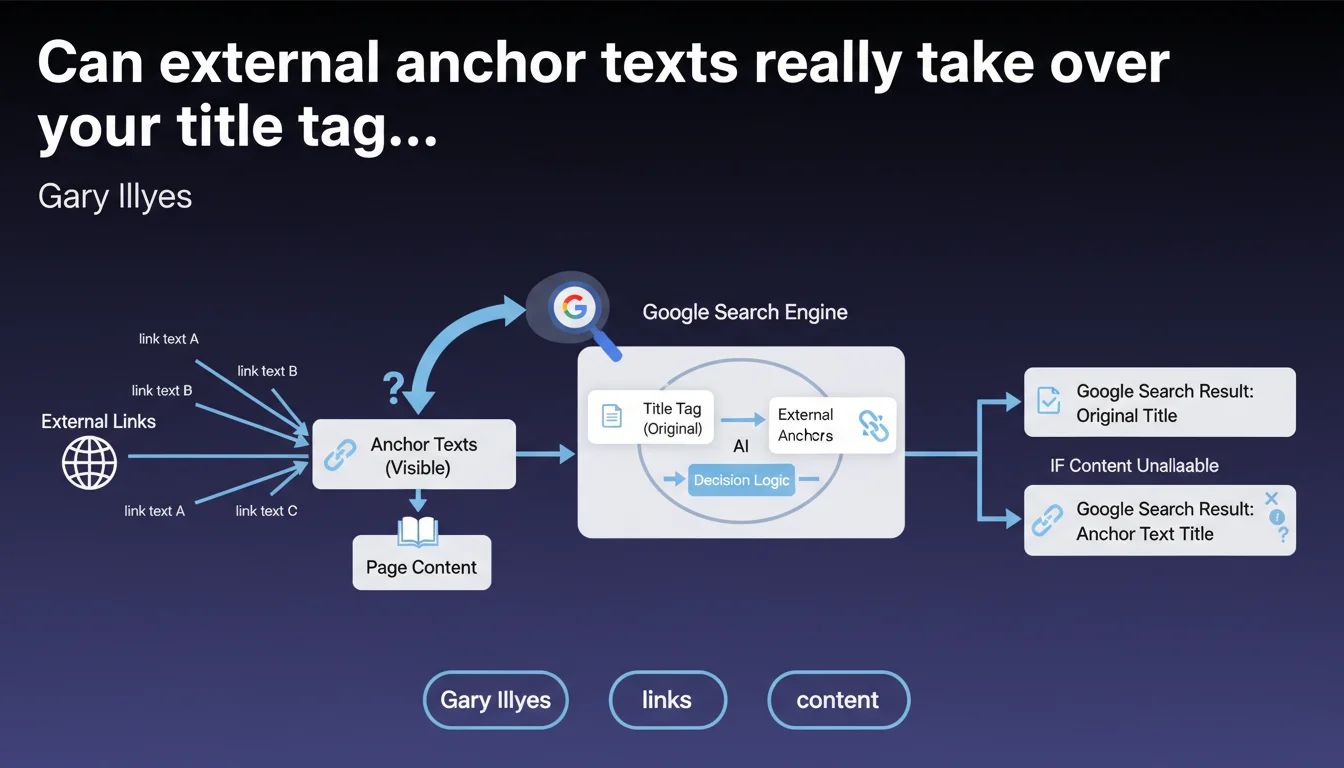
Google can generate the title link displayed in search results from anchor texts of external links when the page content is unavailable or difficult to access. While documented, this practice remains unclear regarding the precise triggering criteria and raises questions about the real control webmasters have over their titles in the SERP.
What you need to understand
What does "unavailable content" really mean in this context?
Gary Illyes discusses situations where page content is unavailable, which may seem counterintuitive. If a page is inaccessible, how can it be indexed and displayed in search results?
In reality, Google is probably referring to cases where crawling is hindered or incomplete: poorly executed JavaScript, server timeouts, blocked resources, or pages requiring authentication that Googlebot cannot bypass. In these configurations, Google sometimes has an indexed URL via backlinks, but without direct access to the complete HTML.
- JavaScript-heavy pages whose server-side rendering fails
- Content protected by paywall or login that Googlebot cannot pass through
- Sites with infrastructure problems (slow server, overly restrictive robots.txt on resources)
- Situations where Google partially crawled a page but could not extract the title tag
How does Google concretely use anchor texts?
When Google cannot access a page's HTML title, it falls back on external sources. Anchor texts — the clickable portion of hyperlinks — then become a privileged source of information for generating a coherent title link.
Google probably aggregates multiple anchor texts pointing to the same URL to extract a semantic consensus. If ten sites mention "Complete guide to SEO copywriting" as anchor text to your page, there's a good chance Google will adopt this phrasing — or a variation of it — as the title link.
Is this practice really exceptional?
On paper, yes. In the real world? Less obvious. [To verify] — Google provides no metrics on how frequently this mechanism occurs.
We regularly observe rewritten title links in the SERP, but it's difficult to isolate cases where anchor text is the primary source rather than a title tag deemed inadequate. Google blends several signals: HTML title, H1, in-page content, and anchor texts. Untangling these influences remains an interpretive exercise.
SEO Expert opinion
Is this statement consistent with what we observe in the field?
Partially. We've known for years that Google massively rewrites title tags — up to 60-70% of cases according to some studies. But precisely identifying when anchor text becomes the primary source remains complex.
Gary Illyes's statement lacks operational criteria. What exactly do we mean by "unavailable content"? Does a 2-second timeout suffice? JavaScript that fails once in three? A soft 404 page that remains temporarily indexed? [To verify] — no concrete data supports these thresholds.
What risks does this practice pose to title control?
The real problem is loss of control. If your backlinks use approximate, off-topic, or spammed anchor texts, and Google uses them to generate your title links, you end up with SERP titles that reflect neither your intent nor your positioning.
Let's be honest: few webmasters systematically audit the anchor texts of their backlinks. Yet, if your site experiences recurring accessibility issues — slow server, poorly configured CMS, unreliable JavaScript — you're letting Google compose your titles from third-party sources over which you have no direct control.
Does this logic apply uniformly to all types of sites?
No. Established authority sites, with high crawl budget and solid infrastructure, rarely experience this phenomenon. Google easily accesses their content and has clean title tags.
Conversely, niche sites, recent projects, under-optimized blogs, or poorly configured JavaScript-first platforms are natural candidates. And that's where it gets tricky: these sites already have less control over their backlink profile, making anchor text as a title source even more random.
Practical impact and recommendations
What should you concretely do to maintain control over your title links?
The first line of defense is to ensure Google always accesses the complete content of your pages. This means a responsive server, controlled JavaScript rendering, and title tags clearly present in the source HTML.
Next, regularly audit your title links in the SERP. Use Search Console, position tracking tools, or simple manual searches to verify that Google displays your title tags and not variants generated from anchor texts or H1 tags.
- Ensure your title tags are present in the initial HTML source (not injected via JS only)
- Check your server response speed and eliminate recurring timeouts
- Control your JavaScript rendering: test your pages with Search Console's URL inspection tool
- Monitor the anchor texts of your backlinks via Ahrefs, Majestic, or SEMrush — identify parasitic formulations
- Set up automated monitoring of your title links in the SERP to detect wild rewrites
How do you audit and clean up your anchor text profile?
If you suspect Google is using your anchor texts to generate title links, you first need to map your backlink profile. Identify dominant anchor texts, recurring formulations, errors, or spam.
Then act on two fronts: disavow toxic links (spammed or off-topic anchor texts) and, if possible, contact webmasters to correct problematic anchor texts. It's a long, often thankless job, but essential if your link profile is polluted.
When is it wise to call in external expertise?
Precisely diagnosing why Google rewrites your title links — and determining whether anchor texts are the cause — requires multilayered technical analysis: crawling, rendering, backlink profile, SERP monitoring. It's rarely an isolated problem.
If your site experiences massive title link rewrites, unexplained ranking fluctuations, or inconsistencies between your title tags and what appears in the SERP, it may be worthwhile to engage a specialized SEO agency. These configurations often require thorough diagnosis, infrastructure audit, and customized action plans — difficult to orchestrate alone without proper tools and experience.
❓ Frequently Asked Questions
Google peut-il utiliser les anchor texts même si ma balise title est présente et correcte ?
Les anchor texts internes (maillage interne) peuvent-ils aussi être utilisés pour générer les title links ?
Comment savoir si Google utilise mes anchor texts pour générer mes title links ?
Désavouer des backlinks avec des anchor texts inadéquats peut-il résoudre le problème ?
Cette pratique impacte-t-elle directement le classement ou seulement l'affichage en SERP ?
🎥 From the same video 12
Other SEO insights extracted from this same Google Search Central video · published on 23/04/2024
🎥 Watch the full video on YouTube →
💬 Comments (0)
Be the first to comment.