
Official statement
Other statements from this video 5 ▾
- □ Why does the text result remain the most strategic element of Google SERPs?
- □ Is Google really rewriting your title tags as often as people think?
- □ Do webmasters really have complete control over Google search result attribution elements?
- □ Why does Google display your URLs as breadcrumb trails in search results?
- □ How can you precisely control the appearance of your results in Google's SERP?
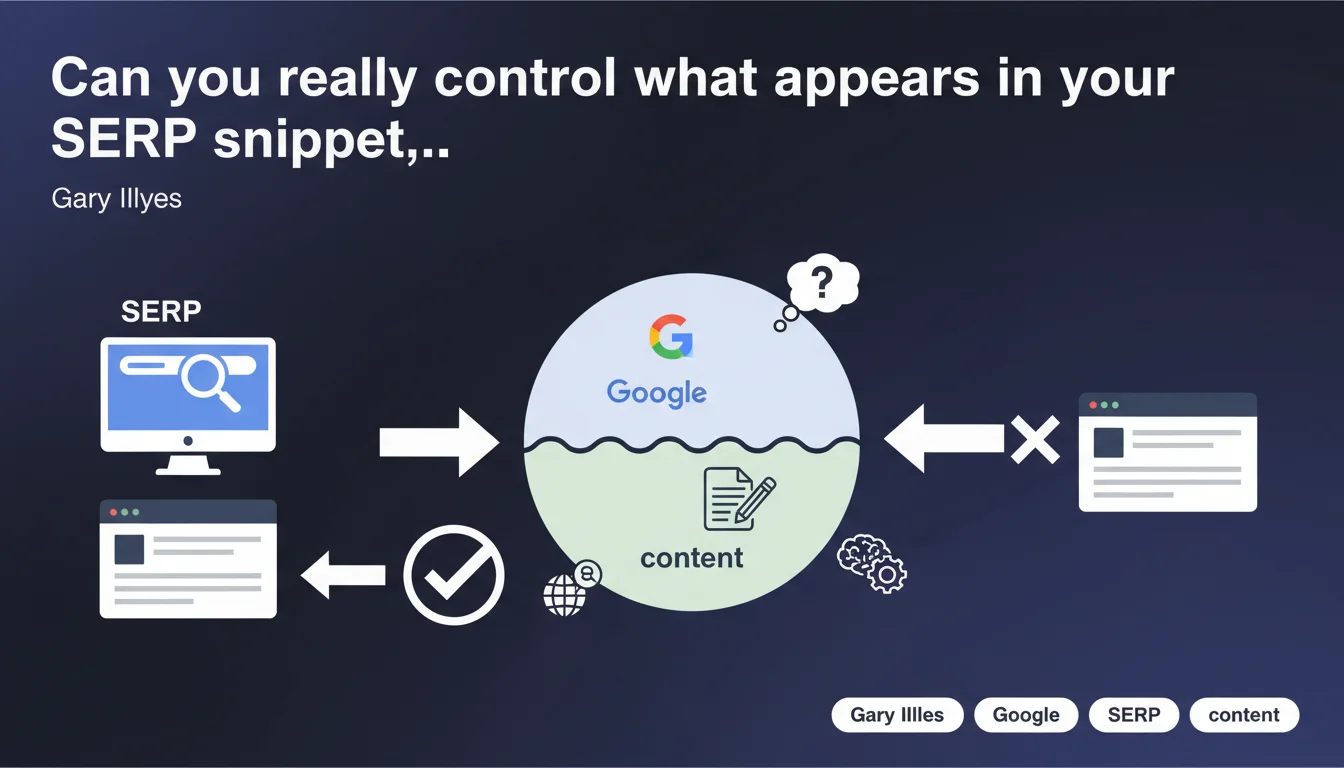
Google generates snippets directly from the content on your web pages. Contrary to what some believe, it's not the meta description tag that dictates the displayed excerpt—it's the search engine that pulls from your content. Your main lever remains the quality and structure of your visible text.
What you need to understand
Does Google systematically ignore the meta description?
No, but it doesn't treat it as an absolute directive. The engine extracts the snippet that seems most relevant based on the user's search query. If your meta description aligns well with search intent, it may be displayed. Otherwise, Google pulls from elsewhere on your page.
This principle means one simple thing: the snippet varies according to the query. The same page can generate different excerpts depending on the search context. Your job isn't to force a single text, but to provide structured content that the algorithm can exploit.
Where does Google pull the snippet from if not the meta description?
The engine scans all visible text content on the page: paragraphs, lists, tables, sometimes even internal anchors. It looks for the passage that best answers the presumed user intent. This is why sites without a meta description can display perfectly coherent snippets.
This logic rewards well-structured pages with clear answers and informative paragraphs from the start. If your content is hollow or generic, your snippet will be too—regardless of your meta.
Can you still influence what gets displayed?
Yes, by working on semantic hierarchy and information density in your content. Introductory paragraphs, questions/answers, concise definitions are all elements Google prioritizes when building its excerpts. You don't control the final choice, but you can guide the available options.
- The snippet comes from the visible content of the page, not just the meta description.
- Google adapts the excerpt based on the user's query.
- A single page can generate multiple snippets depending on search context.
- Structuring your content clearly increases your chances of getting a relevant excerpt.
- No meta description? Google will manage fine if your content is exploitable.
SEO Expert opinion
Is this statement consistent with observed practices?
Yes, but it glosses over several critical mechanisms. In the field, we see Google favors certain content patterns: definitions at the beginning of paragraphs, short descriptive sentences, question-answer structures. Saying "the snippet comes from content" is accurate, but insufficient—you still need to know what type of content works.
In practice, the meta description still plays a non-negligible role for navigational or brand queries, where intent is clear. There, Google tends to display the meta if it exists and is well-written. For informational queries, meanwhile, it's a free-for-all: the algorithm extracts what seems optimal, and that can shift day to day. [To verify]: no official data specifies Google's internal selection criteria.
What nuances should be added to this claim?
The notion of "controllable" is misleading. Sure, you control your page content, but not Google's selection logic. The engine may easily ignore your carefully crafted paragraphs to pull an unassuming sentence that better matches a given query. It's frustrating, but that's reality.
Moreover, some content types escape this logic: rich snippets rely on structured markup (Schema.org), and there, yes, you have more direct control. But for the standard snippet? You propose; Google disposes.
In what cases doesn't this rule apply?
Pages with dynamic content loaded via JavaScript can cause problems: if Google doesn't render the page correctly, it may fall back on the meta description for lack of better options. The same goes for JavaScript-heavy sites where content isn't immediately crawlable.
Very short or overly technical pages (think e-commerce product sheets with minimal specs) can generate disappointing snippets if visible content is too sparse. In these cases, a well-written meta description remains a useful safety net, even if it guarantees nothing.
Practical impact and recommendations
What should you do concretely to optimize your snippets?
Start by structuring your content with informative introductory paragraphs. The first 100-150 words of your page should set the context, define the topic, and signal what the user will find. Google often pulls from this zone for generic queries.
Integrate question-answer formats or clear definitions into your text. A well-placed FAQ, explicit subheadings, and synthesized lists boost your chances of delivering a relevant excerpt. Think "scannability": your content must be readable and exploitable at a glance.
Don't forget the meta description altogether: it remains a useful secondary lever, especially for strategic pages (homepage, main categories). Write it like a sales pitch in 150-160 characters, but don't count on it to impose your text.
What mistakes should you avoid at all costs?
Never leave empty or hollow content at the top of your page. Generic intros like "Welcome to our site" or "Discover our services" are useless to Google and harm user experience. If your content doesn't start until three scrolls down, your snippet will be mediocre.
Also avoid duplicate or overly similar content across pages: Google may generate identical snippets, diluting your visibility. Each page should have a clear and unique value proposition from the opening lines.
How can you verify that your site generates effective snippets?
Use Google Search Console to analyze your pages' CTR. Abnormally low CTR for a decent ranking may signal an unattractive snippet. Compare against actual SERP excerpts to spot inconsistencies or poorly cut sentences.
Test your content in real search: type your target queries and watch what Google displays. If the excerpt matches neither your meta nor your polished paragraphs, your content structure isn't optimal. Adjust, rephrase, test again.
- Write informative introductory paragraphs in the first 100-150 words of each page.
- Integrate question-answer formats and clear definitions into your content.
- Treat your meta description like a sales pitch, but don't count on it always being displayed.
- Avoid empty, generic, or duplicate content at the top of the page.
- Use Search Console to analyze CTR and displayed snippets.
- Test your target queries under real conditions to refine your structure.
❓ Frequently Asked Questions
Dois-je toujours rédiger une meta description ?
Google peut-il générer plusieurs snippets différents pour la même page ?
Pourquoi mon snippet affiche-t-il un texte que je n'ai pas rédigé ?
Les snippets enrichis échappent-ils à cette logique ?
Comment savoir si mon contenu est bien structuré pour les snippets ?
🎥 From the same video 5
Other SEO insights extracted from this same Google Search Central video · published on 23/04/2024
🎥 Watch the full video on YouTube →
💬 Comments (0)
Be the first to comment.