
Official statement
Other statements from this video 5 ▾
- □ Does Google really require Core Web Vitals optimization to rank higher in search results?
- □ Should you really stop over-optimizing Core Web Vitals?
- □ Does reducing JavaScript usage really matter for your SEO rankings?
- □ Are unnecessary redirects silently killing your site's crawl budget?
- □ How can you optimize your images to boost your technical SEO and improve Core Web Vitals?
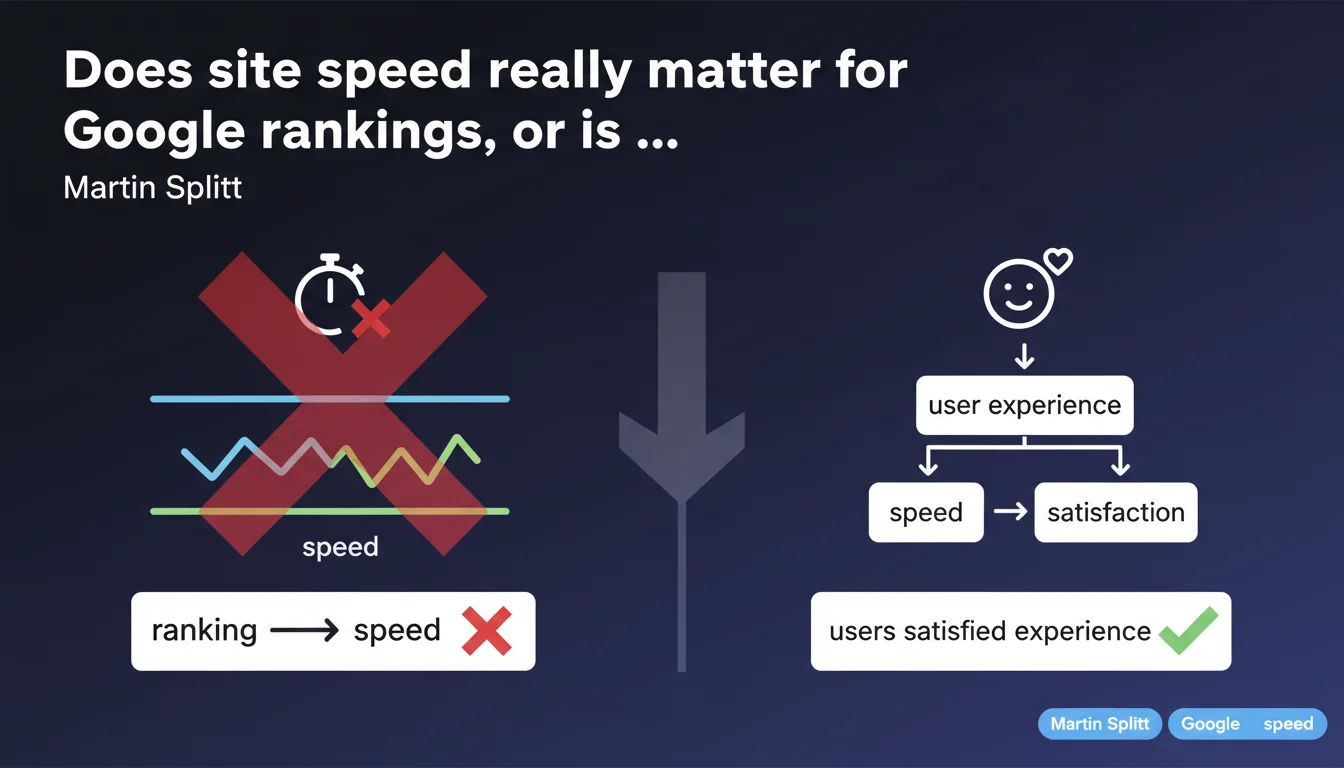
Martin Splitt claims that site speed does not directly affect Google search rankings, but improves user experience. This statement seems to contradict previous announcements about Core Web Vitals as a ranking factor. The ambiguity persists about what constitutes a direct signal versus an indirect one.
What you need to understand
What does "not directly" really mean in the context of ranking?
Google is playing with words. "Not directly" leaves the door open for an indirect impact through other signals. If a slow site causes a high bounce rate or reduces time spent on page, these behavioral metrics can influence rankings.
Speed remains a criterion for user experience, which matters to Google — but the algorithm wouldn't use it as an isolated variable in its ranking formula. This is consistent with their messaging around Core Web Vitals: one signal among many, never presented as decisive.
Does this position contradict the Core Web Vitals announcements?
Yes and no. Google did confirm that Core Web Vitals are a ranking factor since their rollout in 2021. But Splitt seems to downplay their actual weight.
This gap reflects typical Google communication: announce a factor to push webmasters into action, while limiting its real impact to prevent easy manipulation. [To verify]: no public data quantifies the exact weight of CWV in the algorithm.
Why does Google insist so much on user experience then?
Because it's profitable for Google. A faster web increases engagement, so more clicks on ads. The commercial argument hides behind user satisfaction rhetoric.
For us practitioners, the semantics don't matter: a slow site converts less, generates fewer revenues, and harms reputation. Whether it's a direct signal or not, optimization remains a priority.
- Probable indirect impact through behavioral metrics (bounce, engagement)
- Core Web Vitals confirmed as a ranking factor, but real weight unknown
- User experience = business priority, independent of pure SEO
- Google's communication often strategically vague to prevent manipulation
SEO Expert opinion
Is this statement consistent with real-world observations?
Partially. A/B tests rarely show an immediate position boost after speed improvement alone. However, on e-commerce sites, accelerating load time correlates with higher conversions and organic traffic growth over time.
The problem? Impossible to isolate speed from other variables. A faster site often triggers other optimizations (better UX, code reduction, optimized images) that also impact SEO. [To verify]: no study strictly isolating speed as the only variable has been published by Google.
In what cases does this rule not apply?
On mobile and for high-traffic sites. An extremely slow site (>10 seconds) risks being penalized indirectly through reduced crawl budget and massive user abandonment. Google may also apply manual or algorithmic filters on catastrophic experiences.
Another exception: competitive mobile searches. If two pages have equivalent content, Core Web Vitals become a tie-breaker. Splitt doesn't mention this scenario, making his statement incomplete.
Should we downplay the importance of speed in SEO?
No. Even if the direct impact is debatable, speed remains a critical business lever. Amazon measured that one second of latency costs 1% in revenue. For SEO, it's one signal among 200+ factors, but it touches everything: crawl, indexing, experience, conversions.
Let's be honest: Google has an interest in minimizing the importance of technical factors to prevent SEO from becoming a pure technical arms race. That doesn't mean we should ignore them.
Practical impact and recommendations
What should you do with this information?
Keep optimizing speed, but don't expect ranking miracles. Focus on overall user experience: reduced load time, smooth interactions, visual stability.
Prioritize Core Web Vitals (LCP, FID/INP, CLS) since Google officially confirmed them. But don't neglect non-CWV metrics like Time to First Byte or Total Blocking Time, which impact real user experience.
What mistakes should you avoid after this announcement?
Don't fall into the "it's not important" trap. Some SEOs will interpret this statement as permission to ignore performance. Mistake: indirect impact remains massive.
Another mistake: over-optimizing to the point of sacrificing functionality. An ultra-fast but broken site with degraded UX won't help. Balance trumps obsession with perfect scores.
How do you measure the real impact on your site?
Monitor Google Search Console (Core Web Vitals report) and PageSpeed Insights. But most importantly, measure business metrics: bounce rate, pages per session, conversions.
Compare your performance against top 3 competitors. If you're significantly slower, that's a competitive handicap, even if it's not an admitted ranking factor.
- Optimize Core Web Vitals as a priority (LCP < 2.5s, CLS < 0.1, INP < 200ms)
- Monitor behavioral metrics (bounce, time spent, conversions)
- Compare your performance to direct competitors in SERPs
- Don't sacrifice functionality for a few milliseconds
- Test the business impact of optimizations via A/B testing when possible
❓ Frequently Asked Questions
Les Core Web Vitals sont-ils vraiment un facteur de classement si la vitesse ne l'est pas ?
Dois-je arrêter d'investir dans l'optimisation de la vitesse après cette déclaration ?
Pourquoi Google minimise-t-il l'importance de la vitesse alors qu'ils poussent les CWV ?
Un site très lent peut-il quand même bien se positionner ?
Quelle métrique de vitesse prioriser en SEO : LCP, FID, CLS ou autre ?
🎥 From the same video 5
Other SEO insights extracted from this same Google Search Central video · published on 18/09/2024
🎥 Watch the full video on YouTube →
💬 Comments (0)
Be the first to comment.