
Official statement
Other statements from this video 5 ▾
- □ Faut-il vraiment optimiser les Core Web Vitals pour ranker sur Google ?
- □ Faut-il vraiment réduire l'usage de JavaScript pour améliorer votre SEO ?
- □ Faut-il vraiment supprimer toutes les redirections de votre site ?
- □ Comment optimiser vos images pour améliorer votre SEO technique ?
- □ La vitesse du site est-elle vraiment un facteur de classement Google ?
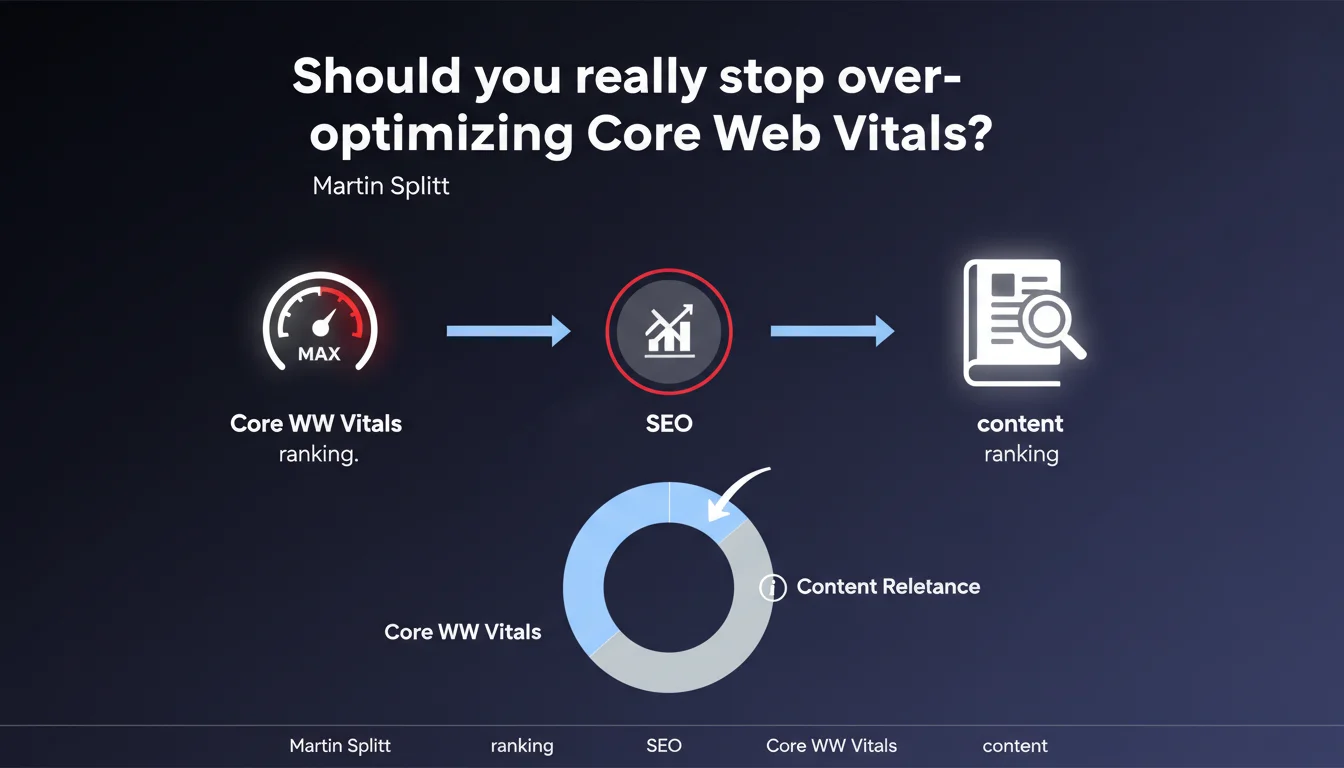
Martin Splitt claims that Core Web Vitals have limited impact on SEO rankings compared to content relevance. Google recommends not focusing too heavily on these performance metrics, while clarifying that they are not entirely irrelevant either. A statement that challenges the priorities of many SEO professionals.
What you need to understand
Why is Google downplaying the importance of Core Web Vitals?
This statement comes after several years of intensive communication from Google about the importance of Core Web Vitals. In 2021, the rollout of the Page Experience Update created a wave of activity among SEO professionals, who massively invested in optimizing these metrics.
Splitt is clarifying things today: performance remains a factor, but its relative weight is low compared to content relevance. In other words, a ultra-fast site with mediocre content will not outrank a slower competitor with relevant and comprehensive content.
What does "limited impact" concretely mean?
Google never communicates precise figures about the weight of each ranking factor. Limited impact remains deliberately vague phrasing that leaves practitioners in uncertainty.
What we can infer: Core Web Vitals probably function as a tiebreaker between content of equivalent quality. They don't magically push a site up in search results, but they can tip the balance between two competing pages.
Has Google's stance on this evolved over time?
Yes, definitely. The initial discourse around Page Experience was much more alarmist, pushing webmasters to urgently fix their CWV metrics or risk losing rankings.
Today, Google is implicitly admitting that the impact was overstated. This nuance is typical of Google's communication: first create urgency to drive technical improvements on the web, then moderate the message to prevent technical optimization from overshadowing content quality.
- Core Web Vitals remain a ranking signal, but not a major one
- Content relevance remains the dominant criterion for ranking
- Google avoids giving precise figures on the relative weight of each factor
- The underlying message: balance efforts between technical and content optimization
- Over-optimizing CWV at the expense of content is counterproductive
SEO Expert opinion
Is this statement consistent with real-world observations?
Both yes and no. Real-world data shows that sites with catastrophic Core Web Vitals can maintain excellent rankings if their content is solid and they have strong domain authority. This is particularly visible in informational sectors.
But — and this is critical — in ultra-competitive sectors (e-commerce, finance, health), where content quality is equivalent, CWV becomes a deciding factor. Ignoring these metrics in these markets amounts to handing an advantage to your competitors.
What nuances should be added to this position?
Splitt speaks of limited impact on rankings, but deliberately omits the impact on conversion rate and user experience. A slow site that ranks may lose visitors before they even consume the content.
Another point: Google likely measures user engagement signals (time on site, bounce rate, interactions) and these metrics are directly affected by performance. So even if CWV aren't a major ranking factor, they indirectly influence other behavioral signals that do matter more. [To be verified]
In what cases does this rule not apply?
On mobile, notably. Mobile users are far more sensitive to loading speed and visual stability. A site with catastrophic LCP on mobile can see its bounce rate skyrocket, which will eventually impact rankings even if not through the direct CWV signal.
Similarly, for e-commerce sites where every millisecond of latency can kill conversions, neglecting Core Web Vitals under the pretext that they have "limited SEO impact" would be a major strategic mistake.
Practical impact and recommendations
What should you do concretely after this statement?
Rebalance your priorities. If your site has orange CWV scores but solid, well-structured content, don't panic. Focus first on continuous content improvement, deeper subject treatment, and satisfying search intent.
That said, don't completely neglect CWV. Aim for the "green" threshold as a reasonable objective, without becoming obsessed with perfect scores. An LCP under 2.5s, FID under 100ms, and CLS under 0.1 are more than sufficient for the vast majority of cases.
What mistakes should you avoid in Core Web Vitals optimization?
First mistake: sacrificing functionality or aesthetics of your site to gain a few points on PageSpeed Insights. If you break user experience to improve a technical score, you lose overall.
Second mistake: ignoring business context. A media site with programmatic advertising will always have worse CWV scores than a minimalist blog. This is normal and acceptable as long as you optimize what's under your control.
How should you adjust your SEO strategy accordingly?
Adopt a 70/30 approach: devote 70% of your resources to creating quality content, understanding search intent, improving semantic depth, and building authority.
The remaining 30% goes to technical aspects: crawlability, structure, speed, mobile-first. Core Web Vitals fit within this envelope, not outside it. They're one component among others in technical optimization.
- Audit your existing content and identify low-value-add pages
- Prioritize semantic enrichment and exhaustive topic coverage
- Aim for the "green" threshold on CWV without seeking absolute perfection
- Test real user experience, not just synthetic metrics
- Balance investments between content and technical work (70/30 ratio)
- Don't sacrifice functionality to improve a PageSpeed score
- Monitor engagement metrics (time on site, pages per session) as a priority
❓ Frequently Asked Questions
Les Core Web Vitals sont-ils encore un facteur de classement en 2025 ?
Faut-il abandonner l'optimisation des Core Web Vitals ?
Quel est le bon ratio entre optimisation technique et contenu ?
Les Core Web Vitals ont-ils plus d'impact sur mobile que sur desktop ?
Comment savoir si mes scores CWV sont suffisants ?
🎥 From the same video 5
Other SEO insights extracted from this same Google Search Central video · published on 18/09/2024
🎥 Watch the full video on YouTube →
💬 Comments (0)
Be the first to comment.