
Official statement
Other statements from this video 5 ▾
- □ Faut-il vraiment arrêter de sur-optimiser les Core Web Vitals ?
- □ Faut-il vraiment réduire l'usage de JavaScript pour améliorer votre SEO ?
- □ Faut-il vraiment supprimer toutes les redirections de votre site ?
- □ Comment optimiser vos images pour améliorer votre SEO technique ?
- □ La vitesse du site est-elle vraiment un facteur de classement Google ?
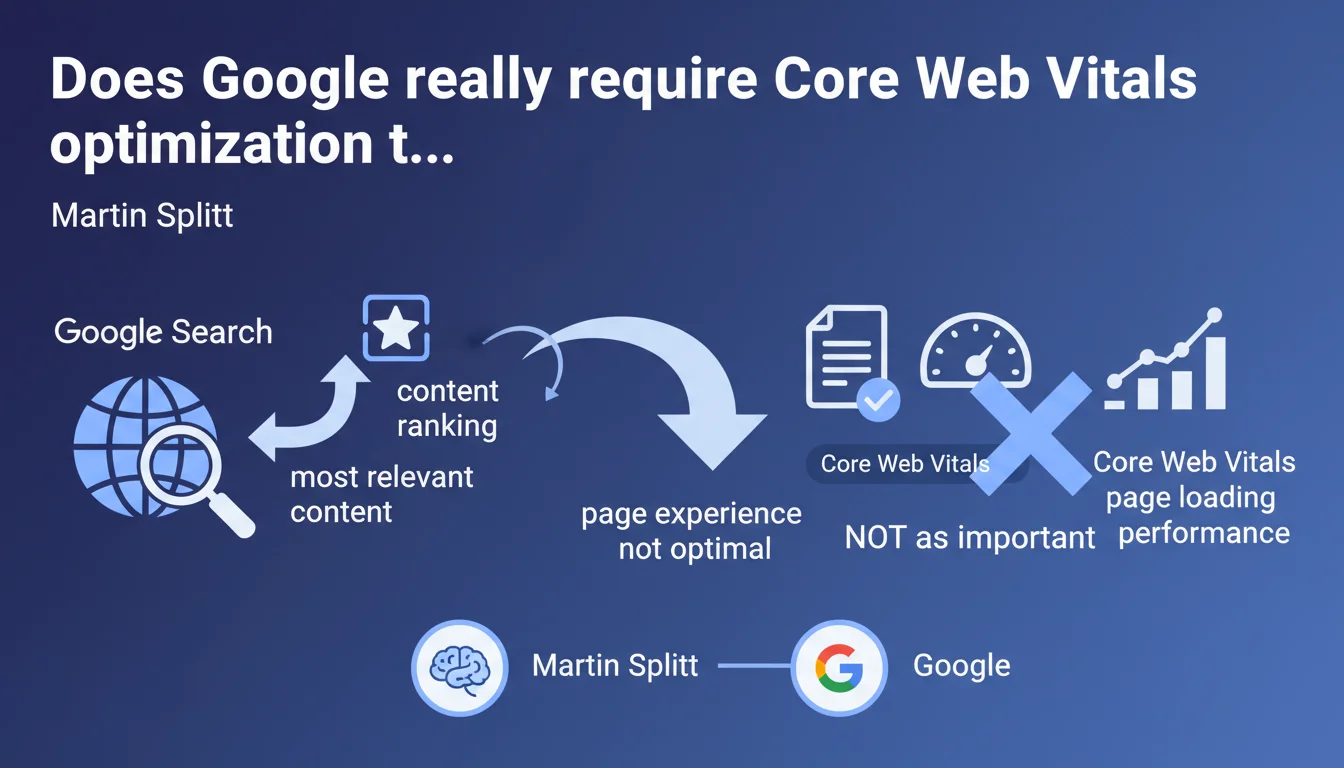
Google states that content relevance outweighs page experience in search rankings. Core Web Vitals and page loading performance have less impact than many SEO professionals believe. In practice: relevant content with poor UX can outrank average content with excellent Core Web Vitals.
What you need to understand
What exactly does Google say about the hierarchy of ranking signals?
Martin Splitt makes a clear distinction: content relevance remains the dominant factor in Google's algorithm, even when page experience is poor. This statement puts into perspective the importance given to Core Web Vitals since their introduction as a ranking signal.
What matters above all is your content's ability to precisely answer the search intent. A slow but highly relevant site can theoretically outrank a fast site with average content. Google seeks first to satisfy the user through the quality of the answer, not through the smoothness of the experience.
Why this clarification now?
Since the rollout of the Page Experience Update, part of the SEO industry has focused — sometimes obsessively — on technical optimizations at the expense of content. Google is recalibrating priorities here.
The confusion stems from the fact that Google did introduce Core Web Vitals as an official ranking factor. But the weight of this signal has never been as significant as some imagined. This statement explicitly confirms that.
Does this mean we can ignore technical UX?
No. And that's where the message can be misleading. Google says relevance wins, not that page experience doesn't matter. In reality, Core Web Vitals play a tiebreaker role when two pieces of content are of comparable quality.
Another nuance: catastrophic page experience can indirectly impact rankings through behavioral metrics — bounce rate, time on page, return to SERPs. Google will never officially say it uses these signals, but the effect exists.
- Content relevance remains the dominant signal for Google rankings
- Core Web Vitals carry less weight than many SEO professionals assume
- A slow but relevant site can outrank a fast site with average content
- Page experience acts mainly as a tiebreaker between equivalent content
- Disastrous UX can impact rankings indirectly through behavioral metrics
SEO Expert opinion
Is this statement consistent with real-world observations?
Yes and no. On low-competition queries, we do see sites with catastrophic Core Web Vitals ranking on the first page thanks to highly targeted content. Content clearly wins.
But on ultra-competitive SERPs — finance, health, e-commerce — reality is more nuanced. When 10 sites offer equivalent content quality, Core Web Vitals become a real differentiator. [To be verified]: Google remains vague about the exact weight of this signal depending on query competitiveness.
What are the gray areas of this claim?
Google doesn't specify what it means by "non-optimized page experience." An LCP of 4 seconds? 10 seconds? At what point does the experience degrade so much that it cancels out content relevance?
Another point: the statement doesn't distinguish between query types. On an informational search, users might better tolerate a slow site if the content is excellent. On a transactional query with immediate purchase intent, experience probably weighs heavier.
Finally, this statement completely ignores the indirect impact of UX on SEO. A slow site generates fewer shares, fewer natural backlinks, less engagement — all signals that influence rankings. Let's be honest: completely separating relevance from experience is an oversimplified view.
In what cases does this rule not apply?
On mobile, user tolerance for poor experience is virtually nonexistent. Google knows this. Even with relevant content, an unusable site on smartphones will struggle to maintain positions, because behavioral signals will reveal user frustration.
Another exception: YMYL sites (Your Money Your Life). On these topics, Google applies stricter standards. Poor UX can be interpreted as a lack of professionalism, which indirectly impacts the perceived E-E-A-T of the site.
Practical impact and recommendations
What should you actually do with this information?
Reorient your priorities: before spending 3 months scraping 0.2 seconds off your LCP, ask yourself if your content actually answers search intent better than the competition. Semantic audits come before technical audits.
That said, don't swing to the opposite extreme. If your Core Web Vitals are in the red, fix major issues — those that genuinely degrade user experience, not those that just push your PageSpeed score from 85 to 92.
What mistakes should you avoid following this statement?
Mistake #1: completely abandoning technical optimization. Core Web Vitals remain a ranking factor, even if secondary. And most importantly, they directly influence conversion rate — which matters as much as traffic.
Mistake #2: believing that mediocre content can be compensated by perfect UX. This is the opposite message from this statement. Google first seeks relevance — experience is a bonus, not a substitute.
Mistake #3: ignoring behavioral metrics. Google can say Core Web Vitals have little weight, but it will never say bounce rate or pogo-sticking don't influence rankings. Yet these metrics are directly tied to UX.
How to adjust your SEO strategy in practice?
Adopt a graduated approach. Prioritize content optimization on strategic pages — those generating traffic but converting poorly or stagnating in positions 5-10. ROI will be faster than optimizing speed.
Next, set a minimum technical acceptability threshold: Core Web Vitals in "good" or "needs improvement" zones, not necessarily green everywhere. Focus heavy optimizations on pages with high business stakes, not the entire site.
- Audit the semantic relevance of your content before optimizing technical performance
- Fix major Core Web Vitals issues that genuinely degrade UX, not cosmetic details
- On competitive SERPs, aim for Core Web Vitals at least in the "needs improvement" zone to avoid disadvantage
- Measure the impact of technical optimizations on behavioral metrics, not just PageSpeed Insights
- Prioritize content to gain rankings, UX to improve conversion
- Don't neglect mobile: user tolerance for poor experience there is virtually nonexistent
❓ Frequently Asked Questions
Les Core Web Vitals ont-ils encore un impact sur le classement Google ?
Dois-je arrêter d'optimiser la vitesse de mon site après cette déclaration ?
Comment Google définit une expérience de page non optimale ?
Cette règle s'applique-t-elle de la même façon sur mobile et desktop ?
Quelle est la priorité : contenu ou technique ?
🎥 From the same video 5
Other SEO insights extracted from this same Google Search Central video · published on 18/09/2024
🎥 Watch the full video on YouTube →
💬 Comments (0)
Be the first to comment.