
Official statement
Other statements from this video 5 ▾
- □ Can you control exactly how your brand name appears in Google search results?
- □ Should you really display your site name in every single page title?
- □ Does Google's site name feature really apply to your domain's subdirectories?
- □ How long does Google really take to process your SEO updates?
- □ Can you really speed up how quickly Google reindexes your site markup changes in Search Console?
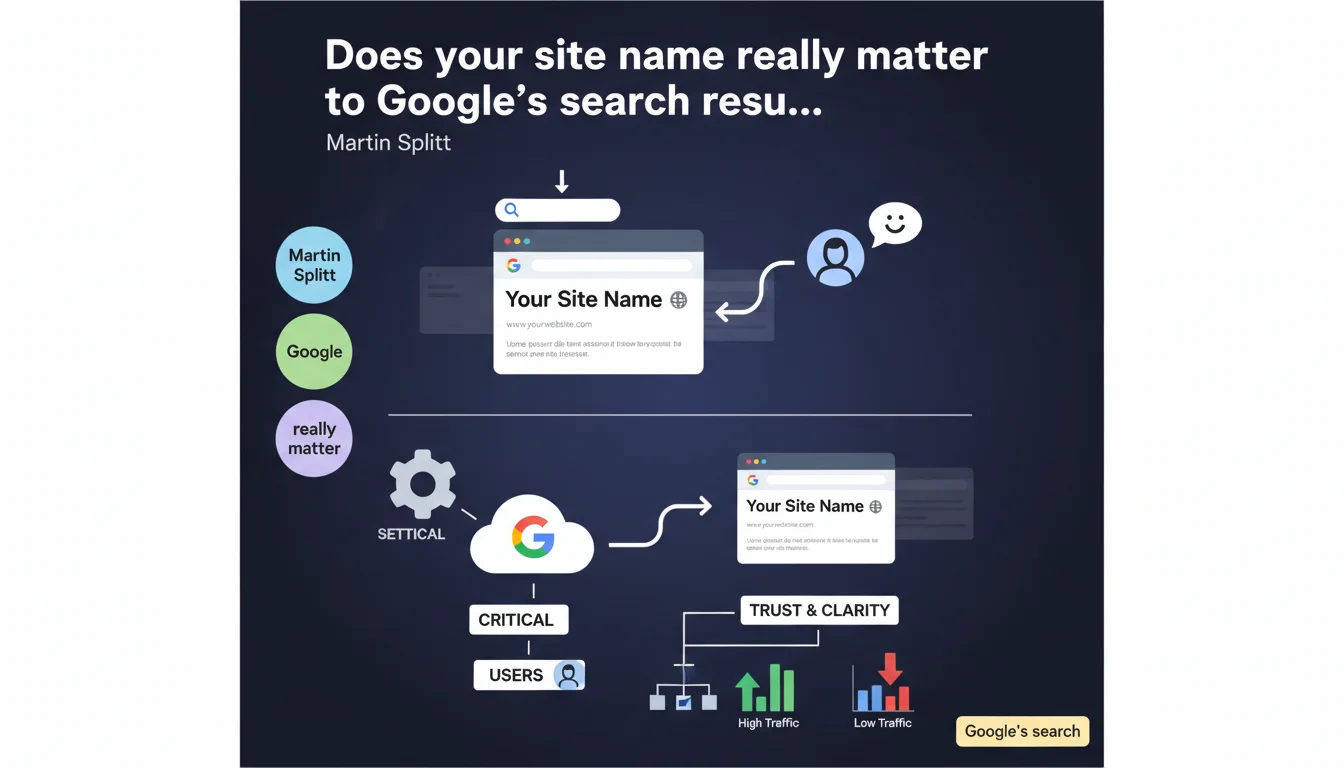
Google confirms that the site name displayed in search results is a crucial signal for users. Martin Splitt reminds us that you must ensure this name displays correctly, which requires technical control over tags and structured data. Practically speaking: if your site appears under a wrong or truncated name, you lose visibility and credibility.
What you need to understand
What problem is Google trying to solve here?
Users rely on the site name to quickly identify the source of a search result. A poorly displayed or inconsistent name muddles brand recognition and hurts click-through rate.
Google has introduced mechanisms to display the site name more reliably — notably through WebSite structured data and the name property in JSON-LD. If you don't control them, Google will choose for you, often based on your <title> or other internal signals.
How does Google determine which site name to display?
Google prioritizes WebSite-type structured data with the name property when they are present and consistent. If they're missing or deemed unreliable, the engine falls back on other sources: <title>, internal link anchors, logo text, etc.
The problem? These alternative sources can generate truncated, generic, or poorly formatted names. Hence the importance of explicitly declaring your site name via Schema.org.
Why this announcement now?
Google continues to fine-tune search result display to improve user experience. Google's tests show that users scan the site name first, even before the page title.
If your site name isn't immediately recognizable, you lose clicks — even if your content is relevant. It's a signal of trust and authority that plays out in a fraction of a second.
- The site name is a trust signal for the user before they click.
- Google uses WebSite structured data as priority for display.
- Without structured data, Google chooses itself — often with imperfect results.
- A poorly displayed name hurts click-through rate and brand recognition.
SEO Expert opinion
Does this announcement really bring anything new to the table?
No, and that's precisely what's interesting. Google is repeating advice that has existed since the introduction of WebSite structured data. What's changing is Splitt's emphasis on the importance from the user's perspective — not just technical.
This suggests that Google is likely observing correlations between poorly displayed site names and low click-through rates. If this announcement is coming out now, it's because there are still too many sites neglecting this basic parameter.
In which cases does the site name fail to display correctly?
The most frequent real-world cases: total absence of WebSite structured data, inconsistent names between Schema.org and <title>, names that are too long (Google truncates them), or generic names like "Home" or "Welcome".
I've also observed situations where Google ignores structured data because it contains keyword stuffing or excessive marketing language. Google then prefers to choose itself. [To verify]: Google has never publicly specified the exact rejection thresholds, but real-world experience shows you need to keep it simple.
Does this impact rankings?
Directly? No. Site name is not a declared ranking factor by Google. Indirectly? Yes, through click-through rate (CTR).
A clear and recognizable site name improves CTR, and Google uses user behavior signals to adjust rankings. If your competitor has a flawless site name and you have a truncated one, they'll capture more clicks — and over time, this can influence your visibility.
Practical impact and recommendations
What should you do concretely to control the site name displayed?
First step: implement WebSite structured data with the name property in JSON-LD in the <head> of your homepage. The name must match your official brand exactly.
Minimal example:
{
  "@context": "https://schema.org",
  "@type": "WebSite",
  "name": "Your Brand Name",
  "url": "https://www.yoursite.com"
}
Next, verify in Search Console that Google is correctly indexing this structured data. Use the Rich Results Test tool and the "Enhancements" report to detect any potential errors.
Which mistakes should you absolutely avoid?
Don't declare different site names across your pages. Google values consistency — if your homepage says "Brand A" and your internal pages say "Brand B", Google will choose for itself.
Avoid names that are too long or loaded with keywords. Google truncates site names beyond a certain length (roughly 30-35 characters displayed), and a marketing-heavy name like "Brand | SEO Leader in France" will be ignored or shortened awkwardly.
Finally, don't neglect alternative tagging like <title> and logo text. If your structured data is rejected, Google will fall back on these elements — make sure they stay clean.
How do you verify that your site name is displaying correctly?
Type site:yoursite.com in Google and examine how the site name appears in the results. Compare it with what you've declared in your structured data.
If the name doesn't match, several causes are possible: absent structured data, rejection by Google for inconsistency, or indexing delay. Wait a few weeks after implementation — Google doesn't always update immediately.
- Implement WebSite structured data with
namein JSON-LD on the homepage. - Use your official brand name, short and consistent across all pages.
- Check indexing in Search Console and the Rich Results Test tool.
- Monitor actual display in the SERPs via
site:and adjust if necessary. - Avoid names that are too long, keyword stuffing, and variations between pages.
- Ensure that
<title>and logo text remain clean as fallback solutions.
Site name is often underestimated, yet it plays a direct role in brand recognition and click-through rate. Implementing WebSite structured data is technical but accessible — yet consistency, format, and validation errors remain frequent.
If you manage a complex site with multiple brands or international versions, these optimizations can quickly become tricky to orchestrate. In those cases, working with a specialized SEO agency can save you time and avoid costly visibility mistakes.
❓ Frequently Asked Questions
Les données structurées WebSite sont-elles obligatoires pour que Google affiche un nom de site ?
Peut-on déclarer un nom de site différent selon les versions linguistiques ou géographiques ?
Combien de temps faut-il pour que Google prenne en compte un changement de nom de site ?
Le nom de site affiché influence-t-il directement le classement dans les résultats ?
Que faire si Google ignore mes données structurées WebSite ?
🎥 From the same video 5
Other SEO insights extracted from this same Google Search Central video · published on 28/09/2023
🎥 Watch the full video on YouTube →
💬 Comments (0)
Be the first to comment.