
Official statement
Other statements from this video 5 ▾
- □ Can you control exactly how your brand name appears in Google search results?
- □ Should you really display your site name in every single page title?
- □ Does Google's site name feature really apply to your domain's subdirectories?
- □ Can you really speed up how quickly Google reindexes your site markup changes in Search Console?
- □ Does your site name really matter to Google's search results, and why is it critical to get it right?
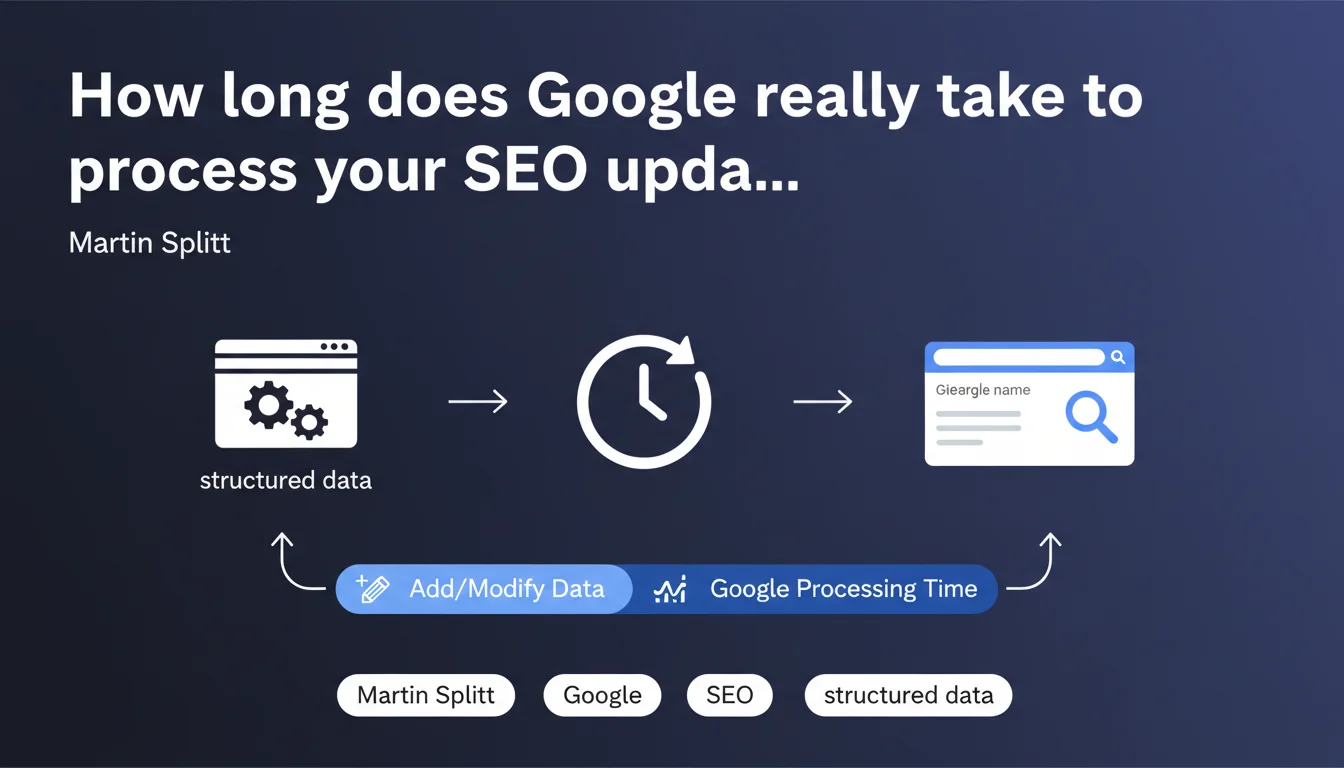
Google needs time to process structured data modifications or title changes before displaying the updates in search results. This statement reminds you not to panic if the effects aren't immediate — but it remains vague about actual timelines to anticipate.
What you need to understand
Why does Google emphasize this concept of processing time?
Because the search engine operates through crawl and indexation cycles that are never instantaneous. When you modify title tags or add schema.org markup, Googlebot must first recrawl the page, then reindex it, then update the snippets displayed in the SERPs.
And that takes time — variable depending on the crawl frequency of your site, its popularity, Google's server load, and other opaque factors. Martin Splitt is simply reminding you: don't expect to see your changes reflected in a few hours.
What does Google mean by "some time"?
Excellent question. The statement provides no specific timeframe. "Some time" could mean 24 hours, a week, or a month depending on the case. For a site crawled daily, expect a few days. For a site with low authority or sporadic crawling, it can drag on for weeks.
This vagueness is characteristic of Google: reality varies too much from one site to another for them to commit to a fixed deadline. But for an SEO professional, it's frustrating — we'd like concrete benchmarks. [To be verified]: field observations suggest that a well-crawled site sees its titles updated within 2-7 days, but Google will never officially confirm this.
What are the essential takeaways?
- Modifications to structured data (schema.org) and titles don't appear immediately in the SERPs.
- Google must first recrawl the page, then reindex the content, then update its display systems.
- The timeline varies greatly depending on the crawl frequency of your site and its priority in Google's queue.
- Don't panic if nothing changes after 48 hours — but still monitor the URL Inspection Tool to verify that crawling is actually occurring.
SEO Expert opinion
Is this statement consistent with what we observe in the field?
Yes and no. On high-authority sites with good crawl rates, title changes often appear within 24-72 hours. For rich structured data (FAQ, HowTo, etc.), we sometimes observe longer delays — up to 10-15 days — without clear reason. Google publishes no SLA, so it's impossible to know if it's "normal" or a temporary bug.
The problem is that this statement provides no way to diagnose a blockage. If after three weeks your sitename still hasn't appeared despite clean schema.org, is that normal? A bug? A silent penalty? Martin Splitt doesn't answer. [To be verified]: some SEOs report that forcing a recrawl via Search Console sometimes speeds up the process, but Google has never officially confirmed this.
What nuances should be added to this advice?
First, not all changes are equal. Modifying a title on a page crawled daily? It passes quickly. Adding complex schema.org markup to a site that's rarely crawled? That can drag on. Google prioritizes high-traffic, high-authority sites — it's not fair, but it's reality.
Second, "giving it time" doesn't mean "sit back and wait." You need to monitor actively: URL Inspection Tool, server logs, Search Console. If after two weeks nothing has changed and Googlebot hasn't recrawled, there's a problem — and it's not a question of patience.
In what cases does this rule not apply?
If you modify a title and Google continues displaying the old one after a confirmed recrawl, it's no longer a delay issue — it's an algorithmic choice. Same for structured data: if the Rich Result Test validates your markup but nothing appears after a month, it's probably a quality filter or a bug.
In these cases, "giving it time" does nothing. You need to investigate: markup errors, tag conflicts, canonicalization issues, or simply a Google bug that needs to be reported through official channels.
Practical impact and recommendations
What should you do concretely after modifying a title or schema.org markup?
First step: force a URL inspection in Search Console. That doesn't guarantee an immediate crawl, but it signals to Google that the page has changed. Then monitor your server logs to confirm that Googlebot has actually visited.
Second step: check in the URL Inspection Tool that the indexed version contains your modifications. If Googlebot crawled but the old version is still cached, there's a processing problem — and then you need to dig deeper (redirect, canonical, accidental noindex, etc.).
What mistakes should you avoid during this waiting period?
Don't modify your tags every 48 hours thinking you'll "speed up" the process. That creates noise, and Google might crawl an intermediate version. Wait at least 7-10 days before touching a title or markup you've already modified.
Another mistake: not monitoring logs. If Googlebot isn't crawling, waiting does nothing. Verify that you haven't accidentally blocked the page (robots.txt, accidental noindex, chain redirects). Patience doesn't excuse negligence.
How do you verify that everything is working correctly?
- Inspect the URL via Search Console and verify that the indexed version is up to date
- Check server logs to confirm Googlebot's visit (user-agent, 200 status code)
- Test the markup with the Rich Result Test and verify no errors appear
- Monitor the SERPs manually or with a rank tracking tool to detect when the change appears
- If nothing changes after 15 days: investigate (canonical, redirects, markup conflicts)
Google gives no precise timeline, but in practice, expect 3-7 days for a title on a well-crawled site, and up to 2-3 weeks for complex structured data. Don't stay passive: monitor crawls, force inspections if needed, and quickly diagnose any blockages.
These technical optimizations — including schema.org, canonicals, crawl management, and advanced diagnostics — can quickly become time-consuming. If you lack internal time or resources to manage these projects, support from a specialized SEO agency can save you time and prevent costly mistakes.
❓ Frequently Asked Questions
Combien de temps Google met-il généralement à afficher un nouveau title dans les SERP ?
Faut-il forcer un recrawl via la Search Console après avoir modifié des données structurées ?
Pourquoi mon sitename n'apparaît-il toujours pas malgré un schema.org correct ?
Google peut-il afficher un ancien title même après avoir recrawlé la page ?
Après combien de temps faut-il s'inquiéter si rien ne change dans les SERP ?
🎥 From the same video 5
Other SEO insights extracted from this same Google Search Central video · published on 28/09/2023
🎥 Watch the full video on YouTube →
💬 Comments (0)
Be the first to comment.