
Official statement
Other statements from this video 5 ▾
- □ Comment indiquer à Google le nom de site que vous souhaitez afficher dans les résultats de recherche ?
- □ Faut-il vraiment afficher le nom du site dans tous les titres de page ?
- □ Combien de temps Google met-il vraiment à traiter vos mises à jour SEO ?
- □ Peut-on vraiment accélérer l'indexation d'un changement de balisage via Search Console ?
- □ Pourquoi Google insiste-t-il sur l'importance du nom de site dans les résultats de recherche ?
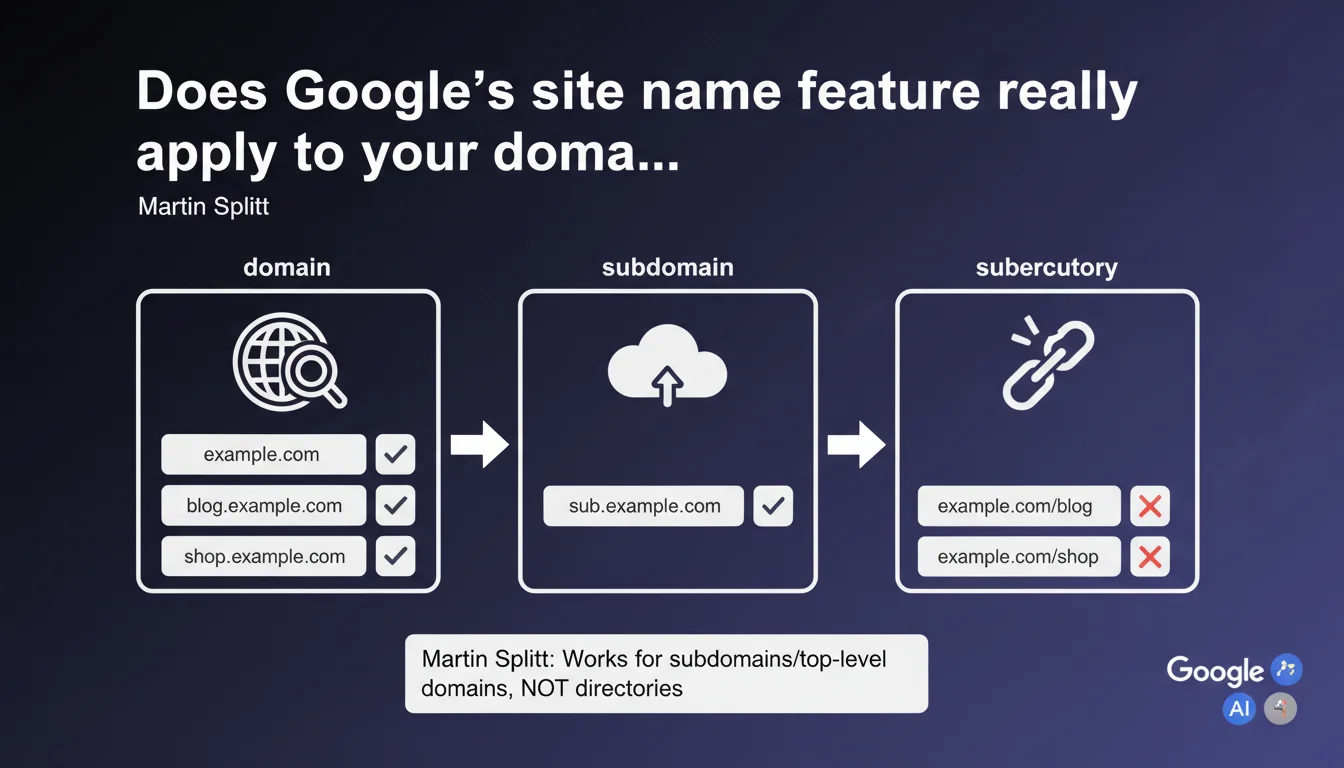
Google confirms that the site name feature only works for domains and subdomains. Directories and subdirectories of a website cannot benefit from this feature in search results. This structural limitation directly impacts complex website architecture strategies.
What you need to understand
What exactly is the site name feature?
Google sometimes displays a site name above snippets in SERPs — that gray line identifying the source domain. This feature lets users immediately recognize the brand or entity behind the result.
Control over this name is managed through WebSite structured markup with the "name" property. The catch is that Google enforces strict rules on its scope: root domain or subdomain only.
Why this restriction to domains and subdomains?
Google's logic is based on the concept of a distinct entity. A domain or subdomain represents an autonomous web property with its own identity space. A directory, on the other hand, is simply a segment of the site's architecture.
This approach prevents confusion in search results: imagine if every category of an e-commerce site could claim its own site name. The SERPs would become unreadable.
What's the difference between a subdomain and a subdirectory in this context?
blog.example.com can have its own distinct site name separate from example.com. But example.com/blog/ must inherit the site name from the root domain.
This technical distinction isn't new, but Martin Splitt reaffirms it clearly to stop unnecessary experimentation with structured markup on paths.
- Site name applies only at the domain/subdomain level
- Subdirectories automatically inherit the parent domain's name
- WebSite markup on a directory page will be ignored by Google
- This limitation is architectural, not technical — it won't change
SEO Expert opinion
Is this statement consistent with observed practices?
Absolutely. In the field, there's no documented case showing a subdirectory with its own distinct site name in the SERPs. Structured markup tests on paths systematically fail.
What Splitt confirms here is an implicit rule that experienced SEOs already know. The real news is that he permanently closes the door: no future evolution planned, it's a design choice.
What are the implications for multi-brand or multi-country websites?
The subdomain vs subdirectory strategy takes on new importance. If you want each brand or country to display its own name in Google results, you're forced to use subdomains.
Except this decision has massive consequences: domain authority dilution, more complex technical management, fragmented crawl budgets. The architectural choice becomes a trade-off between brand recognition in SERPs and pure SEO optimization.
Does Google leave any room for maneuver?
No. Splitt's wording leaves no ambiguity or exceptions. It's binary: domain/subdomain = yes, directory = no.
[To verify] It's theoretically possible that Google might evolve on this point in several years, but nothing in this statement or the public roadmap suggests it. Plan on this being a permanent rule.
Practical impact and recommendations
What should you do concretely if you manage a multi-entity site?
Start by auditing your current architecture. List all sections that could deserve a distinct site name: brands, geographic zones, business verticals. For each one, evaluate whether it justifies a subdomain.
If you opt for subdomains, make sure each one implements structured WebSite markup with a unique and consistent "name" property. Also verify that Google treats them as separate entities through Search Console.
What mistakes should you absolutely avoid?
Don't waste time testing WebSite markup on directory pages. Google will ignore it, and you'll create inconsistencies in your source code for nothing.
Also avoid creating subdomains just for this feature if your overall SEO strategy doesn't justify it. Site name is a minor branding element compared to the massive structural impacts of an architecture change.
- Identify whether your structure really needs distinct site names
- Favor subdirectories unless there's an explicit need for entity separation
- Implement WebSite markup only on domains and subdomains
- Test display in actual SERPs after deploying the markup
- Document the architectural logic for future site evolution
- Measure real impact on CTR before generalizing the strategy
How do you validate that your implementation works?
Use Google's rich results test on your domain/subdomain pages. The tool should detect the WebSite markup and confirm it's valid.
Then monitor actual SERPs on branded queries. Site name doesn't appear systematically — Google decides based on search context. Be patient and observant.
❓ Frequently Asked Questions
Peut-on forcer l'affichage du nom de site pour un sous-répertoire ?
Le nom de site influence-t-il le positionnement dans les résultats ?
Faut-il migrer vers des sous-domaines pour afficher des noms distincts ?
Google affiche-t-il toujours le nom de site quand le balisage est présent ?
Un site multilingue en sous-répertoires peut-il avoir des noms de site traduits ?
🎥 From the same video 5
Other SEO insights extracted from this same Google Search Central video · published on 28/09/2023
🎥 Watch the full video on YouTube →
💬 Comments (0)
Be the first to comment.