
Official statement
Other statements from this video 5 ▾
- □ Faut-il vraiment afficher le nom du site dans tous les titres de page ?
- □ Les noms de site Google s'appliquent-ils vraiment aux sous-dossiers de votre domaine ?
- □ Combien de temps Google met-il vraiment à traiter vos mises à jour SEO ?
- □ Peut-on vraiment accélérer l'indexation d'un changement de balisage via Search Console ?
- □ Pourquoi Google insiste-t-il sur l'importance du nom de site dans les résultats de recherche ?
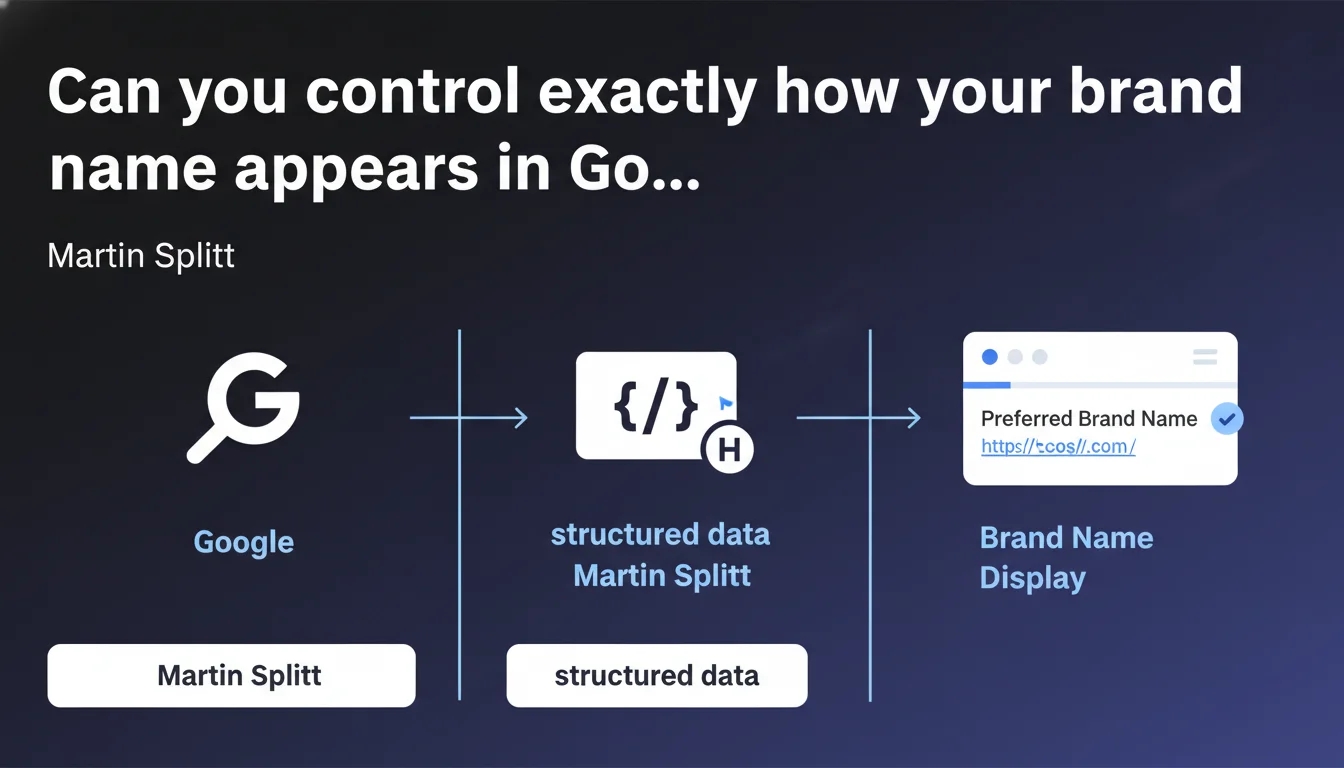
Google now allows you to control how your site name displays in search results through structured data on your homepage. This is a genuine opportunity to manage your brand image directly in the SERPs, but it requires precise technical implementation.
What you need to understand
Why did Google introduce this site name control mechanism?
Historically, Google chose itself which name to display for a site in search results, relying on different signals: the homepage title tag, link anchors, visible content. The problem? This automation regularly created brand inconsistencies.
Some sites ended up with truncated names, unofficial variants, or worse — names taken from external backlinks. For brands with multiple variations (international versions, sub-brands), it was a permanent headache.
What type of structured data needs to be implemented?
Google expects a specific Schema.org markup of type WebSite with the "name" property. This isn't new in itself — what's changing is that Google officially confirms using it as a priority signal for displaying the site name.
The markup must be placed only on the homepage, not across the entire site. A frequent mistake is duplicating this markup on all pages, which dilutes the signal.
Does this directive guarantee your chosen name will always display?
No. Google talks about "helping" the engine choose the right name, not guaranteeing its display. Translation: it's a strong signal, but not an absolute directive. If Google detects a flagrant inconsistency between the structured name and other signals, it can ignore it.
The wording remains intentionally vague about validation criteria. We don't know exactly in which cases Google sets aside the suggested name.
- The Schema.org WebSite markup with "name" property becomes an official signal to control site name display
- Implementation must be done exclusively on the homepage
- Google retains the ability to ignore this signal if other indicators diverge
- This feature is primarily aimed at sites with brand consistency issues
SEO Expert opinion
Does this announcement really change the game for SEO practitioners?
Honestly? For the majority of sites, the impact will be marginal. If your brand is clearly established, consistent across your title tags, H1s, and backlinks, Google was probably already displaying the right name. This markup primarily provides additional security.
On the other hand, for multi-country sites with brand variations (example: "Company FR" vs "Company France" vs "Company"), or for those that have suffered from parasitic backlink anchor issues, this is a real breakthrough. Finally a direct lever.
Can you trust this signal to always be respected?
[To be verified] Google remains extremely vague about the conditions of application. "Helping to choose" is not "imposing". We lack documented cases where Google has actually ignored correct markup in favor of another signal.
My hypothesis — based on 15 years of observation — : if the structured name massively contradicts backlink anchors or visible content, Google will favor these latter. The engine seeks above all the coherence perceived by users, not the webmaster's wishes.
Another point to watch: what about sites that attempt to abuse the system with misleading or over-optimized brand names (e.g., "Best Plumber in Paris")? Google certainly has filters, but no details on this.
Are structured data becoming a mandatory passage in SEO?
They already are for rich snippets, FAQs, reviews — but this announcement confirms a trend: Google is progressively formalizing control mechanisms via Schema.org. It's a way for the engine to collect clean, structured data, rather than inferring everything.
The problem? This creates a technical barrier for less mature sites. A poorly configured WordPress, a rigid proprietary CMS, and you lose this lever. SEO becomes even more dependent on technical implementation.
Practical impact and recommendations
What should you prioritize checking on your site?
First step: audit how your site name currently displays in the SERPs. Search for your exact brand name and verify what Google shows. If it's already in line with your expectations, the markup will mainly serve as reinforcement.
If you notice unwanted variants, truncated versions, or names taken from external backlinks, then this implementation becomes a priority. This is your chance to take back control.
How do you correctly implement the Schema.org WebSite markup?
The JSON-LD code must be placed in the <head> or at the end of the <body> of your homepage only. Minimum expected format:
{"@context": "https://schema.org", "@type": "WebSite", "name": "Your Official Brand Name", "url": "https://yoursite.com"}
Be precise and consistent: use exactly the brand name as you want it to appear. No keyword stuffing, no multiple variants. One name, clear, official.
What mistakes must you absolutely avoid?
Don't duplicate this markup across all pages of your site. Google was explicit: homepage only. Multiple presence risks diluting the signal or being interpreted as structured spam.
Also avoid inconsistencies between this markup and your other tags. If your Schema.org says "Brand A" but your title, H1, and internal link anchors say "Brand B", Google risks ignoring everything.
- Check how your site name currently displays in Google search results for your brand
- Implement the Schema.org WebSite markup with the "name" property on the homepage only
- Use the exact brand name, as it should appear in the SERPs
- Ensure consistency with title tags, H1s, and internal link anchors
- Test the implementation using Google's structured data testing tool
- Monitor the evolution of the display in the weeks following deployment
- Don't duplicate this markup on other pages of your site
Implementing this structured data may seem straightforward on paper, but it requires precise technical coordination between SEO, development, and brand management. Complex CMSs, multi-domain architectures, or international brand issues often make the exercise tricky.
If you manage multiple sites, have a constraining technical architecture, or lack in-house development resources, it may be wise to get support from a specialized SEO agency. A preliminary technical audit and supervised implementation prevent errors that could compromise your brand image in search results.
❓ Frequently Asked Questions
Le balisage Schema.org WebSite doit-il être dupliqué sur toutes les pages du site ?
Google garantit-il d'afficher le nom de site indiqué dans les données structurées ?
Peut-on utiliser plusieurs variantes de nom dans le balisage ?
Ce balisage fonctionne-t-il aussi pour les sites multi-pays ?
Combien de temps faut-il pour que Google prenne en compte ce balisage ?
🎥 From the same video 5
Other SEO insights extracted from this same Google Search Central video · published on 28/09/2023
🎥 Watch the full video on YouTube →
💬 Comments (0)
Be the first to comment.