
Official statement
Other statements from this video 6 ▾
- □ Can exporting your Search Console data actually revolutionize your SEO strategy?
- □ How can you fully leverage data exports from Search Console to boost your SEO strategy?
- □ Why does Google cap Search Console exports at just 1000 rows?
- □ How can you leverage Search Console exported data to build custom SEO dashboards that reveal hidden insights?
- □ How can you effectively analyze the SEO performance of each section on your website?
- □ How can you leverage Search Console metrics to pinpoint your highest-potential markets?
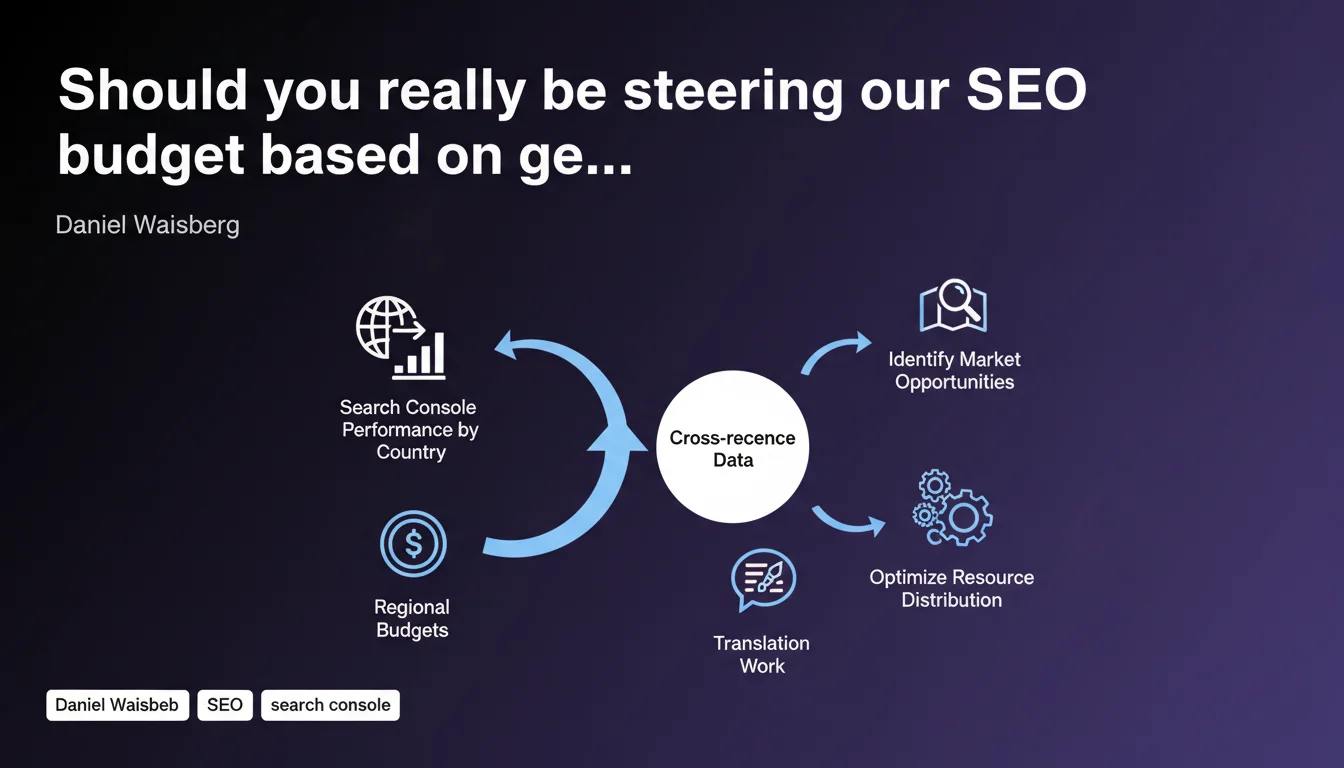
Google recommends leveraging Search Console data by country to strategically allocate your SEO budget. The key idea: identify underperforming yet promising markets, then prioritize translations and optimizations based on actual commercial potential rather than spreading resources uniformly across all regions.
What you need to understand
What does this geographic approach mean in practical terms?
Daniel Waisberg suggests combining organic performance by country (impressions, clicks, CTR, average rankings) with regional business data to decide where to invest. Rather than translating all content into every language or optimizing each local version uniformly, the idea is to concentrate effort where potential ROI is highest.
In concrete terms? If Search Console shows significant search volumes in Germany but low conversion rates, and your internal data reveals a mature German market with strong margins — then that's where you should allocate translation budget, local link building, and specific technical optimizations.
Why does this methodology make sense right now?
Geographic analysis tools in Search Console have become significantly more refined. You now have access to country-level segmentation precise enough to detect exploitable patterns. At the same time, translation and local adaptation costs remain high — it's impossible to do everything everywhere with the same level of polish.
The international SEO market has become too competitive to spread your forces thin. Sites that dominate locally are often those that have prioritized intelligently rather than diluted their budget across 15 mediocrely optimized languages.
Which Search Console data should you exploit precisely?
The "Country" dimension in performance reports lets you segment impressions, clicks, CTR, and average position. But you need to cross-reference these metrics with your conversion rates by country, your product catalog available locally, and your logistical capabilities.
- High impressions + low CTR: metadata problem or relevance issue with translated content
- Good clicks + high bounce rate: user experience mismatch or misaligned expectations
- Low volume but strong conversion: opportunity to invest heavily to capture more qualified traffic
- Uniform performance everywhere: likely widespread under-optimization, no market truly worked in depth
SEO Expert opinion
Is this recommendation really anything new?
Let's be honest: the idea of prioritizing markets based on potential isn't revolutionary. It's marketing strategy 101. What's changing is that Google is now formalizing this approach as an official SEO best practice and highlighting Search Console tools to drive it.
The real signal here? Google is implicitly acknowledging that attempting to optimize all your markets simultaneously with the same resources leads to widespread mediocrity. Sites winning today are those that accept temporarily abandoning certain markets to first dominate the most strategic ones.
What nuances should you add to this methodology?
First pitfall: confusing search volume with commercial potential. A country with enormous impressions but low purchasing power or insurmountable logistical barriers doesn't necessarily deserve priority. Search Console data tells you nothing about your actual ability to convert and serve those audiences.
Second trap: overlooking network effects and credibility factors. Sometimes being present in a strategically important country (even with modest volumes) boosts your overall legitimacy and eases expansion into similar markets. A purely short-term ROI analysis might miss these dimensions.
[To verify]: Google doesn't specify how to handle emerging markets where search volumes are still low but growth is explosive. Should you invest in anticipation or wait for clearer signals? The proposed methodology naturally favors mature markets over longer-term strategic bets.
In which cases does this approach reach its limits?
If your business model relies on immediate global presence (marketplaces, international SaaS), you can't afford to ignore entire geographic zones for months. Prioritization should then focus on depth of optimization rather than coverage.
Another limit: sites with highly interdependent content (news, social networks, community platforms). Abandoning certain countries creates dead zones that weaken the entire ecosystem and harm perceived domain authority.
Practical impact and recommendations
How do you identify priority markets concretely?
Export your Search Console data by country for the last 12 months. Cross-reference these figures with your actual revenue by geographic zone and commercial margins. You're looking for discrepancies: markets where you're visible but convert poorly, or conversely, markets where you're less visible but highly profitable when you do convert.
Build a two-dimensional matrix: SEO potential (available search volume, ranking gap versus local competitors) versus business potential (margin, logistical capacity, market size). The quadrants with high SEO opportunity + high business opportunity are your priority targets for the next 6-12 months.
What actions should you deploy once markets are identified?
Don't just translate. Invest in original local content, not linguistic copies. Analyze queries specific to the target country, local seasonality, cultural sensitivities. Perfectly translated content that's culturally off-base will serve no purpose.
On the technical side: optimize load times by region (CDN, local hosting if necessary), adapt structured data to local specifics (currencies, date formats, service availability). And crucially, build link equity from local sources — a backlink from a quality German media outlet is infinitely more valuable than a generic link from an international directory.
- Export and segment Search Console data by country over a minimum 12-month period
- Cross-reference SEO performance with actual revenue and margins by geographic zone
- Identify 2-3 priority markets presenting the best ratio of opportunity versus resources
- Audit the actual quality of existing translated content (not just linguistic accuracy)
- Invest in original local content addressing market-specific search queries
- Optimize technical infrastructure by region (CDN, hosting, localized structured data)
- Develop a link-building strategy from quality local sources
- Measure incremental ROI by market every quarter and adjust priorities accordingly
How do you avoid spreading yourself thin once the strategy is launched?
Set yourself a strict rule: maximum 3 markets in active optimization simultaneously. For other zones, simply maintain what exists without investing new resources. Reassess priorities every 6 months based on results achieved.
Document precisely the investments by market (time, translation, technical, content, link building) and measurable returns (traffic, conversions, revenue). This traceability is essential to justify future budget decisions and avoid emotional or political choices.
The geographic approach to SEO budgeting imposes a healthy discipline of prioritization. It forces you to confront vanity metrics ("we're present in 20 countries!") with economic reality. But it requires analytical rigor and cross-functional skills — data, technical, content, local link building — that are difficult to master without dedicated expertise. For organizations lacking these resources in-house, partnering with an agency specialized in international SEO can significantly accelerate the identification of opportunities and coordinated execution across priority markets.
❓ Frequently Asked Questions
Faut-il attendre d'avoir des données Search Console sur un nouveau marché avant d'y investir ?
Comment gérer les marchés qui partagent la même langue mais ont des comportements de recherche différents ?
Quelle est la durée minimale d'investissement sur un marché prioritaire avant de réévaluer ?
Les données Search Console suffisent-elles ou faut-il d'autres sources ?
🎥 From the same video 6
Other SEO insights extracted from this same Google Search Central video · published on 28/02/2023
🎥 Watch the full video on YouTube →
💬 Comments (0)
Be the first to comment.