
Official statement
Other statements from this video 10 ▾
- □ Les chaînes de redirections bloquent-elles vraiment le crawl de Google sur votre site ?
- □ Pourquoi l'écart entre URLs découvertes et indexées révèle-t-il des problèmes critiques ?
- □ Pourquoi les problèmes d'indexation se concentrent-ils sur certains dossiers de votre site ?
- □ Le no-index libère-t-il vraiment du crawl budget pour les pages importantes ?
- □ Les chaînes de redirections tuent-elles vraiment l'expérience utilisateur ?
- □ Faut-il vraiment supprimer toutes les redirections internes de votre site ?
- □ Pourquoi Google ralentit-il son crawl quand votre serveur faiblit ?
- □ Faut-il vraiment multiplier les outils de crawl pour diagnostiquer efficacement vos problèmes SEO ?
- □ Pourquoi faut-il détecter les erreurs techniques avant que Google ne les trouve ?
- □ Les Developer Tools du navigateur suffisent-ils vraiment pour auditer vos redirections SEO ?
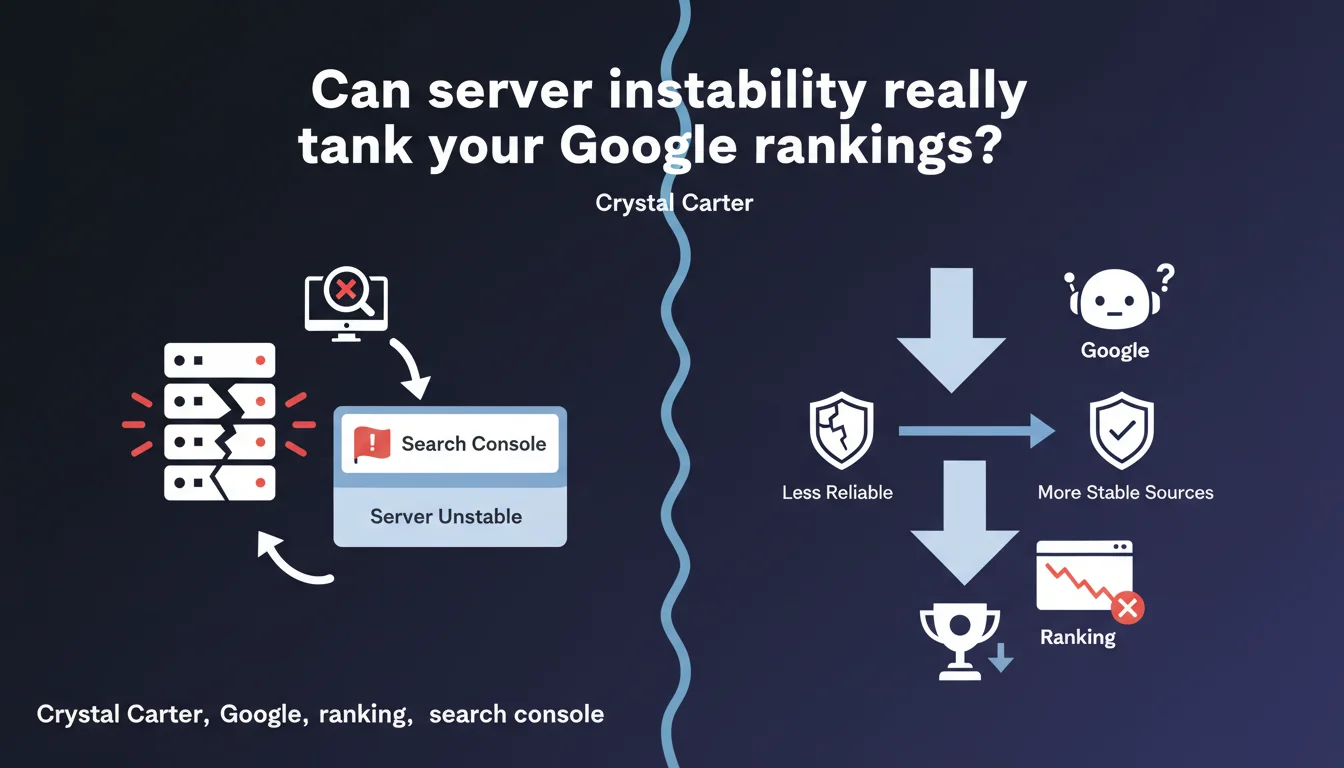
Google Search Console features a dedicated report on server reliability. If your infrastructure is flagged as unstable, Google views your site as less trustworthy and may prioritize more stable competitors in search results. A technical signal that directly impacts the confidence Google places in your domain.
What you need to understand
Where exactly do you find this report in Search Console?
The report in question is located in the Settings section of Search Console, under the Crawl Statistics tab. Google lists the server errors it encountered during crawling: HTTP 5xx codes, timeouts, DNS failures.
This isn't a new tool — it's been around for years — but its role takes on strategic importance when Google explicitly confirms it uses this as a reliability signal. Repeated instability is no longer just a one-off technical problem: it becomes a competitive handicap.
What does "less reliable" actually mean in Google's eyes?
Google is talking about trust at the infrastructure level. If Googlebot regularly encounters 503 errors, timeouts, or inconsistent server responses, it concludes that your site can't guarantee consistent availability to users.
The result: when two pages compete for the same ranking and one comes from a domain flagged as unstable, Google will favor the source it considers more trustworthy. It's not a binary factor that removes you from SERPs, but a progressive handicap that erodes your positions.
What instability criteria does Google use?
- High 5xx error rate: if more than 5-10% of Googlebot requests fail with server errors, that's a red flag
- Frequent timeouts: server responses that consistently exceed 2-3 seconds or never complete
- Intermittent DNS issues: DNS resolution failing randomly, a sign of fragile infrastructure
- Performance variability: alternating between ultra-fast responses and complete crashes, symptom of an undersized server
- Duration of instability: a one-time incident isn't enough — Google observes patterns over days or even weeks
SEO Expert opinion
Is this claim consistent with what we see in the real world?
Absolutely. We regularly see sites with excellent content and a solid link profile that plateau in the SERPs for no apparent reason. An infrastructure audit often reveals chronic server errors or excessive latency.
The problem is that many SEOs never check the crawl stats in Search Console — they focus on indexation, Core Web Vitals, content. Infrastructure remains a blind spot. And that's precisely where some lose rankings without understanding why.
What nuances should we add to this claim?
Google doesn't specify the threshold at which a site becomes "unstable". Is it 2% of 5xx errors? 10%? Over what timeframe? [Needs verification] — this vagueness leaves practitioners in the dark.
Another point: Google says "may favor other sources". Stated that way, it remains conditional. We understand it's not an absolute factor that automatically demotes you, but rather a tie-breaker when multiple pages are equally relevant. Except in practice, how many situations are truly at perfect parity? Hard to measure.
In which cases does this rule not really apply?
If you dominate a niche with overwhelming authority — strong brand, massive backlinks, unique content — a few sporadic server errors probably won't hurt you. Google tolerates instability better on reference domains than on secondary players.
But on competitive markets where ten sites battle for three top positions, it's a different story. There, even minor technical weaknesses become a burden. And it's precisely in these contexts that Google will activate this reliability filter.
Practical impact and recommendations
What concrete steps should you take to avoid this problem?
First, actively monitor the crawl statistics in Search Console. Don't just check once a quarter — set up alerts if your server error rate exceeds an acceptable threshold (say 2-3%).
Next, audit your infrastructure critically. Can your server handle Googlebot's crawl spikes without breaking a sweat? Do your response times stay stable under load? A realistic load test will save you from nasty surprises.
What mistakes must you absolutely avoid?
Never artificially throttle Googlebot with an overly aggressive robots.txt or rate limiting. If Google can't crawl properly, it interprets that as instability — even if you're voluntarily closing the door.
Another trap: migrating to a cheap host without testing resilience under intense crawl activity. Googlebot can represent 20-30% of server traffic on some sites — if your infrastructure can't keep up, you'll lose rankings.
How do you verify that Google considers your site reliable?
- Check the Crawl Statistics in Search Console and verify that your 5xx error rate stays under 1-2%
- Analyze median response times: they should stay under 500-800ms for Googlebot, even during peak periods
- Verify the absence of DNS error spikes or repeated timeouts in server logs
- Compare performance between Google user-agent and real users: if Googlebot sees 10x more errors, your config is broken
- Set up uptime monitoring with probes from multiple geographic locations
- Audit your WAF and CDN rules to ensure they don't block or slow down Googlebot
❓ Frequently Asked Questions
À partir de quel taux d'erreurs serveur Google considère-t-il un site comme instable ?
Un CDN peut-il masquer les problèmes d'instabilité serveur aux yeux de Google ?
Les erreurs serveur ponctuelles lors d'une maintenance planifiée impactent-elles le classement ?
Comment différencier une instabilité serveur d'un blocage volontaire de Googlebot ?
Un site sur un serveur mutualisé est-il désavantagé face à un site sur serveur dédié ?
🎥 From the same video 10
Other SEO insights extracted from this same Google Search Central video · published on 29/11/2022
🎥 Watch the full video on YouTube →
💬 Comments (0)
Be the first to comment.