
Official statement
Other statements from this video 5 ▾
- □ Google ignore-t-il vraiment les mauvaises pratiques SEO détectables automatiquement ?
- □ Google notifie-t-il vraiment toutes les actions manuelles via Search Console ?
- □ Google tolère-t-il vraiment les erreurs SEO involontaires ?
- □ Une erreur SEO peut-elle ruiner définitivement votre classement Google ?
- □ Google tolère-t-il vraiment les mauvaises pratiques SEO si votre site a du bon contenu ?
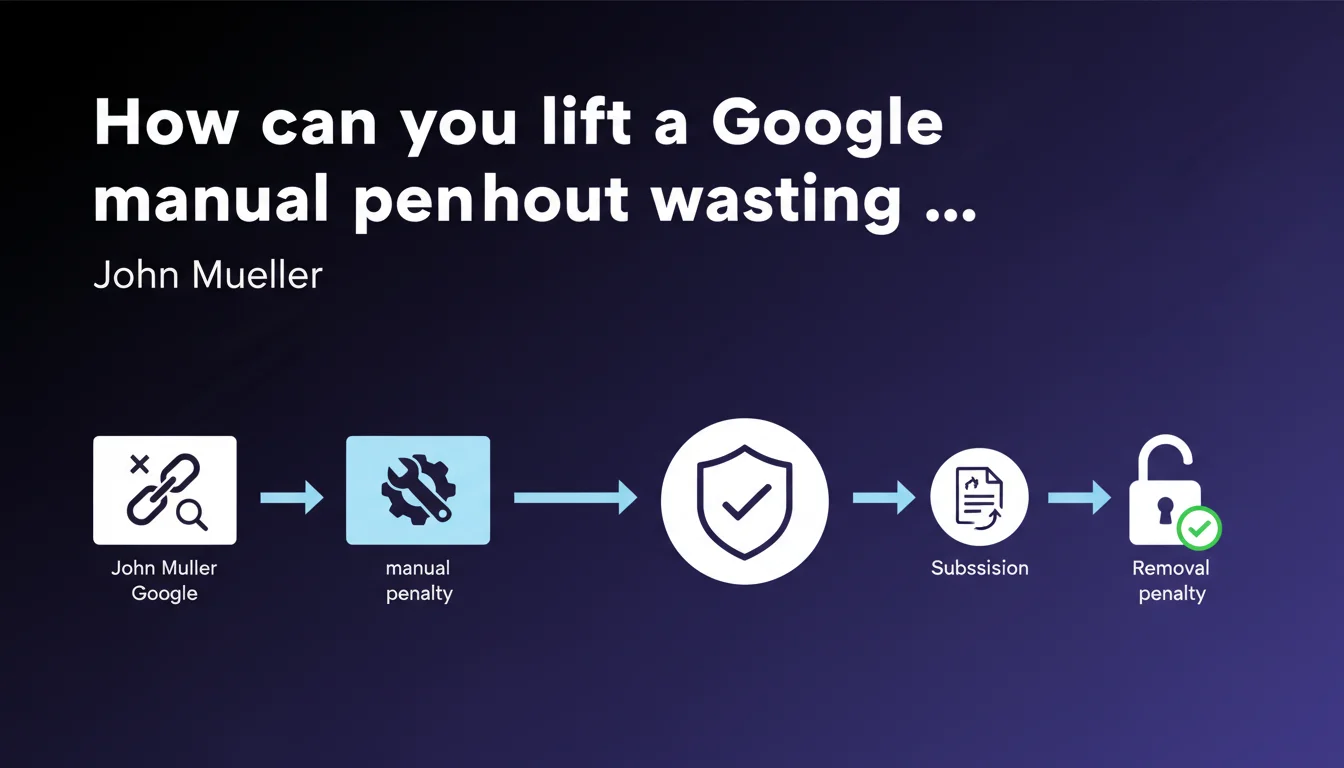
Google allows you to request a reconsideration after fixing the issues that triggered the manual action. The team verifies that corrections are effective before lifting the penalty. This process provides a clear exit route, but requires precise understanding of Google's expectations to avoid successive rejections.
What you need to understand
Manual actions represent the most explicit form of penalty in Google's ecosystem. Unlike algorithmic fluctuations where you're searching blindly, here Google tells you explicitly what's wrong.
The challenge is knowing how to decode the message correctly and correct in the right direction.
What exactly is a manual action?
A penalty applied by a human Quality Rater after reviewing your site. It can target artificial links, thin content, cloaking, automatically generated spam — in short, any flagrant violation of the guidelines.
You're notified via Search Console. The impact is immediate: loss of rankings, partial or total deindexation depending on severity. Unlike an algorithmic drop, you have a precise diagnosis.
Why does Google allow this reconsideration process?
Because their goal isn't to destroy your site, but to clean up search results. If you actually fix the problem, they have no interest in maintaining the penalty.
It's also a matter of fairness: mistakes can be corrected, bad vendors replaced, strategies adjusted. Reconsideration offers a second chance — provided you play fairly.
How does this process actually work?
You identify and fix the violations, then submit a reconsideration request via Search Console. A human reviewer verifies that the corrections are truly effective and complete.
If everything checks out, the penalty is lifted — sometimes within days, sometimes within weeks. If the corrections are insufficient, your request is rejected with additional guidance.
- The manual action notification in Search Console indicates precisely the type of violation
- Corrections must be real and complete — not cosmetic
- Processing time varies depending on complexity and Google's workload
- Multiple reconsideration requests may be necessary if initial corrections are incomplete
- Lifting the penalty does not guarantee immediate return to previous rankings
SEO Expert opinion
Is this procedure really as straightforward as it seems?
In theory, yes. In practice, the gap between what Google considers "fixed" and what you think you've fixed can be enormous.
I've seen sites submit 4-5 reconsideration requests before approval, not out of bad faith, but because they didn't understand the full extent of cleanup required. Google says "artificial links" — you disavow 200 toxic links, but 800 remain that you consider borderline. Request rejected.
What are the gray areas in this process?
Google never quantifies its expectations precisely. How many links do you need to clean up? What proportion of thin content is acceptable? [To verify] because exact thresholds are never communicated.
Another point: processing time. Mueller mentions that "Google verifies" — but how long? I've observed reconsiderations processed in 72 hours and others that took 6 weeks. No predictability, no SLA communicated.
And let's be honest: some manual action notifications remain deliberately vague. "Aggressive SEO techniques" — OK, but which ones exactly? This imprecision creates frustration and unnecessary back-and-forth.
Does lifting the penalty guarantee traffic recovery?
No, and this is crucial to understand. Lifting the manual action means that Google is no longer actively penalizing you, but doesn't automatically restore your rankings.
If you massively cleaned your backlink profile to get the penalty lifted, your link profile is now weaker. If you deleted thin content, your index is smaller. You have to rebuild, and it takes time — often months before reaching comparable traffic levels.
Practical impact and recommendations
What should you do immediately upon receiving a manual action notification?
Don't panic, but don't procrastinate either. Immediately analyze the notification to identify precisely the type of violation. Google provides examples of URLs or sections involved — that's your starting point.
Document everything you're going to do. Create a spreadsheet listing the corrections made, with URLs, dates, precise actions. This documentation will serve for your reconsideration request and as proof of good faith.
How do you ensure corrections are sufficient?
Go beyond the minimum visible. If Google flags 20 pages of thin content, don't just fix those 20 pages — audit your entire site to track down all similar pages.
For artificial links, use Search Console, Ahrefs, Majestic — cross-reference sources. Disavow widely, even if you lose some borderline links. Better to lose a few questionable links than see your request rejected.
Wait a few days after making corrections before submitting the reconsideration request. Give Google time to recrawl modified or deleted pages.
What strategy should you adopt if the request is rejected?
Read the rejection message carefully — Google often provides additional clues about what remains problematic. Don't immediately resubmit the same request hoping for a different reviewer.
Dig deeper. If it's a link issue, expand the scope of disavowals. If it's content, be more radical in deletions or improvements. Each rejection should trigger an escalation in correction severity.
- Identify precisely the type of manual action and the URLs/sections involved
- Exhaustively document all corrections made
- Go beyond the examples provided — fix all similar cases on the site
- For links: disavow broadly, cross-reference multiple analysis tools
- For content: substantially improve or delete — no half-measures
- Wait for Google to recrawl modified pages before submitting reconsideration
- Write a detailed reconsideration request explaining each correction
- If rejected: analyze the clues provided and intensify corrections
- Monitor the site after lifting to avoid falling into the same errors
The manual action recovery process is transparent in principle, but demanding in execution. Google expects complete and definitive corrections, not cosmetic adjustments.
The complexity lies in interpreting Google's actual expectations and the scope of cleanup required. Between thorough technical audit, backlink analysis, massive disavowal, content overhaul, and monitoring the reconsideration process, you're facing a project that can quickly exceed your internal resources.
These critical situations often require outside expert perspective and proven methodology. If you lack time, tools, or experience in this type of recovery, enlisting a specialized SEO agency skilled in penalty recovery can make the difference between recovery in weeks and months of costly trial-and-error.
❓ Frequently Asked Questions
Combien de temps prend une demande de réexamen ?
Peut-on soumettre plusieurs demandes de réexamen successives ?
La levée de la pénalité restaure-t-elle immédiatement le trafic ?
Que se passe-t-il si on ne corrige jamais les problèmes ?
Google peut-il lever automatiquement une action manuelle sans demande ?
🎥 From the same video 5
Other SEO insights extracted from this same Google Search Central video · published on 01/02/2022
🎥 Watch the full video on YouTube →
💬 Comments (0)
Be the first to comment.