
Official statement
Other statements from this video 5 ▾
- □ Google ignore-t-il vraiment les mauvaises pratiques SEO détectables automatiquement ?
- □ Google notifie-t-il vraiment toutes les actions manuelles via Search Console ?
- □ Comment sortir d'une pénalité manuelle Google sans perdre des mois ?
- □ Google tolère-t-il vraiment les erreurs SEO involontaires ?
- □ Google tolère-t-il vraiment les mauvaises pratiques SEO si votre site a du bon contenu ?
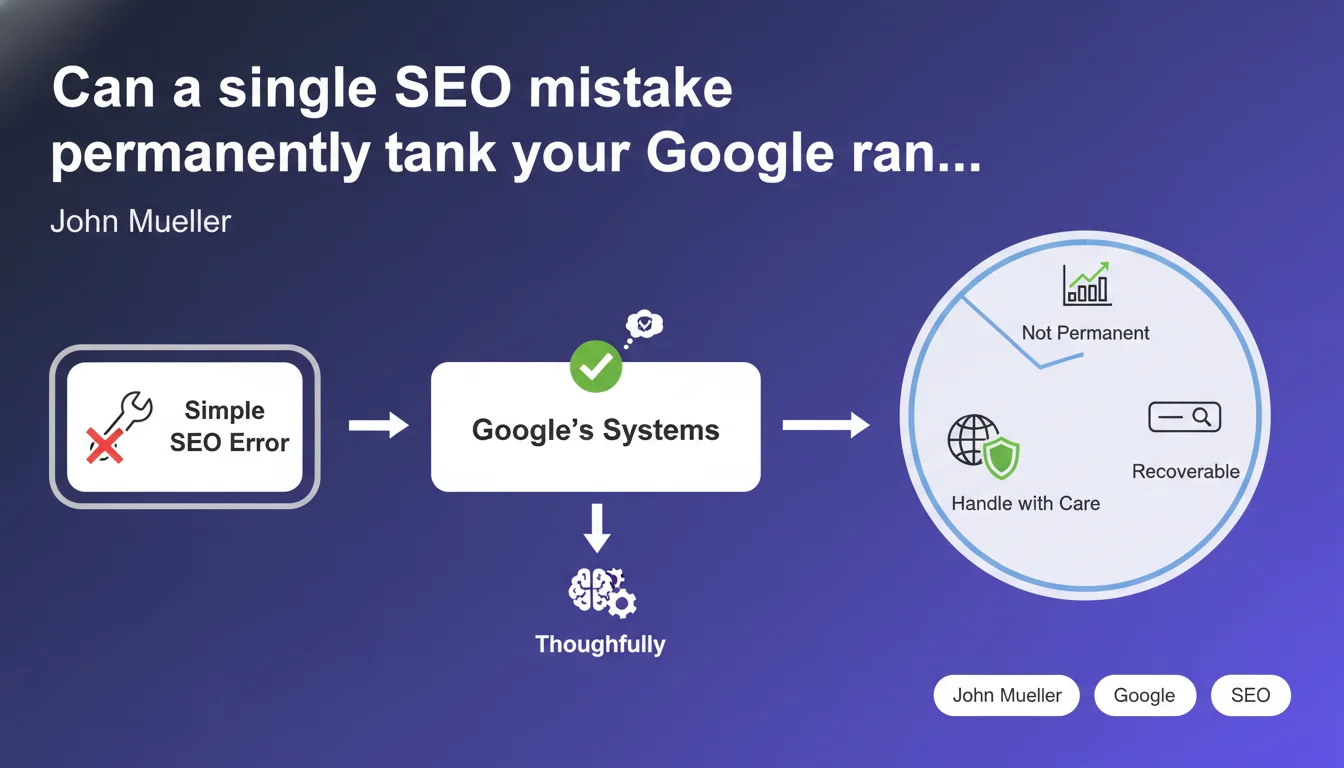
Google states that a simple SEO error will not permanently destroy a website's ranking position in search results. Its systems are designed to handle honest mistakes with discretion, without applying irreversible penalties. The nuance? Everything depends on what Google considers a "simple error" versus deliberate manipulation.
What you need to understand
What does a "simple error" actually mean according to Google?
John Mueller's statement relies on a fundamental distinction between unintentional technical mistakes and manipulation attempts. A misconfigured canonical tag, an overly restrictive robots.txt file that's quickly fixed, or a bad redirect that's corrected rapidly — these are what Google qualifies as simple errors.
The catch? [To verify] Google provides no exhaustive list of what constitutes a "simple error". The boundary remains fuzzy. The same issue can be interpreted differently depending on context, the site's history, or how quickly it's fixed.
How does Google distinguish between honest mistakes and manipulation?
Google's systems analyze multiple combined signals: whether the problem recurs, consistency with other observed practices on the site, speed of correction once detected. A site that chains together "errors" that seem suspicious likely won't receive the same leniency.
What really counts is presumed intent. Google looks for patterns: a massive link purchase followed by an express disavow looks less like an error and more like limit testing. Google's machine learning detects these behaviors — but with what accuracy? [To verify]
What is NOT covered by this statement?
Mueller talks about simple and honest errors. But what about complex errors? A botched migration lasting three months? A code error generating duplicate content at scale?
The statement also doesn't cover manual actions. If a human reviewer detects a guidelines violation, algorithmic leniency no longer applies. And certain errors — even unintentional ones — can trigger manual review if they resemble spam.
- A one-time technical error (canonical, redirect) doesn't result in permanent penalty
- Google distinguishes honest mistakes from manipulation attempts using behavioral signals
- The speed of correction plays a key role in how algorithms interpret the error
- Manual actions are not covered by this "algorithmic leniency"
- The definition of "simple error" remains vague — Google judges case by case
SEO Expert opinion
Is this statement consistent with real-world observations?
Yes and no. With purely technical errors — wrong redirect, temporary 500 error, server issue — we do see that Google recovers rankings once the problem is fixed. No lasting damage if the correction is quick.
But be careful: reality is more nuanced for errors affecting content or links. A site that accidentally loses thousands of backlinks during migration may take months to recover its positions — even if the error is corrected. Is it a penalty? No. Is it "permanently destroyed"? No either. But "treated thoughtfully" doesn't mean "with no measurable impact".
What are the limitations of this reassuring claim?
First point: Mueller doesn't define the severity threshold. One simple error, okay. But two simultaneous errors? Three? At what point does Google stop seeing accidents and start seeing systematic incompetence — or even negligence?
Second limitation: [To verify] the notion of "permanence". Google claims the impact isn't permanent, but over what timeframe? If an error drops a site for 6 months before full recovery, is that really reassuring for an e-commerce business losing 50% of revenue meanwhile?
Third point — and this is crucial: this statement says nothing about repeated errors. If your site accumulates "small mistakes", Google can legitimately doubt your ability to deliver a reliable user experience. No formal penalty, but gradual trust erosion.
In which cases is this rule clearly not applied?
First obvious case: clear guidelines violations. Buying links, publishing spam content, cloaking — even if it's a "first time", Google won't treat it as a simple error. It's direct manual action.
Second case: YMYL sites (Your Money Your Life). A medical or financial site that accidentally publishes inaccurate content can face far harsher impact than a lifestyle blog. Google applies stricter standards on these topics.
Practical impact and recommendations
What should you do if you spot an SEO error on your site?
Fix it immediately. The longer you wait, the more pages Google will have crawled with the error, the longer recovery will take. An error detected within hours may have zero measurable impact. The same error left for three weeks might require several crawl cycles to be fully purged.
Document everything: when the error appeared, what it affected, when it was fixed. If you see any impact in Search Console later, you'll have clear history to share. And use the "Request indexing" feature to speed up how quickly Google recognizes the fix on critical URLs.
How can you prevent "small errors" from piling up?
Implement continuous monitoring: Search Console alerts, weekly crawls with Screaming Frog or equivalent, position tracking on your key queries. The goal isn't perfection — it doesn't exist — but quick response time.
Test every major change in a staging environment. A migration, CMS switch, URL restructure — anything affecting architecture must be validated before going live. The most expensive errors often come from untested changes.
When should you really worry?
If you see a traffic drop exceeding 20% across several consecutive days, investigate immediately. Check Search Console for massive crawl errors, indexation problems, or manual action.
If an error lasted more than two weeks before correction, closely monitor recovery. Google says it's not permanent, but recovery speed varies tremendously depending on the issue type and how often Google crawls your site.
- Set up Search Console alerts to catch critical errors in real-time
- Schedule weekly site crawls to identify technical anomalies
- Test all structural changes in staging before deploying to production
- Document every detected error and its fix to build a history
- Use "Request indexing" on critical URLs after fixing an error
- Monitor positions and traffic daily to spot any unusual impact
- Create an emergency action plan for critical errors (quick verification checklist)
❓ Frequently Asked Questions
Si je corrige une erreur SEO immédiatement, Google la prend-il en compte tout de suite ?
Une erreur qui dure plusieurs semaines est-elle encore considérée comme "simple" par Google ?
Est-ce que Google différencie vraiment erreur technique et manipulation délibérée ?
Une erreur corrigée peut-elle laisser des traces négatives dans l'historique du site ?
Les actions manuelles sont-elles concernées par cette déclaration ?
🎥 From the same video 5
Other SEO insights extracted from this same Google Search Central video · published on 01/02/2022
🎥 Watch the full video on YouTube →
💬 Comments (0)
Be the first to comment.