
Official statement
Other statements from this video 5 ▾
- □ Google ignore-t-il vraiment les mauvaises pratiques SEO détectables automatiquement ?
- □ Google notifie-t-il vraiment toutes les actions manuelles via Search Console ?
- □ Comment sortir d'une pénalité manuelle Google sans perdre des mois ?
- □ Une erreur SEO peut-elle ruiner définitivement votre classement Google ?
- □ Google tolère-t-il vraiment les mauvaises pratiques SEO si votre site a du bon contenu ?
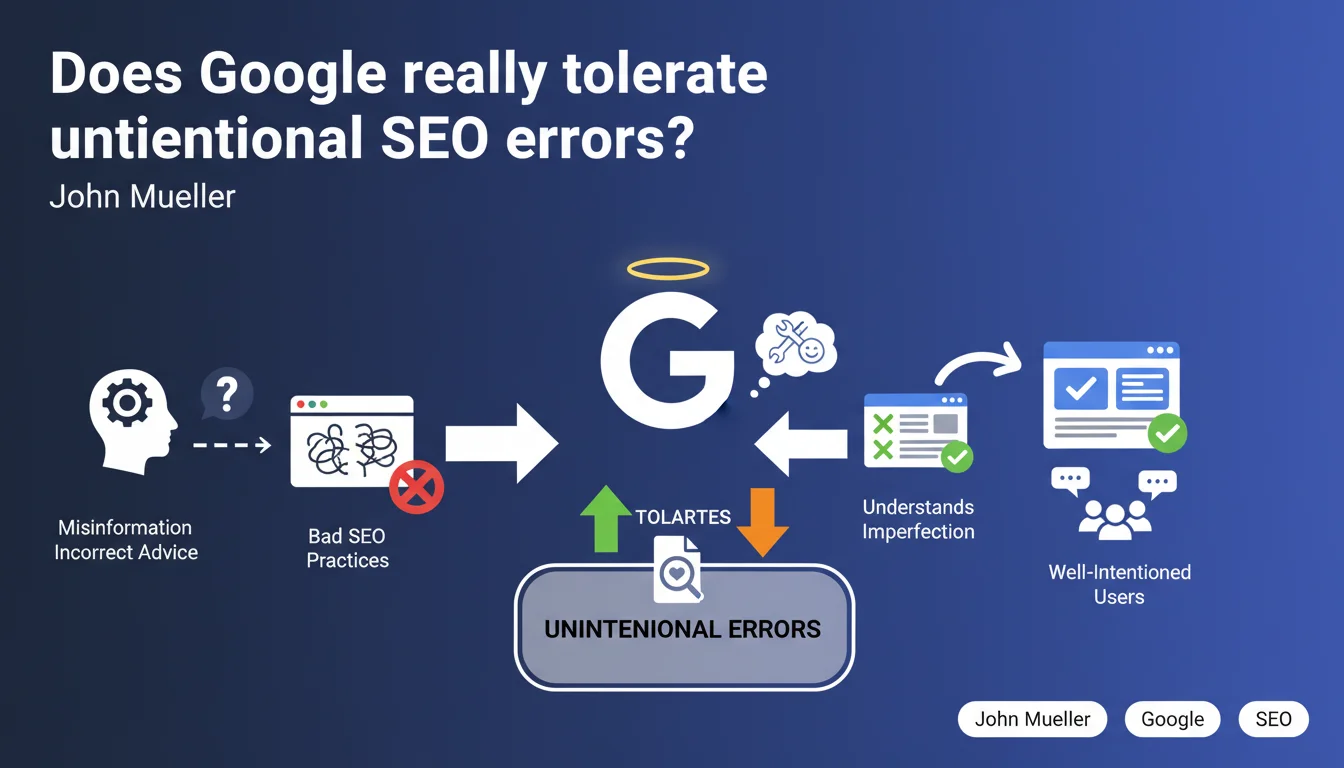
Google acknowledges that SEO practitioners can make honest mistakes, fueled by misinformation or poorly advised recommendations. This statement aims to distinguish intentional manipulation from technical stumbles, suggesting some leniency for unintentional mishaps. The question remains how far this tolerance extends in practice.
What you need to understand
Why is Google suddenly showing empathy toward SEO professionals?
This statement from John Mueller marks a notable shift in tone. Historically, Google has always maintained a strict stance: webmasters are responsible for their content and the practices applied to their site, period.
Here, Mueller acknowledges that the SEO ecosystem is polluted with contradictory information and outdated advice. Between forums, variable-quality SEO blogs, and self-proclaimed "experts," it's easy to drift toward risky practices without even realizing it.
What qualifies as an "honest mistake" according to Google?
Google doesn't precisely define what it considers an honest mistake versus deliberate manipulation. One might assume it refers to tactics applied in good faith but contrary to guidelines — like mild keyword stuffing based on old advice, or purchased links because a "SEO coach" said it was normal.
The nuance is crucial: Google seems intent on differentiating intention. A site that massively purchases links to manipulate rankings won't receive the same leniency as a site that applied a dated recommendation found on a 2012 blog.
Does this mean Google will stop penalizing technical errors?
Absolutely not. This statement removes no responsibility from webmasters. Google can acknowledge that an error is understandable while still applying its algorithms normally. A site penalized for spam remains penalized, regardless of intent.
What Mueller suggests is that Google doesn't assume every violation is malicious. This could potentially impact the severity of manual actions and recovery speed after correction — but nothing is guaranteed.
- Google now distinguishes (in theory) between intentional manipulation and honest errors
- The SEO ecosystem is recognized by Google itself as a source of misinformation
- No formal guarantee of leniency: algorithms continue to penalize non-compliant practices
- This acknowledgment could influence the handling of manual reconsideration requests
SEO Expert opinion
Is this statement consistent with real-world observations?
Let's be honest: Mueller's position is diplomatic, but ground-level facts tell a different story. Sites penalized for manifestly unintentional errors — a bad robots.txt file deployed by mistake, 302 redirects instead of 301 after a botched migration — have waited months before recovering.
Google has always applied its algorithms in a binary manner: compliant or non-compliant. Intent has never been a visible parameter in automated processing. This statement therefore seems aimed more at reassuring concerns than reflecting a measurable operational reality. [To be verified]
What gray areas could this tolerance potentially cover?
Imagine a site that applied an aggressive guest posting strategy for years because an external consultant recommended it in 2016. Will Google consider this an "honest mistake"? Unlikely.
The real question: where's the boundary between legitimate ignorance and professional negligence? A paid SEO professional should know the guidelines. A business owner who followed a YouTube tutorial has more excuses. But Google doesn't differentiate in its algorithms. This statement remains vague on concrete cases.
Why is Google communicating like this now?
Two hypotheses. First possibility: Google observes that its official documentation alone isn't enough to counter the mass of outdated information circulating. By acknowledging the problem, Mueller attempts to reposition Google as a benevolent source of truth.
Second hypothesis — more cynical: this position allows Google to defuse criticism when a site is penalized. "We understand that was a mistake, correct it and resubmit" becomes a standard response, without commitment on recovery timelines or actual impact.
Practical impact and recommendations
What should you do concretely to avoid these "honest mistakes"?
First rule: trust only primary sources. Google's official documentation, statements from John Mueller, Gary Illyes, and Martin Splitt, recorded Google Search Central Hangouts. Everything else must be verified.
Second rule: implement a validation process before applying any SEO recommendation. If a consultant suggests a tactic, ask for the official source. If it's "it works well for my other clients," be wary.
How can you verify that your site doesn't contain inherited risky practices from the past?
Conduct a complete technical audit at least once a year. Specifically look for classic warning signs: hidden text, keyword stuffing in title tags, outbound links to PBNs or link farms, chained redirects, massive duplicate content.
Also check your backlink profile. Links acquired 5-7 years ago through low-quality directories or link exchanges can still weigh negatively. Use the Disavow Tool if necessary, but sparingly.
What approach should you take if your site has already been penalized for an "honest mistake"?
Correct immediately and document everything. In your reconsideration request, clearly explain the source of the error, corrective actions taken, and processes implemented to prevent recurrence. Be factual, not apologetic.
If the penalty is algorithmic (no manual action visible in Search Console), you must correct and wait for the next update of the relevant algorithm. No guaranteed timeframe, no "undo" button. This is where Mueller's benevolent discourse meets operational reality.
- Audit your site to identify inherited past practices (directories, link exchanges, keyword stuffing)
- Systematically verify the source of any SEO recommendation before implementation
- Set up monitoring of Google's official communications (Search Central Blog, spokespersons' Twitter)
- Document each major SEO modification with its justification and source
- Train your internal teams or service providers on official guidelines, not "best practices" found online
- Configure Search Console alerts to quickly detect any technical issues or manual actions
❓ Frequently Asked Questions
Google va-t-il lever automatiquement les pénalités si je prouve que mon erreur était involontaire ?
Comment Google distingue-t-il une erreur honnête d'une manipulation intentionnelle ?
Cette déclaration signifie-t-elle que Google va assouplir ses guidelines ?
Si j'ai suivi un conseil SEO trouvé sur un blog populaire et que cela a causé une pénalité, puis-je m'en servir comme justification ?
Quelles sont les erreurs les plus courantes considérées comme « honnêtes » par Google ?
🎥 From the same video 5
Other SEO insights extracted from this same Google Search Central video · published on 01/02/2022
🎥 Watch the full video on YouTube →
💬 Comments (0)
Be the first to comment.