
Official statement
Other statements from this video 11 ▾
- □ Have site migrations really become less risky for SEO now?
- □ Are Meta Refresh Redirects Destroying Your SEO Migration Strategy?
- □ Do you really need to panic if your site traffic hasn't recovered a year after migration?
- □ Are you hiding redirects from Googlebot and killing your site migration?
- □ Should you really avoid combining domain migration and complete redesign at the same time?
- □ Can changing your HTML structure really impact your Google rankings?
- □ Should you really verify a domain's history before SEO migration?
- □ Can a domain with a problematic past secretly tank your SEO performance for an entire year?
- □ Are HTTPS migrations really as trouble-free as Google claims?
- □ Is a comprehensive URL mapping really the single most critical factor that makes or breaks an SEO migration?
- □ Does a properly executed SEO migration really guarantee zero traffic loss?
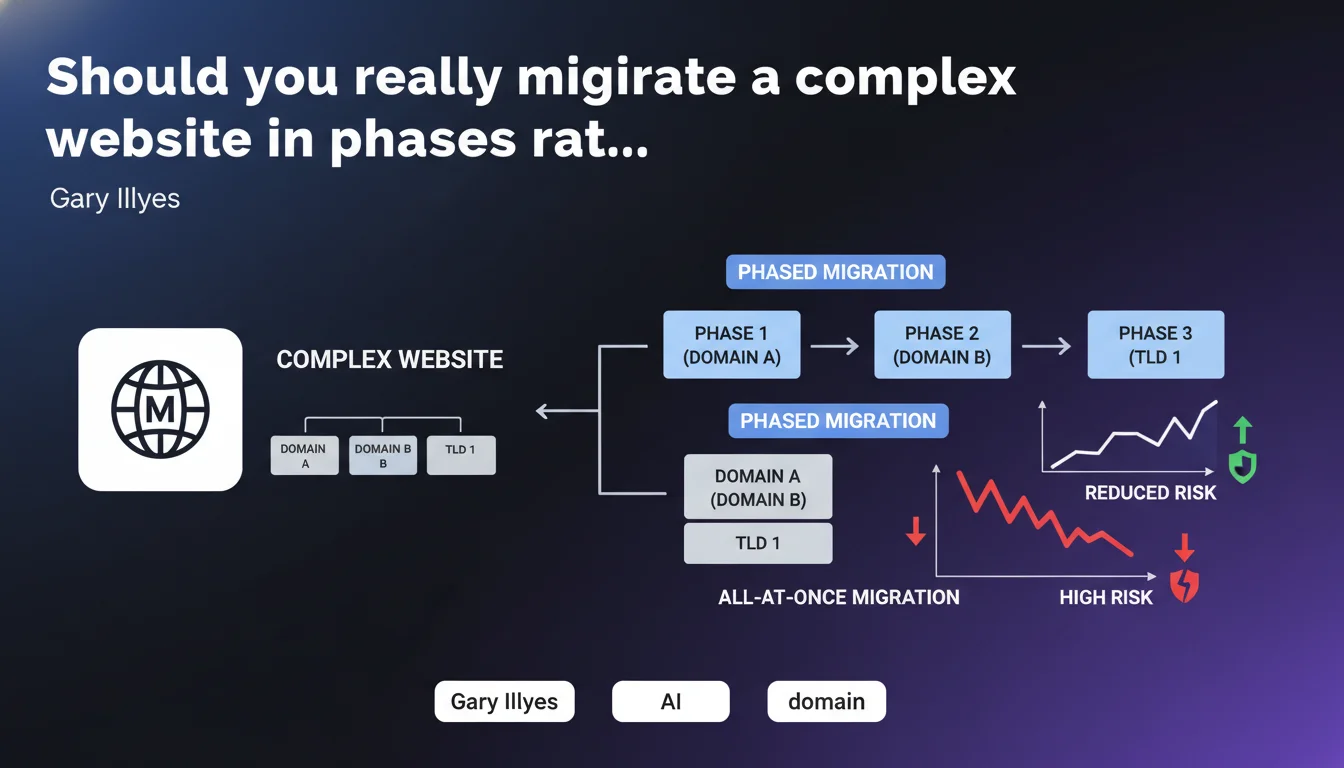
Google recommends migrating complex websites (multi-domain or multi-TLD) in successive phases rather than all at once. The goal: minimize the risk of a sudden drop in organic traffic by allowing Google to gradually assimilate the changes. A cautious approach that certainly lengthens timelines, but secures your SEO performance.
What you need to understand
Why does Google emphasize phased migrations?
Complex migrations — those involving multiple domains, TLDs, or radically different URL structures — represent a considerable technical and algorithmic risk. Google must recrawl all pages, re-evaluate relevance signals, and transfer authority from old URLs to new ones via 301 redirects.
When everything switches at once, Google's algorithms can interpret the change as an anomaly. Crawl budget spikes temporarily, signals become muddled, and some pages may end up deindexed or poorly ranked for weeks.
What exactly do we mean by "phased migration"?
Concretely, this means segmenting the migration into coherent blocks: by geographic market, language, site section, or content type. Each phase is deployed independently, followed by a monitoring phase before moving to the next one.
This approach allows you to validate that redirects work properly, that new pages are correctly indexed, and that organic traffic stabilizes — or ideally, holds steady — before repeating the process on another segment.
What are the concrete risks of a sudden migration?
- Temporary loss of visibility: Google may take several weeks to recrawl and re-evaluate all migrated pages.
- Undetected technical errors: a bug in redirects or canonicalization can go unnoticed until it's too late.
- Server resource overload: the spike in crawling can saturate infrastructure if it hasn't been sized to absorb the shock.
- Authority dilution: chained or misconfigured redirects can weaken PageRank transfer.
SEO Expert opinion
Is this recommendation consistent with what we observe in the field?
Yes, and that's even putting it mildly. Every SEO who has lived through a complex migration knows that it's always more chaotic than expected. "Big bang" migrations have a high failure rate, with traffic drops regularly exceeding 20-30% for several months.
Phased migration helps limit the damage — but it doesn't eliminate it. Each phase comes with its share of technical surprises, and you must accept that some temporary drops are inevitable. The advantage is that the affected scope remains contained.
What nuances should we add to this directive?
First nuance: not all websites are equal. A site with 500 pages and a single domain doesn't need phased migration — it's actually counterproductive. This recommendation targets complex sites: multi-country, multi-language, or those managing multiple TLDs (.fr, .de, .co.uk, etc.).
Second nuance: [To be verified] Google doesn't specify what the ideal granularity of phases should be. Should you migrate in blocks of 10,000 pages? By country? By section? No concrete data is provided, leaving practitioners in the dark. Field experience suggests that segmentation must be functional and coherent: an entire country, a complete language, or a distinct business section.
In what cases does this rule not apply?
If your site has fewer than 1,000 pages, you're not changing domains or major URL structures, and you operate on a single TLD — ignore this recommendation. A simple migration can be done all at once without excessive risk.
However, as soon as you're talking about multi-domain sites, deep structural overhauls, or consolidating multiple brands under a single domain, phased migration becomes non-negotiable.
Practical impact and recommendations
What do you need to do concretely to succeed with a phased migration?
First step: map out the scope of each phase. Identify coherent blocks (by language, country, or section) and prioritize them based on risk and SEO value. Start with a limited but representative scope — never the largest piece first.
Next, prepare a comprehensive redirect plan for each phase. Test it in a staging environment, verify each URL manually if necessary, and ensure no redirect chains exist. Tools like Screaming Frog or OnCrawl are essential here.
Finally, implement intensive monitoring: Search Console, Analytics, server logs, rankings on strategic queries. Set clear alert thresholds (for example: traffic drop > 15% in a week) and be ready to rollback if a major issue appears.
What errors should you absolutely avoid?
Never migrate multiple phases in parallel. It's tempting to save time, but it negates all the benefits of the progressive approach. If two blocks migrate simultaneously and traffic drops, you won't know which one is responsible.
Another common mistake: underestimating the time between phases. Google can take 2 to 4 weeks to stabilize its crawls and re-evaluate pages. If you chain migrations too quickly, you create permanent chaos in the index.
How do you verify that each phase went smoothly?
- Verify that all old URLs return a 301 code (never 302) to the new ones.
- Confirm in Search Console that new pages are indexed and error-free.
- Compare organic traffic before/after on the migrated scope — tolerate a temporary drop of max 5-10%.
- Analyze server logs to verify that Googlebot is actively crawling the new URLs.
- Monitor rankings on strategic queries from the migrated scope for at least 3 weeks.
- Ensure that old domains or sections remain online with active redirects for at least 6 months.
Complex migrations are high-risk projects that require advanced technical expertise and meticulous management. A misconfiguration in redirects, poor crawl budget management, or insufficient monitoring can cost you months of traffic.
If your site falls into the "complex" category — multi-domain, international, or high volume — it may be strategic to work with an SEO agency specialized in migrations. The initial investment quickly pays for itself if it prevents you from losing 30% of your organic traffic for six months.
❓ Frequently Asked Questions
Quelle est la durée idéale entre deux étapes de migration ?
Peut-on migrer un site e-commerce complexe en une seule fois ?
Les redirections 301 doivent-elles rester en place indéfiniment ?
Faut-il soumettre un nouveau sitemap à chaque étape ?
Que faire si une étape provoque une chute de trafic importante ?
🎥 From the same video 11
Other SEO insights extracted from this same Google Search Central video · published on 23/02/2023
🎥 Watch the full video on YouTube →
💬 Comments (0)
Be the first to comment.