
Official statement
Other statements from this video 10 ▾
- □ Faut-il vraiment baliser son contenu payant avec la structured data 'paywall' ?
- □ Faut-il vraiment empêcher le contenu paywall de se charger dans le DOM ?
- □ Pourquoi robots.txt ne protège-t-il pas vos contenus privés de l'indexation Google ?
- □ Pourquoi robots.txt ne protège-t-il pas votre contenu privé ?
- □ Pourquoi vos pages privées n'apparaissent jamais dans Google malgré leur indexation ?
- □ Faut-il vraiment enrichir vos pages de login pour améliorer leur indexation ?
- □ Faut-il vraiment rediriger vos pages privées vers du contenu marketing plutôt qu'un simple login ?
- □ Pourquoi Google refuse-t-il d'indexer les intranets d'entreprise ?
- □ Pourquoi vos URLs peuvent trahir vos données privées malgré un contenu protégé ?
- □ Faut-il vraiment tester son site en navigation privée pour évaluer sa visibilité SEO ?
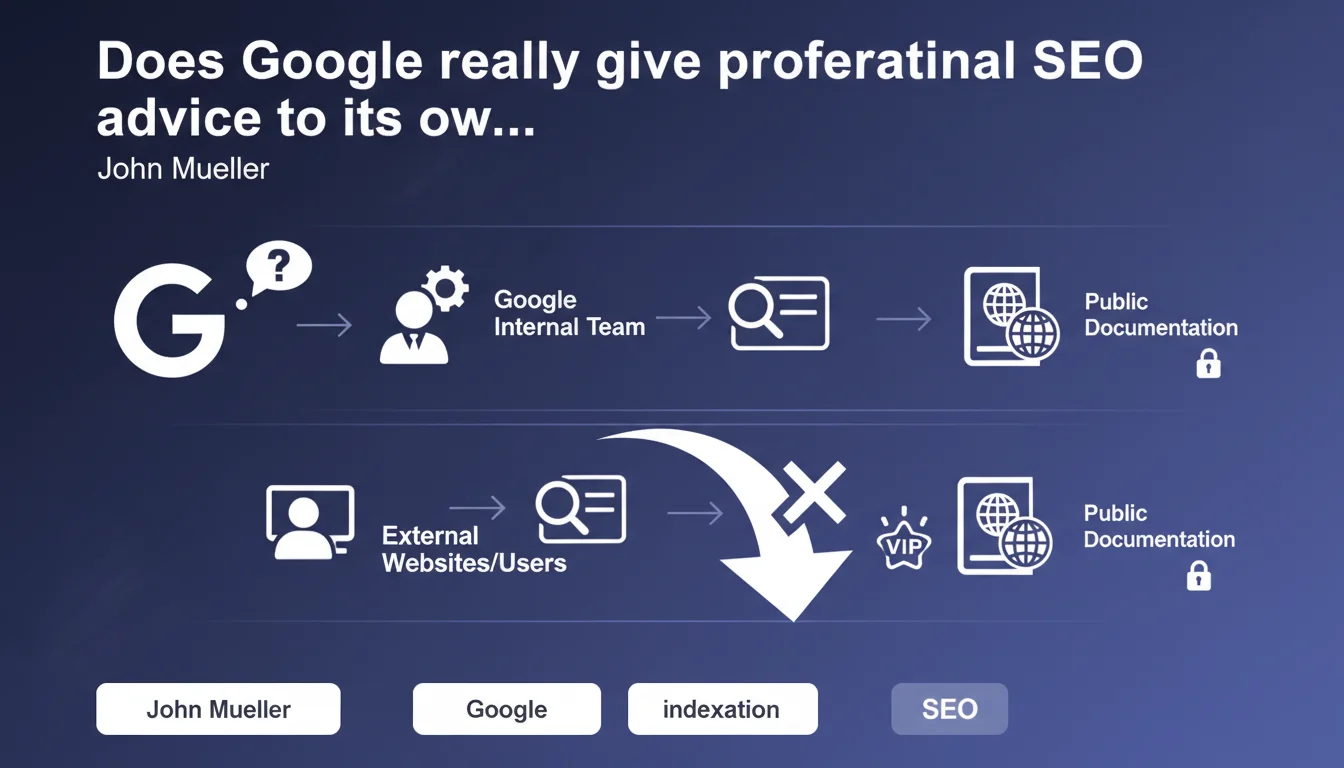
Google claims to give no preferential treatment internally for SEO. When their own product teams ask for help with indexation, they are directed to public documentation just like any other webmaster. A statement that raises questions about the real fairness of the system and the value of official documentation.
What you need to understand
What exactly does Mueller's statement say?
John Mueller claims that Google's internal teams managing public services (Think with Google, Google Cloud, etc.) have no privileged access to special SEO advice. When they encounter indexation issues, they are directed to Search Console Help and public documentation.
In short: no internal SEO hotline, no Googler coming to fix problems behind the scenes. At least, that's what's being said officially.
Why this clarification now?
This statement responds to a recurring suspicion in the SEO industry: Google properties (YouTube, Maps, Shopping) would benefit from favorable algorithmic treatment. Mueller shifts the debate — he's not talking about algorithmic advantage here, but about technical support.
The nuance is important. Saying there are no privileged tips doesn't mean there are no structural advantages in search results.
What is the value of this information for an SEO professional?
If we take this statement at face value, it means that Google's public documentation actually contains everything needed to properly index a site. No secret doctrine, no tips reserved for insiders.
Practically speaking? It validates the approach of relying on official resources (Search Central, Mueller/Illyes videos, Search Console changelog) rather than forum rumors.
- Google claims equal treatment between its internal teams and external webmasters
- Public documentation would be sufficient to solve all common indexation issues
- No privileged SEO support channel would exist internally
- This statement only concerns technical support, not ranking algorithms
SEO Expert opinion
Is this equal treatment truly credible?
Let's be honest: claiming that a Google team member can't ping a colleague to understand why their pages aren't indexing is hard to believe 100%. But — and this is where Mueller is probably sincere — there probably isn't an official process for obtaining preferential treatment.
The distinction is subtle. A Google developer may have access to Googlers for debugging, but not through a formalized support channel reserved for internal staff. The practical result remains a form of advantage, even if it's not institutionalized.
Should we ignore the disparities observed in SERPs?
Mueller responds on technical SEO support, not on ranking results. Yet, what frustrates SEOs is seeing YouTube dominate video results, Google Maps saturate local searches, or Google Shopping appear in the top position for commercial queries.
These advantages don't stem from privileged advice, but from structural integration within Google's ecosystem. A Google product mechanically benefits from synergies (behavioral data, automatic rich schemas, dedicated placements) that a third-party site cannot replicate.
What lesson should we draw from this statement for our daily practice?
If public documentation is truly sufficient for Google itself, then it should be for us. This means that we must actually read it — not skim blog articles paraphrasing it, but consult official pages, Search Console release notes, technical videos.
But it also means not taking this statement as proof that the playing field is perfectly level. The rules are the same, but the players don't have the same equipment.
Practical impact and recommendations
What should you do concretely with this information?
First action: prioritize official sources for your SEO diagnostics. Search Console Help, Search Central documentation, and public statements from Mueller/Illyes must be your baseline references before speculating on undocumented factors.
Second point — stop looking for the secret technique that Google is hiding. If their own teams don't have access to it, it probably doesn't exist. Focus on rigorous execution of fundamentals rather than hunting for hacks.
What mistakes should you avoid following this statement?
Don't fall into the trap of believing Google plays completely fair. Mueller talks about support, not algorithmic neutrality. Continuing to monitor structural biases in SERPs remains relevant.
Another mistake: ignoring that certain Google properties have technical capabilities (server speed, CDN infrastructure, first-party data) that a regular site cannot match even with the best intentions. This isn't SEO favoritism, it's a real technical advantage.
How should you adjust your strategy going forward?
Invest in deep mastery of official documentation. Follow Search Console changelogs, subscribe to official YouTube channels, participate in Search Central events. If Google relies on it internally, you must do the same.
Then, accept that certain battles are lost from the start. If you're in a sector where Google has a competing product (travel, jobs, local), your strategy must integrate this structural reality and diversify your acquisition channels.
- Audit whether your team regularly consults Google's official documentation rather than third-party sources
- Verify that your SEO hypotheses align with Google's recent public communications
- Identify verticals where Google has an internal product and adjust your organic traffic expectations
- Train your teams to use Search Console as the primary diagnostic tool
- Stop looking for "hidden" techniques and focus on flawless technical execution
🎥 From the same video 10
Other SEO insights extracted from this same Google Search Central video · published on 04/09/2025
🎥 Watch the full video on YouTube →
💬 Comments (0)
Be the first to comment.