
Official statement
Other statements from this video 1 ▾
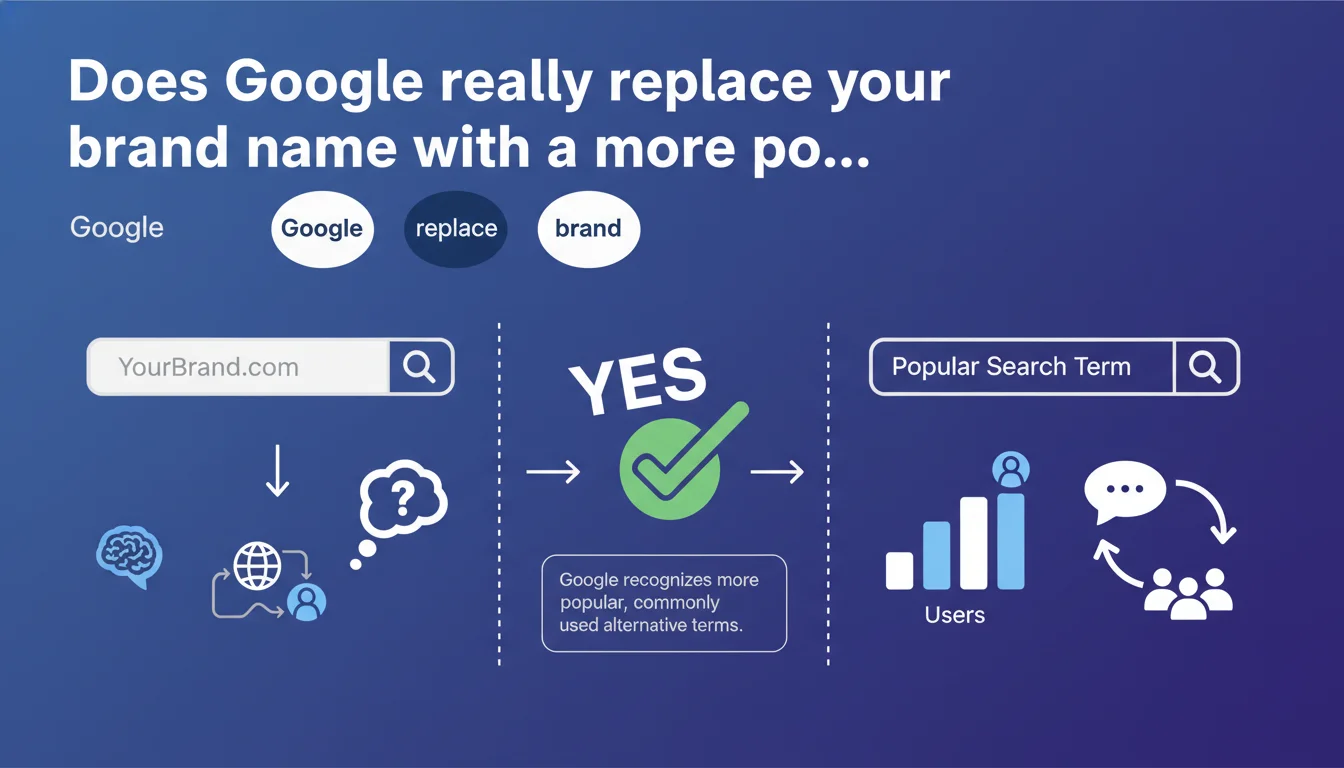
Google sometimes substitutes the exact name of a website with an alternative term deemed more popular and commonly used by internet users. This mechanism aims to improve the relevance of search results by aligning queries with actual search behaviors, even if it can confuse brands whose identity is less anchored in common usage.
What you need to understand
What does this Google statement mean in concrete terms?
Google is admitting here that it sometimes rewrites queries by replacing the exact name of a site with a term it deems more popular or more commonly searched. This substitution is based on the analysis of aggregated search behaviors: if users are massively searching for an alternative term rather than the official name of a brand, Google may decide to prioritize this term in its suggestions or results.
This practice is part of the logic of query rewriting, a mechanism designed to maximize SERP relevance by anticipating the user's true intent. For an SEO practitioner, this means that the brand name you're optimizing may not be the one Google displays or values in its suggestions.
Why does Google carry out this substitution?
The stated objective is to improve user experience by proposing results aligned with the most frequent queries. If internet users are massively searching for "running shoes" rather than the name of a specific brand, Google considers that the generic term better reflects collective intent.
But this logic raises a strategic question: who decides what is "popular"? Google relies on search volumes, but doesn't reveal the precise thresholds or criteria that trigger this substitution. A lesser-known site may find itself confined to a generic term, even if its branding is legitimate.
Which sites are affected by this phenomenon?
In practice, it's mainly emerging, local, or niche brands that experience this reality. If your brand recognition doesn't reach sufficient search volume, Google may consider that a broader or competing term is more relevant for users.
Established major brands generally escape this mechanism, because their name generates high and recognized search traffic. For others, this substitution can hinder the building of brand identity in the SERPs.
- Google will rewrite your query if an alternative term generates more searches than your brand name
- This practice aims to align results with actual user behaviors
- Lesser-known brands are the first affected, especially if their name is close to a generic term
- No precise criteria are communicated about the popularity thresholds triggering this substitution
SEO Expert opinion
Is this statement consistent with field observations?
Yes, and it's even a phenomenon that many SEO practitioners have documented without necessarily obtaining clear official confirmation until now. We regularly observe that Google suggests alternative terms in related searches or auto-completions, even when the user types a precise brand name.
The problem is that Google provides no exploitable metric to anticipate this behavior. What is the popularity threshold? How many monthly searches does it take for Google to consider a term "more common"? [To be verified] — no public data exists on this point, which makes optimization difficult.
What nuances should be added to this statement?
Google talks about "popularity" and "common usage," but these notions remain vague. A term can be popular in a geographic, temporal, or semantic context without being universally relevant. A site can have a legitimate brand name but be pushed aside in favor of a competitor simply because the latter generates more search volume.
Another nuance: this substitution doesn't apply uniformly. Some highly competitive sectors see Google prioritize dominant brands, while less competitive niches give more latitude to emerging players. Google's logic is therefore not binary — it depends on the context and semantic competition.
In which cases does this rule not apply?
Well-known brands with high search volume largely escape this mechanism. If your brand name generates tens of thousands of monthly searches, Google will have no reason to substitute it. Conversely, a young or local site may see its name sidelined in favor of a broader term, even if its positioning is legitimate.
Another case: explicit navigation queries. If a user types your URL or a very specific brand name, Google generally respects the intent without substitution. But as soon as the query becomes more vague or generic, rewriting comes into play.
Practical impact and recommendations
What should you concretely do to limit this phenomenon?
The absolute priority is to build sufficient brand awareness so that Google recognizes your name as a legitimate search entity. This is achieved through increasing the volume of direct searches for your brand: branding campaigns, media presence, mentions from authoritative sources.
Next, work on semantic consistency between your brand name and your content. If your brand is too generic or ambiguous, Google will have an easier time substituting it. Use structured tags (Schema.org Organization, LocalBusiness) to anchor your identity in the Knowledge Graph.
What mistakes should you absolutely avoid?
Don't rely entirely on a brand name that looks like a generic term or a query already dominated by a massive competitor. If you launch a "running shoes" site under a little-known brand, Google will likely prioritize more popular terms in its suggestions.
Another frequent mistake: neglecting brand searches in your content strategy. If nobody searches for your name, Google won't value it. Invest in awareness campaigns to generate direct search traffic.
- Increase the volume of direct searches for your brand name through branding campaigns
- Use Schema.org tags to anchor your identity in the Knowledge Graph
- Avoid brand names that are too generic or ambiguous, risking substitution
- Monitor Google search suggestions to detect any undesirable substitution
- Work on semantic consistency between your brand and your content to strengthen recognition
- Invest in media visibility so Google considers you a legitimate entity
Google prioritizes the most popular search terms, which can penalize emerging or local brands. To counter this mechanism, the strategy relies on building brand awareness and structuring the semantic presence of your online presence.
These optimizations require a sophisticated technical and strategic approach, including analysis of search behaviors, exploitation of structured data, and deployment of targeted branding campaigns. Given the complexity of these levers, it may be wise to call on a specialized SEO agency for personalized support and recommendations tailored to your industry.
❓ Frequently Asked Questions
Comment savoir si Google substitue mon nom de marque par un autre terme ?
Puis-je forcer Google à privilégier mon nom de marque dans les suggestions ?
Un nom de marque trop générique est-il un handicap SEO ?
Les marques locales sont-elles plus vulnérables à cette substitution ?
Est-ce que cette substitution affecte mon positionnement organique ?
🎥 From the same video 1
Other SEO insights extracted from this same Google Search Central video · published on 04/09/2025
🎥 Watch the full video on YouTube →
💬 Comments (0)
Be the first to comment.